
Maruti Suzuki Kharkhoda Plant: Location, Production & Industrial Growth Impact
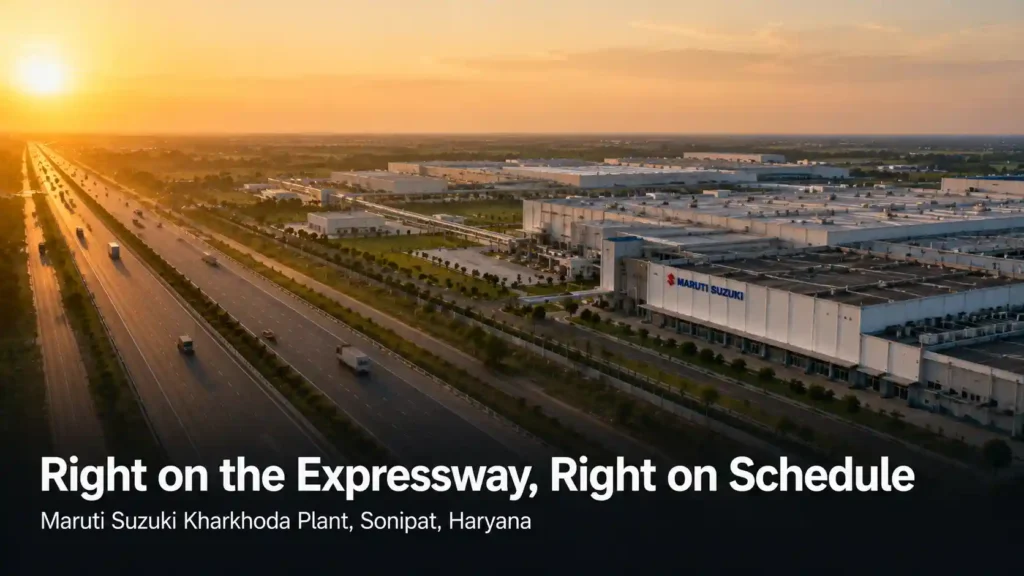
Where exactly is the Maruti Suzuki Kharkhoda plant, and how big is it really? Also, search results mix old figures with new ones, since this plant has grown fast, in phases. So, this guide fixes that. Specifically, it covers the real location, the current production numbers, and what the plant means for industrial land nearby.
Quick Answer: Maruti Suzuki Kharkhoda Plant at a Glance
- Location: IMT Kharkhoda, Sonipat district, Haryana — about 19 km from Sonipat town, on the KMP Expressway’s second toll point from the north.
- Land: 800 acres for the car plant, plus a separate 100-acre Suzuki Motorcycle India unit next door.
- Production: 5 lakh vehicles a year today (Brezza and Victoris), confirmed to scale toward 10 lakh.
- Investment: ₹35,000 crore across all phases, inaugurated July 2, 2026, by PM Modi and Japan’s PM Sanae Takaichi.
- Confirmed suppliers on-site: UNO Minda (alloy wheels, operating) and Jay Bharat Maruti Limited (body/chassis parts, under construction).
Where Is the Maruti Suzuki Kharkhoda Plant Located?
The Maruti Suzuki Kharkhoda plant sits in IMT Kharkhoda, Sonipat district, Haryana, about 19 km from Sonipat town. It runs on 800 acres, next to a separate 100-acre Suzuki Motorcycle India unit nearby. So, together, the two sites cover 900 acres. Currently, the plant makes 5 lakh vehicles a year, across two production lines, building the Brezza and the Victoris. Also, Maruti Suzuki inaugurated the facility on July 2, 2026, alongside Japan’s Prime Minister Sanae Takaichi. Furthermore, the company has confirmed plans to double output, to 10 lakh vehicles a year. Two named suppliers, UNO Minda and Jay Bharat Maruti, have already set up inside the plant’s own supplier park.
Specifically, the plant sits inside IMT Kharkhoda’s official boundary, set by HSIIDC back in 2013. Also, it runs along the Kundli-Manesar-Palwal Expressway. Specifically, it sits at the second toll point from the expressway’s northern end, right after Kundli. So, this gives fast access to NH-44, and to the Delhi-Amritsar-Katra Expressway just 5 km away. Also, Sonepat Railway Station sits about 18 km out, and Delhi’s IGI Airport is roughly 65 km by road. For the full boundary and road network, see RS Group Realty’s IMT Kharkhoda map and connectivity guide.
What Is the Full Address and PIN Code of the Maruti Suzuki Kharkhoda Plant?
The Maruti Suzuki Kharkhoda plant does not have its own separate street address. Instead, it sits inside IMT Kharkhoda’s industrial estate, under Kharkhoda tehsil, Sonipat district, Haryana, with PIN code 131402. So, for courier, GPS, or postal use, IMT Kharkhoda, Sonipat, Haryana – 131402 is the correct working address.
Also, Maruti Suzuki holds its full 800-acre block directly from HSIIDC as one estate, not a standard subdivided plot, so no separate plot number appears in public records for the car plant itself. Therefore, the Google Maps location above remains the most exact way to pinpoint the site, especially for site visits or vendor deliveries.
Is Suzuki Motorcycle India’s Plant the Same as the Maruti Suzuki Car Plant?
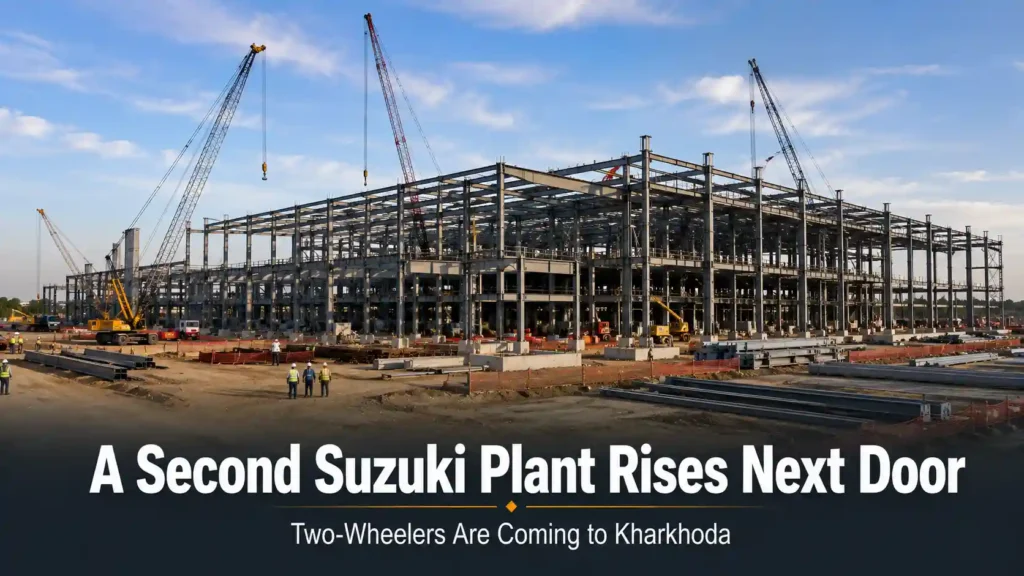
No, they are two separate companies on adjoining land, not one plant. Suzuki Motorcycle India Private Limited (SMIPL) is building its own 100-acre, two-wheeler-only facility right beside the 800-acre Maruti Suzuki car plant, inside the same IMT Kharkhoda estate.
Specifically, SMIPL has committed ₹1,200 crore for this first phase, targeting 7.5 lakh two-wheelers a year once it starts. Also, the plant is still under construction, with commercial production targeted for 2027, unlike the car plant next door, which already runs two active lines. So, if a search result mentions a “Suzuki plant” at Kharkhoda without saying cars or bikes, it likely means one of these two, not a single combined facility.
Furthermore, both companies sit under the wider Suzuki Motor Corporation umbrella from Japan, which is exactly why the sites sit side by side rather than across town from each other.
Why Did Maruti Suzuki Choose This Exact Location?
Overall, that location was not an accident. In fact, Gurugram and Manesar, Maruti Suzuki’s two older Haryana plants, sit on this same broad corridor. So, Kharkhoda extends a manufacturing base the company already knew well, inside the same IMT Kharkhoda industrial area that HSIIDC built from scratch. So, it did not start fresh in unfamiliar territory. Also, the site skips central Delhi traffic entirely, since the KMP Expressway rings the city’s west side.
For the fuller timeline of how this corridor grew, RS Group Realty’s guide to Kharkhoda’s industrial development history traces the belt from its earliest HSIIDC planning stage.
Maruti Suzuki Kharkhoda Plant Location Map
Location of the Maruti Suzuki Kharkhoda Plant inside IMT Kharkhoda, showing KMP Expressway, NH-44, Delhi-Amritsar-Katra Expressway, Sonipat, and nearby industrial areas.
How Much Does the Maruti Suzuki Kharkhoda Plant Produce, and Since When?
Specifically, production at Kharkhoda began on February 25, 2025. First, a single line started making the Brezza, at 2.5 lakh units a year. Then, a second line followed on May 18, 2026. So, this added another 2.5 lakh units, plus the Victoris model. So, that took Kharkhoda’s own output to 5 lakh vehicles a year. Together, across Gurugram, Manesar, Kharkhoda, and Hansalpur in Gujarat, Maruti Suzuki now builds 26.5 lakh vehicles a year. Also, Kharkhoda alone is planned to reach 10 lakh units once fully built out. So, that would make it one of Suzuki’s largest single manufacturing sites anywhere.
| Maruti Suzuki Plant | State | Production Began | Focus |
| Gurugram | Haryana | 1983 | Maruti Suzuki’s original India plant |
| Manesar | Haryana | 2007 | Compact and mid-size cars |
| Hansalpur (Suzuki Motor Gujarat) | Gujarat | 2017 | Multiple models, plus the e VITARA export line |
| Kharkhoda | Haryana | February 2025 | Brezza and Victoris; scaling toward 10 lakh units/year |
So, Kharkhoda is Maruti Suzuki’s third plant in Haryana, after Gurugram and Manesar. Also, it is the company’s fourth production site in India overall, counting the Gujarat facility too. In total, the investment across all phases comes to ₹35,000 crore. Furthermore, the project should create over 21,000 jobs once fully scaled, including work inside the supplier park.
📖 Read This Also: Why Invest in IMT Kharkhoda Industrial Plots? ROI Guide Once you see how fast Kharkhoda’s output is scaling, the next question is what that growth is actually worth to an investor — this guide walks through the ROI logic in full.
What Makes the Maruti Suzuki Kharkhoda Plant Different From Its Other Factories?
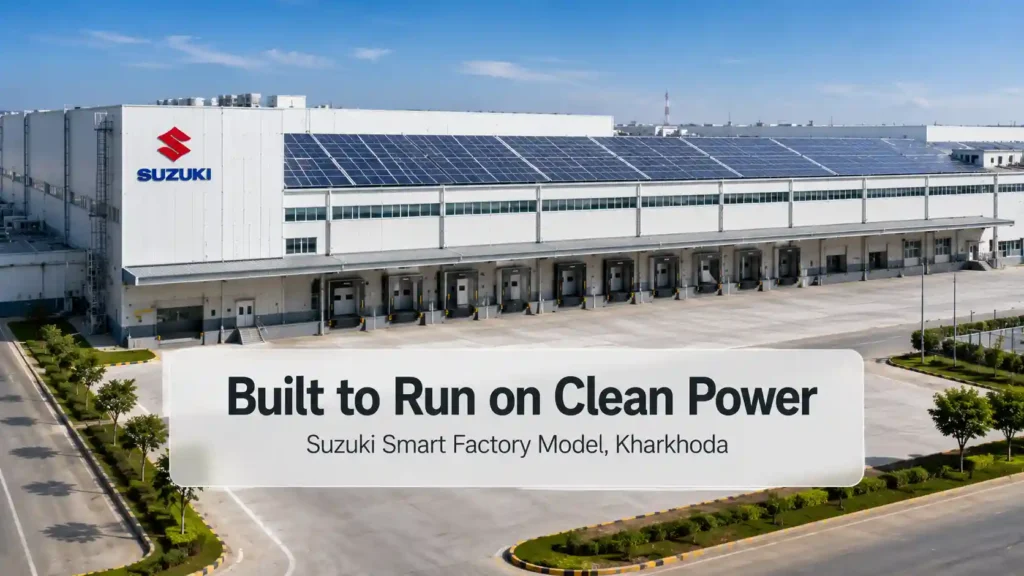
Notably, the Kharkhoda plant runs on what Maruti Suzuki calls its Smart Factory model. Also, it draws 100% of its power from renewable sources, mixing on-site solar with purchased green power. Also, it uses cobots on parts of the line — robots that work alongside people, not instead of them. Furthermore, the site recycles its water fully too, as a zero-discharge facility. In addition, Maruti Suzuki is building a rail siding on-site, so finished cars can leave by train instead of only by road.
How Is Maruti Suzuki’s Plant Pulling Suppliers Into Kharkhoda?
Indeed, a plant this size rarely stays alone for long. So, it needs parts, packaging, and transport close by. So, that pull is already visible at Kharkhoda, in two specific, named companies.
Which Suppliers Have Already Followed Maruti Suzuki to Kharkhoda?
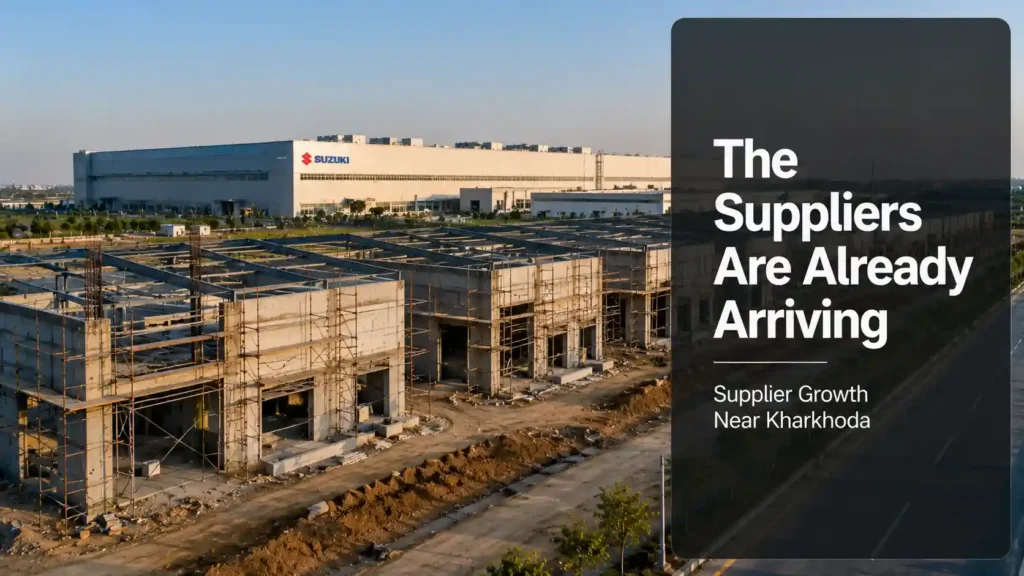
Specifically, UNO Minda has built an alloy-wheel plant near the Maruti Suzuki site, already up and running. Separately, Jay Bharat Maruti Limited joined too. Namely, it is a long-time Tier-1 partner to Maruti Suzuki. In late 2023, JBML laid the first stone for its own unit, inside the plant’s MSIL Supplier’s Park. Overall, that unit covers just over 6.7 acres. So, it will build body and chassis parts, sized to match Kharkhoda’s growth in phases. So, two real, named suppliers are already committed here, not just rumored. If your business fits a similar profile, RS Group Realty’s guide to manufacturing units that fit Sisana’s plots covers who else this belt suits.
Beyond these two named suppliers, RS Group Realty’s separate guide for auto-component companies evaluating land near the plant breaks down what Tier-1, Tier-2, and Tier-3 businesses should check before committing to a site.
What Is Jay Bharat Maruti’s Plant J7 at Kharkhoda?
Plant J7 is Jay Bharat Maruti Limited’s own name for its Kharkhoda facility, sitting on Plot No. 831 inside the MSIL Supplier’s Park. JBML first broke ground here in November 2023, and the unit covers just over 6.7 acres, building body-in-white parts, welded assemblies, and suspension systems for Maruti Suzuki.
Also, JBML is not a new partner chasing this contract. In fact, the company started in 1987 as a direct joint venture with Maruti Suzuki, and it remains part of the JBM Group today. So, this is a decades-old supplier relationship extending into Kharkhoda, not a fresh vendor.
Furthermore, JBML’s board approved a fresh ₹170 crore Phase 2 expansion for Plant J7 in February 2026, funded partly from an earlier ₹350 crore capex plan. That signals real, ongoing investment tied directly to Maruti Suzuki’s own Kharkhoda ramp-up, not a one-time setup.
UNO Minda and Jay Bharat Maruti are the two names confirmed so far — for the full list of companies confirmed and verified inside IMT Kharkhoda, including Suzuki Motorcycle India’s status, RS Group Realty’s companies guide tracks every update.
Does History Support This? What Happened in Gurugram and Manesar?
Importantly, this pattern has real precedent, too. Gurugram grew into a major industrial hub largely because Maruti Suzuki chose it first, back in the 1980s. Manesar then followed the same path, after Maruti expanded there in the 2000s. In fact, Haryana’s own government has pointed to this exact history when discussing Kharkhoda. So, officials expect the new plant to repeat what happened in Gurugram. So, this is not a new theory. So, it is a pattern that has already played out twice, in the same state.
What Does This Mean for Industrial Land Demand Near Kharkhoda?
Indeed, land prices already show early signs of that gap closing. For instance, fresh private plots in the Kharkhoda belt, such as in Sisana, start around ₹14,000 per square yard. Meanwhile, in IMT Manesar, a mature hub built on this same pattern, land now runs ₹60,000 to ₹80,000 per square yard. Still, that gap did not appear by chance. It simply reflects how many more years Manesar has had to mature, so far.
For a broader view beyond Sisana alone, RS Group Realty’s guide to industrial plots in Kharkhoda built for manufacturers and warehouses compares plot types across the wider belt.
Why Is There Still a Price Gap Between Kharkhoda and Manesar?
So, why hasn’t that gap closed already? Because Kharkhoda’s anchor plant only reached full two-line production in May 2026. Also, supporting infrastructure is still catching up. The state highway serving this corridor is being widened, from 66 feet to 200 feet, and that work is still under construction. Once it finishes, frontage land along that road typically gets repriced. So, the timing gap itself is part of the opportunity here, not a flaw in the thesis.
RS Group Realty’s separate breakdown of the KMP Expressway’s freight and investment impact on this corridor covers what this widening project means beyond just travel time.
Exploring industrial land near the Maruti Suzuki Kharkhoda ecosystem?
Government Plot or Private Land — Which Route Fits a Supplier’s Timeline?
Overall, suppliers and investors generally choose between two routes into this corridor. First, government-route plots come through HSIIDC’s own allotment process, inside the official IMT Kharkhoda boundary. However, demand and wait times can both run long there. Instead, private freehold land nearby, including Sisana, skips that queue entirely. It also usually comes with a clear title from day one. RS Group Realty’s IMT Kharkhoda industrial plots page lists what’s currently available on that route. Still, neither route suits every business. Often, a supplier needing to move fast to serve Maruti Suzuki’s ramp-up values speed over a government plot’s lower headline cost.
Positioning Yourself Around a Confirmed Anchor
So, here is the honest summary. Two named suppliers, one government-backed anchor, and a land-price gap that has not yet closed: together, these make Kharkhoda a rare case where the growth story is verified, not promised. RS Group Realty tracks this exact belt every day, from what’s confirmed at the plant itself to which nearby plots actually make sense for a given business. So, talk to the team, before you assume “near Maruti Suzuki” means the same thing on every listing you see.
Looking for industrial plots near IMT Kharkhoda? Get project and availability details from our team.
FAQ Section
Q1. Where exactly is the Maruti Suzuki Kharkhoda plant located? It sits inside IMT Kharkhoda, in Sonipat district, Haryana, about 19 km from Sonipat town. The site sits on the Kundli-Manesar-Palwal Expressway, at the second toll point from the expressway’s northern end, right after Kundli.
Q2. How much does the Maruti Suzuki Kharkhoda plant produce right now? The plant currently produces 5 lakh vehicles a year, across two production lines, building the Brezza and the Victoris. Maruti Suzuki has confirmed plans to double this to 10 lakh vehicles a year in phases.
Q3. Is the Maruti Suzuki Kharkhoda plant fully operational, or still under construction? It’s operational. The first line started commercial production in February 2025, a second line followed in May 2026, and the full facility was formally inaugurated on July 2, 2026, by PM Modi and Japan’s PM Sanae Takaichi.
Q4. How much land does Maruti Suzuki have at Kharkhoda? The car plant sits on 800 acres. A separate, adjoining 100-acre site belongs to Suzuki Motorcycle India, the company’s two-wheeler unit, bringing the combined footprint to 900 acres.
Q5. Which suppliers have already followed Maruti Suzuki into Kharkhoda? Two named companies are already confirmed. UNO Minda operates an alloy-wheel plant near the site, and Jay Bharat Maruti Limited has a unit under construction inside the plant’s own MSIL Supplier’s Park.
More Questions About the Maruti Suzuki Kharkhoda Plant
Q6. What is the MSIL Supplier’s Park at Kharkhoda? It’s a dedicated zone inside the plant’s own land, set aside for component suppliers to operate close to the main assembly line. Jay Bharat Maruti’s new unit, on just over 6.7 acres, sits inside this park.
Q7. How does Kharkhoda compare to Maruti Suzuki’s other Indian plants? Kharkhoda is Maruti Suzuki’s third plant in Haryana, after Gurugram (1983) and Manesar (2007), and its fourth production site in India overall, counting the Hansalpur facility in Gujarat. Combined, all four sites now produce 26.5 lakh vehicles a year.
Q8. What is the total investment in the Maruti Suzuki Kharkhoda plant? The company has confirmed a total investment of ₹35,000 crore across all phases of the project, expected to create over 21,000 jobs once the facility is fully scaled.
Q9. Has Kharkhoda’s growth affected industrial land prices nearby? Not fully yet. Fresh private plots in the Kharkhoda belt, such as in Sisana, still start around ₹14,000 per square yard, well below the ₹60,000 to ₹80,000 per square yard seen in the more mature IMT Manesar.
Q10. Why haven’t land prices in Kharkhoda caught up to Manesar yet? Kharkhoda’s anchor plant only reached full two-line production in May 2026, and supporting infrastructure, including a highway widening from 66 feet to 200 feet, is still under construction. That timing gap is a large part of why the price gap hasn’t closed.
Q12. Is Suzuki Motorcycle India’s plant the same as the Maruti Suzuki Kharkhoda plant? No. Suzuki Motorcycle India Private Limited (SMIPL) is building a separate 100-acre, two-wheeler-only plant next door, with ₹1,200 crore committed for its first phase and commercial production targeted for 2027 — distinct from Maruti Suzuki’s operating 800-acre car plant.
