Rai Industrial Area

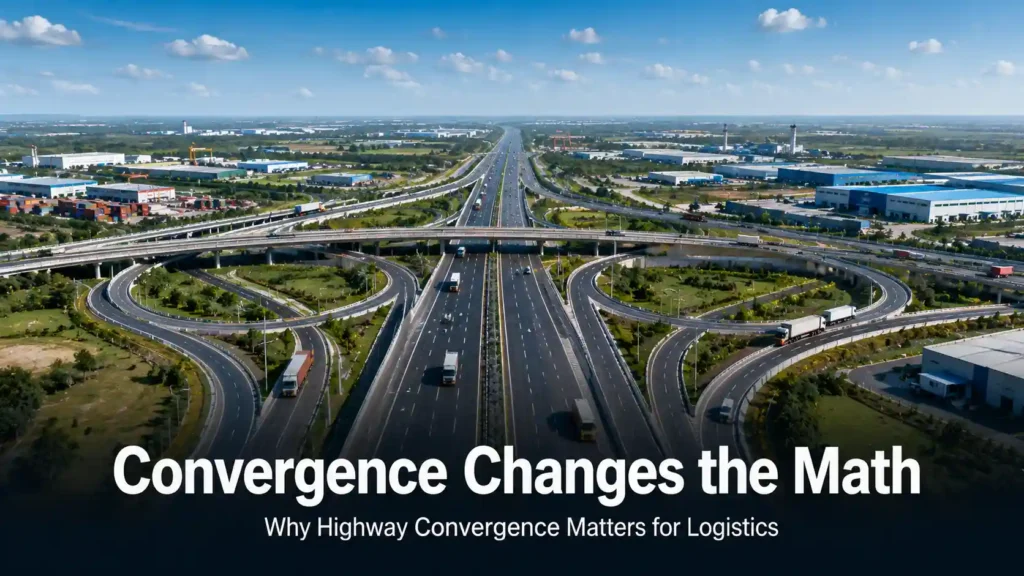
Multi-directional expressway interchange representing Kundli's KMP and Eastern Peripheral Expressway convergence
Rai Industrial Area

Rai vs Kundli Industrial Area: The Full Comparison 2026

Rai Industrial Area vs Kundli: Which Location Is Better for Industrial Business? Both Rai and Kundli sit in Sonipat, Haryana. Both are old, HSIIDC-built estates. Both now sell mostly resale plots, not fresh ones from the government. So “which is better” isn’t really the right question. The better question is which one fits your business, your budget, and how you move goods. This guide compares both on location, industrial ecosystem, logistics, and price, then gives you a straight framework to decide, not a single universal answer. Quick Answer: Rai vs Kundli, at a Glance Rai vs Kundli — Quick Overview Factor Rai Kundli Current Stage Old, established estate Old, established estate (phased development since 1982) Plot Type Mostly resale Mostly resale Typical Resale Range ~₹16,000+ per sq yard ~₹28,000-50,000+ per sq yard Distance from Delhi ~35 km (city) / ~10 km (Narela border) ~20 km (HSIIDC figure), directly on the Delhi border Highway Access NH-44 / GT Road NH-44, plus KMP and Eastern Peripheral Expressway Sector Identity Food processing anchor (Mega Food Park) Broad manufacturing, warehousing, logistics Managed By HSIIDC HSIIDC Neither location is a poor choice. What matters is which set of trade-offs fits your business. Location and Delhi NCR Access: Rai vs Kundli Kundli’s biggest advantage is simple: it sits directly on the Delhi-Haryana border, close to the Singhu border point and Narela. HSIIDC’s own figures put it about 20 kilometres from Delhi. Rai sits a bit further along the same NH-44 corridor, at roughly 35 kilometres from Delhi by the same official measure. However, its own proximity to the Delhi border, via Narela, narrows that gap to around 10 kilometres, which matters if your daily movement is border-adjacent rather than central-Delhi-bound. Both estates sit within the wider Sonipat industrial belt that also includes the newer IMT Kharkhoda estate further along the corridor; our IMT Kharkhoda industrial area overview covers that newer growth zone if you want the fuller regional picture. The trade-off is congestion. Kundli’s border position means heavier daily truck and commuter traffic, especially at peak hours. Rai’s slightly greater distance often means a steadier, less congested daily run. Rai Industrial Area Location Map & Nearby Connectivity Explore the exact location of Rai Industrial Area in Sonipat, Haryana. This map highlights its connectivity to Delhi NCR, NH-44 (GT Road), railway stations, and nearby industrial hubs to help buyers understand its strategic position. Map Highlights Industrial Ecosystem and Sector Identity: Rai vs Kundli Kundli and Rai both carry decades of industrial history, but they built different identities over that time. Kundli grew into a broad, large-scale hub: general manufacturing, large warehousing complexes, cold storage, and logistics distribution serving much of northern India. Its scale runs into the thousands of operating units, spread across multiple development phases dating back to 1982. Rai, on the other hand, built a sharper identity around food processing. Its Mega Food Park, spanning close to 95 acres, has been fully operational for well over a decade, drawing food and agro-based businesses specifically, alongside roughly 800 general manufacturing firms already established there. So, if your business sits inside food processing or agro-based manufacturing, Rai’s existing ecosystem may already include the suppliers and buyers you need. If you need broad, general logistics or warehousing scale, Kundli’s larger base offers more depth. 📖 Read This Also: Sisana Industrial Area vs Rai Industrial Area Comparison See how Rai stacks up against a newer, lower-entry-cost alternative in the same district. Kundli Industrial Area Location Map & Expressway Connectivity View the location of Kundli Industrial Area and understand its connectivity to Delhi, NH-44, KMP Expressway, Eastern Peripheral Expressway, and nearby industrial hubs across the Sonipat industrial corridor. Map Highlights Logistics and Freight Connectivity: Rai vs Kundli Kundli’s connectivity edge comes from convergence, not just proximity. It sits on NH-44 and at the meeting point of the Western Peripheral Expressway, commonly called KMP, and the Eastern Peripheral Expressway, giving it multi-directional expressway access that Rai does not directly share. Rai’s connectivity runs through NH-44 alone, without a direct expressway junction on its own boundary. It sits close enough to Kundli’s own KMP access to benefit indirectly, but a Kundli-based unit reaches that network without the extra drive. On rail, neither estate carries a station directly on-site. Kundli connects through Sonipat Railway Station, while Rai’s nearest options are Rathdhana, about 5 kilometres away, and Sonipat Junction, about 13 kilometres away. For freight corridor reach, both estates fall within the Amritsar-Delhi-Kolkata Industrial Corridor’s influence zone, and Rai specifically sits within the Eastern Dedicated Freight Corridor’s zone too, giving it a genuine national rail-freight link alongside its road access. Not sure which location offers better logistics for your manufacturing or warehouse business? Pricing, Availability and Risk: Rai vs Kundli Price is often the deciding factor once the ecosystem fit looks similar, and here the two estates diverge sharply. Kundli’s resale listings commonly run from ₹28,000 up to ₹50,000 or more per square yard, reflecting its border proximity and multi-expressway access. Rai’s resale market typically starts lower, from around ₹16,000 per square yard, giving a meaningfully lower entry cost for a comparably established estate. Both markets carry the same core risk: since fresh HSIIDC inventory is scarce in either location, buyers are largely working through a resale chain. So, a full legal and title check, including confirmation of any pending dues owed to HSIIDC, matters just as much in Rai as it does in Kundli. Which Location Fits Your Business? A Decision Framework Neither Rai nor Kundli is universally better. The right choice depends on what your business actually needs day to day. Choose Rai If… You want a lower resale entry cost for a similarly established estate. You operate in food processing, agro-based manufacturing, or a related supply chain. You can accept a slightly longer run to central Delhi in exchange for calmer daily traffic. Choose Kundli If… Fast, direct Delhi border access matters more than entry price. You need multi-directional expressway reach through KMP and the Eastern Peripheral Expressway specifically. Your
Split scene of an industrial estate and a decision-point visual, representing an honest evaluation of investing in Rai Industrial Area
Rai Industrial Area

Why Invest in Rai Industrial Area? Full Guide

Why Invest in Rai Industrial Area? Manufacturing, Logistics & Growth Potential Rai Industrial Area comes up constantly in Sonipat industrial searches, but “should you actually invest here” is a different question from “what is it.” This guide answers that second question directly, weighing Rai against what different types of buyers actually need. For the full location and background picture, start with RS Group Realty’s Rai Industrial Area overview. This guide goes further, analyzing Rai specifically as an investment and business-location decision, across manufacturing fit, logistics, infrastructure, and who it suits best. Quick Answer: Is Rai Industrial Area Worth Investing In? Is Rai Industrial Area a Good Fit for Manufacturing Businesses? Rai suits manufacturing businesses that value an established peer network and working infrastructure over ground-floor pricing. Close to 800 firms already operate here, spanning food processing, auto components, rubber goods, and metal fabrication. That existing density means a new manufacturer isn’t operating in isolation. Suppliers, service providers, and a skilled local workforce are already present, built up over decades rather than promised for the future. For a manufacturer that needs to be operational quickly, this maturity has real value. However, Rai’s manufacturing base is MSME-dense rather than anchored by one large plant. A business specifically chasing supply-chain proximity to a single big OEM, the way an auto-component supplier might near Maruti Suzuki’s Kharkhoda plant, won’t find that same anchor-driven demand here. How Strong Is Rai’s Logistics Position? Rai’s logistics position is genuinely strong, anchored by more than just road access. Sonipat has its own inland container depot, giving businesses in the area a direct route into international container trade without relying solely on Delhi’s ports and airports. Beyond that, Rai sits within the influence zone of the Amritsar-Delhi-Kolkata Industrial Corridor and close to the Eastern Dedicated Freight Corridor, a rail-based freight network built specifically to move containerised cargo faster and cheaper than road alone. The Haryana Orbital Rail Corridor, a large-scale rail investment connecting Palwal to Harsana Kalan, adds a further planned layer to this freight network. Road access matters too, through NH-44 (GT Road), roughly 35 km from Delhi. That said, GT Road traffic can run heavy at peak hours, so a logistics plan built purely on map distance will underestimate real transit time. Businesses should factor in actual drive-time variability, not just the highway’s presence. What Does Rai’s Location Actually Offer Investors? Rai’s location offers proximity to an established urban base, not an isolated industrial pocket. It sits just 1 km from Sonipat city and close to Kundli, another established industrial area in the same corridor. This urban adjacency matters practically. Workforce access, local services, and administrative proximity are all easier here than in a newer township still building out its surrounding infrastructure. For a business that values convenience over a lower price point, that’s a genuine advantage. At the same time, this same maturity means Rai’s location doesn’t offer the kind of undeveloped-land upside a newer corridor does. The location’s value is largely already reflected in current pricing, not still unfolding. Rai Industrial Area Investment Location Map See how Rai Industrial Area connects with Sonipat, Delhi NCR, NH-44, Kundli, the Inland Container Depot (ICD), and nearby industrial corridors that influence manufacturing and logistics investments. How Infrastructure-Ready Is Rai Compared to Newer Zones? Rai is significantly more infrastructure-ready today than a still-developing industrial zone, because its systems were built out over decades rather than recently. Power distribution, water supply, sewerage, and a Common Effluent Treatment Plant are already operational across the estate. This matters directly for time-to-operation. A business setting up in Rai generally isn’t waiting on basic utility connections the way it might in a zone still completing its infrastructure rollout. That reduces one entire category of project risk. The trade-off is upgrade pace. Newer zones are actively expanding capacity and adding infrastructure as they grow, while Rai’s existing systems, though functional, aren’t being significantly rebuilt. What you get in Rai is proven reliability, not the newest available capacity. 📖 Read This Also: Sisana vs Rai Industrial Area: Complete Investment Comparison 2026 For a direct, side-by-side breakdown of how Rai and a newer zone like Sisana compare on pricing, connectivity, and growth trajectory, this comparison covers both in full. What Business Types Suit Rai Best? Food processing and agro-based businesses have the clearest, most specific case for Rai, thanks to its dedicated Food Park zone in Sector 38, Phase II. This isn’t a generic claim — verified companies already operate there, including a substantial, well-capitalized food manufacturer. Beyond food processing, general manufacturers in auto components, rubber goods, and metal fabrication also fit Rai’s existing base well, particularly at MSME scale rather than large single-facility operations. Warehousing and light logistics businesses benefit from the estate’s urban proximity and established road network too. Not sure whether your manufacturing or warehouse business is the right fit for Rai Industrial Area? Who Should Consider Rai Industrial Area? Rai suits investors and businesses that prioritise immediate operational readiness over early-stage growth potential. If your business needs to be running quickly, with existing infrastructure and a working peer network already in place, Rai’s maturity is a genuine asset rather than a limitation. It’s also a strong fit for food-processing and agro-based businesses specifically, given the Food Park’s dedicated zoning and existing anchor tenants. Similarly, investors who want exposure to an established, historically stable industrial market, rather than a speculative early-growth story, may prefer Rai’s steadier profile. Finally, buyers comfortable navigating a resale transaction, including full title verification across a chain of previous owners, are better positioned for Rai than those wanting a simple, fresh-title purchase. Who May Prefer Another Location Instead? Investors chasing lower entry cost and long-term price appreciation typically find a better fit outside Rai, since most of its own appreciation from initial development has already happened. A zone still filling its plot inventory offers more room for that kind of growth. Auto-component businesses specifically seeking proximity to a single large OEM’s supply chain, such as Maruti Suzuki’s Kharkhoda plant,

For-sale sign on an industrial plot boundary in Rai Industrial Area, representing its resale-driven market
Rai Industrial Area

Rai Industrial Area Plot Price: 2026 Investment Guide

Rai Industrial Area Plot Prices & Industrial Land Investment Guide 2026 If you’re searching for the Rai Industrial Area plot price, you’ll find a wide spread of numbers, and most listings don’t explain why. That’s because Rai’s market runs almost entirely on resale, not fresh government allotment, so price depends heavily on which specific listing, plot condition, and seller you’re looking at. This guide breaks down what plots and built-up units actually cost in Rai today, what drives that price up or down, and, critically, how asking prices differ from verified, official benchmarks. For the full location and industry picture, see RS Group Realty’s Rai Industrial Area overview first. Quick Answer: Rai Industrial Area Plot Price in 2026 What Is the Current Rai Industrial Area Plot Price? Rai Industrial Area’s plot price typically starts around ₹16,000 per square yard for resale and private plots, with well-positioned or already-developed plots running significantly higher. Because HSIIDC allotted most of the estate’s original land years ago, this is fundamentally a resale market, not a fresh-plot one. Listing data across the belt shows real variation. Some current listings quote resale plots around ₹20,000 per square yard, while more developed positions inside the estate list closer to ₹45,000-plus per square yard equivalent. Built-up factory units, which make up a large share of what’s actually for sale in Rai, price differently again, based on covered area and construction quality rather than land alone. So, when you see a “Rai plot price,” always check exactly what’s being priced: raw resale land, a built factory, or a listing quoting per square metre instead of per square yard. These aren’t the same number. What’s the Difference Between Asking Price and Verified Data in Rai? Asking prices you see in listings are not the same as verified, official price data, and the gap between them matters more in a resale-heavy market like Rai than in a fresh-allotment one. Brokers and sellers set asking prices based on negotiation room, not a fixed benchmark. The one number that is legally fixed is Haryana’s collector rate, the government’s official minimum land value for a given area, used to calculate stamp duty and registration charges. Your stamp duty is charged on whichever is higher: your actual transaction price or the collector rate. So, this figure is worth checking before you trust any asking price at face value. There’s also a useful, if unusual, real-data source: government liquidation and auction notices for distressed industrial assets. One 2026 notice for a Food Park plot in Rai, covering land and an existing building, was listed at a value working out to roughly ₹24,000 per square yard, a genuine, officially recorded figure, even though it reflects a distressed-sale context rather than open-market negotiation. Pricing Methodology Box How the figures in this guide were sourced: Want to know today’s actual asking price for available plots instead of advertised listing prices? How Does Rai’s Plot Price Compare to Nearby Industrial Areas? Rai’s pricing sits meaningfully above fresh-allotment zones in the wider Sonipat belt, reflecting its decades of prior development. The table below places it in context. Location / Plot Type Price Range Note Rai Industrial Area (resale, entry-level) ₹16,000+ per sq yard Mostly resale; verify full ownership chain Rai Industrial Area (developed/premium positions) ₹20,000–₹46,000+ per sq yard Varies significantly by exact location and unit condition Sisana, near IMT Kharkhoda (RS Group Realty) ₹14,000 per sq yard Fresh title, fixed rate, no resale chain IMT Kharkhoda — HSIIDC e-auction (reserve) ~₹32,500–33,000 per sq yard FY 2025-26 reserve; final bid often higher IMT Manesar (established hub, for context) ₹60,000–₹80,000 per sq yard Mature, saturated market 📖 Read This Also: Sisana Industrial Plot Price: Complete Buyer’s Guide for 2026 If Rai’s resale pricing and verification requirements feel like a lot to navigate, this guide covers a fresh-title alternative nearby, with a fixed, transparent rate from day one. Why the Rai-Sisana Price Gap Matters for Buyers The roughly ₹2,000 per square yard gap between Rai’s entry price and Sisana’s fresh rate looks small on paper, but it reflects a real trade-off. Rai’s price buys an established location with a resale chain to verify; Sisana’s buys a clean title with less immediate infrastructure history to lean on. Neither price is objectively better. The right choice depends on whether your business values immediate ecosystem access or a lower-risk paper trail more. For a fuller picture beyond price alone, RS Group Realty’s Sisana vs Rai Industrial Area comparison covers connectivity and growth trajectory too. Not sure whether Rai resale land or a fresh-title industrial plot suits your business better? Get an expert comparison based on your budget. Rai Industrial Area Location Map & Nearby Industrial Corridors Compare Rai Industrial Area with nearby industrial locations including Sonipat, Kundli, Sisana, IMT Kharkhoda, NH-44, and Delhi NCR to understand why land prices vary across the region. What Factors Shape Industrial Plot Prices in Rai? Several factors explain why one Rai listing prices higher than another. Location within the estate matters first — plots with direct frontage on wider internal roads or closer to the main HSIIDC gate typically command a firmer price. Infrastructure readiness counts too. Rai’s estate already has power distribution, water supply, sewerage, and a Common Effluent Treatment Plant in place, so a plot’s condition and access to these systems affects its price more than whether they exist estate-wide. Title and resale chain length also shape price directly. A plot or unit with a short, clean ownership history typically negotiates more smoothly than one with a longer resale chain requiring more verification. Finally, plot size and category — general industrial versus Food Park-designated land — carry different pricing logic, since Food Park plots serve a narrower buyer pool. How Do Plot Characteristics Affect Price for Built-Up Units in Rai? Because so much of what’s for sale in Rai is a built-up factory rather than raw land, physical characteristics move price as much as location does. Covered area and ceiling height matter directly for manufacturers, since usable production

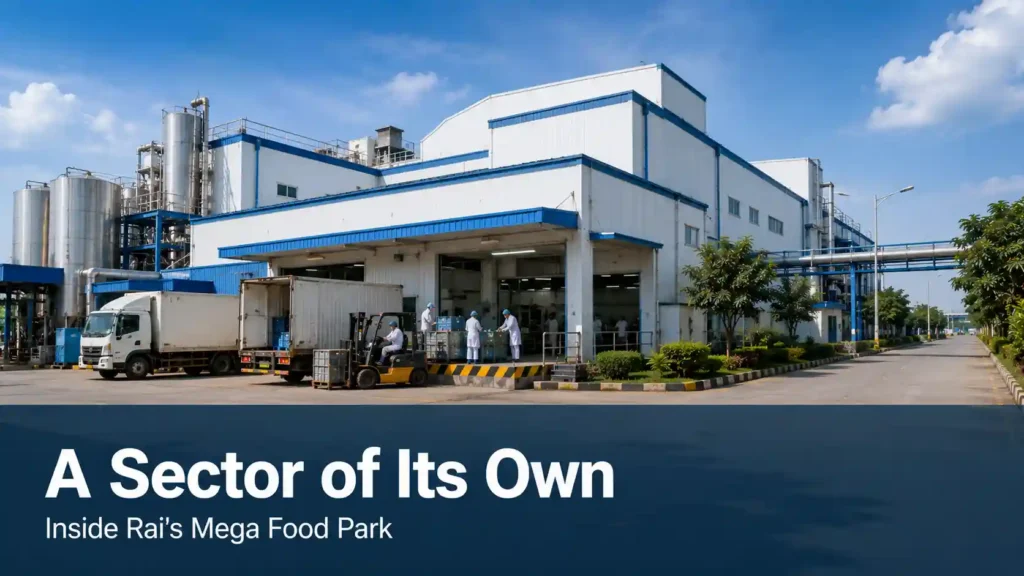
Food processing facility representing Rai Industrial Area's established Mega Food Park cluster
Rai Industrial Area

Rai Industrial Area Location 2026: Map & Distance Guide

Rai Industrial Area Location, Map & Connectivity Guide If you’re searching for “Rai Industrial Area location,” you likely want a straight answer: where it sits, how far it actually is from Delhi, and how goods and people move in and out. Not a sales pitch. This guide gives you exactly that. It covers Rai’s precise location in Sonipat district, an accurate distance table to key NCR points, its road and rail connectivity, and what’s already built there today. Rai is one of Haryana’s oldest HSIIDC industrial estates, and its location is a big part of why it filled up decades ago. Here’s the full picture. Quick Answer: Rai Industrial Area Location at a Glance Where Is Rai Industrial Area Located? Rai Industrial Area sits in Rai block, Sonipat district, Haryana, just north of Delhi along the historic Grand Trunk Road. HSIIDC, the Haryana State Industrial and Infrastructure Development Corporation, developed and still administers the estate directly. The estate sits about 1 kilometre from Sonipat city, giving it an established urban base right next door. Nearby towns and localities include Ganaur, Bahadurgarh, and the Delhi-adjacent suburb of Narela, and the area falls under PIN code 131029. Rai is significant enough locally to be its own state assembly constituency within Sonipat district, reflecting how long this industrial base has anchored the area’s economy. Rai Industrial Area Map: Location, NH-44 Connectivity & Nearby Industrial Hubs The map below highlights the exact location of Rai Industrial Area in Sonipat, Haryana, along with NH-44 (GT Road), Sonipat City, Delhi (Narela Border), Kundli Industrial Area, and nearby industrial corridors. It helps businesses understand Rai’s strategic position within the Delhi NCR industrial belt. How Far Is Rai Industrial Area From Delhi and Key NCR Points? Distance from Delhi depends heavily on which “Delhi” you mean: the city centre, or the border itself. Both numbers matter, for different reasons. Destination Approximate Distance Primary Route Delhi (city, via NH-1/NH-44) ~35 km NH-1 / NH-44 (GT Road) Delhi border (Narela) ~10 km NH-1 / NH-44 Sonipat city centre ~1-2 km Local roads IGI Airport ~46 km NH-44 via Delhi Sonipat Junction railway station ~13 km Local roads Rathdhana railway station (nearest) ~5 km Local roads Note that exact figures shift by a few kilometres depending on which sector within the broader Rai estate you’re measuring from, since it spans several plot sectors along the highway. Rai’s Relationship to Delhi NCR: More Than Just a Distance Number Rai’s real NCR advantage isn’t the 35-kilometre figure. It’s the 10-kilometre one, to the Delhi border at Narela. That gap splits Rai’s story into two parts. Getting to the Delhi border is fast and short. Getting deeper into the city, however, means joining GT Road traffic, which can run heavy at peak hours. So, a plot’s real travel time to central Delhi often runs longer than the straight-line distance suggests. Meanwhile, Rai’s position on NH-1, the original Grand Trunk Road, is not incidental. This corridor has connected Delhi to Punjab and beyond for centuries, and Rai’s industrial estate was built directly on that established movement corridor, decades before newer estates like Kharkhoda existed. 📖 Read This Also: IMT Kharkhoda Map, Layout & Connectivity Guide See how the newer Kharkhoda estate’s boundary and toll-point access compare to Rai’s older GT Road position. Road, Rail and Freight Connectivity at Rai Industrial Area Rai’s connectivity rests on one major road and its surrounding rail and freight context, not a wide expressway network like some newer estates nearby. NH-1, now designated NH-44, runs directly past the estate, linking it to Delhi to the south and Panipat, Karnal, and Punjab to the north. Additionally, Rai sits close enough to Kundli, at KMP Expressway’s northern end, that many listings describe reasonable reach to that expressway too, though it is not directly on Rai’s own boundary the way NH-44 is. On rail, no station sits directly inside Rai itself. The nearest options are Rathdhana, roughly 5 kilometres away, and Sonipat Junction, about 13 kilometres away, both usable for passenger and general freight movement. For larger freight ambitions, Rai’s location matters more structurally. The estate sits within the influence zone of both the Amritsar-Delhi-Kolkata Industrial Corridor and the Eastern Dedicated Freight Corridor, giving established manufacturers here a genuine link to national freight rail networks, alongside the road access NH-44 already provides. Planning a factory, warehouse, or manufacturing unit near Delhi NCR? Let our team help you shortlist the right industrial location. What’s Already Established at Rai Industrial Area Rai is not a blank map. It is one of Haryana’s most built-out industrial estates, and that shapes what a buyer actually finds here today. The Rai Mega Food Park HSIIDC’s Mega Food Park at Rai has been fully operational for well over a decade, making it one of Haryana’s two original food parks, alongside Saha in Ambala district. It spans roughly 95 acres, with plot sizes ranging from 450 square metres up to over 4,050 square metres. This anchor has pulled food processing and agro-based businesses to Rai specifically, giving the estate a genuine sector identity beyond general manufacturing. Nearby Industrial Hubs Along the Same Belt Rai does not sit in isolation. It shares the wider Sonipat industrial belt with Kundli to its south and the newer Kharkhoda estate further along NH-44 and the KMP corridor. For the fuller picture of that belt, see our IMT Kharkhoda industrial area overview. Together, these estates give the Sonipat belt a rare mix: an established, filled-out base at Rai, and open, developing land further along the same corridor. Using This Location Guide: Next Steps for Different Buyers Location data answers “where.” It doesn’t answer “should I buy here.” That depends on what you’re actually looking for. If You’re Comparing Rai to Sisana or Kharkhoda Location alone will not settle a Rai-versus-newer-estate decision. Price, plot availability, and growth stage matter just as much. Our dedicated Sisana vs Rai industrial area comparison walks through those factors side by side, if you’re weighing the two directly. If You

Factory entrance nameplate representing the importance of verifying company presence in Rai Industrial Area
Rai Industrial Area

Rai Industrial Area: 800 Firms, 4 Verified Categories

Rai Industrial Area Companies List: Manufacturers & Major Industries in Sonipat Searching for a company list for Rai Industrial Area turns up a mix of outdated directory scrapes, generic real estate listings, and very little verified detail. That’s largely because Rai doesn’t work like a newer township with two or three named anchor tenants — it’s an older, MSME-dense estate with close to 800 firms and no single public roster. This guide takes the honest route. It categorizes what’s actually verifiable — real, GST-registered businesses and named categories — rather than presenting an invented “top companies” ranking. For the full location and connectivity picture, see RS Group Realty’s Rai Industrial Area overview first; this guide goes deeper specifically on the companies and industries operating there. Quick Answer: Companies and Industries in Rai Industrial Area What Kind of Company Base Does Rai Industrial Area Actually Have? Rai Industrial Area’s company base is wide and MSME-dense, not concentrated around a small number of named anchors. Close to 800 firms operate here, built up over decades, rather than around one dominant employer. This matters for how you should read any “companies list” claim about Rai. Unlike a newer township built around a single large plant, Rai’s economic base comes from breadth — many small and mid-sized manufacturers rather than a handful of giants. So, no single company defines the estate the way an anchor plant might elsewhere. HSIIDC does not publish a full public list of every allottee’s name, and most of Rai’s plot-holders are private, GST-registered MSMEs rather than listed corporations. Therefore, this guide focuses on verified categories and real, named examples within each, rather than claiming a complete roster that doesn’t actually exist anywhere. Rai Industrial Area Location Map: Company Clusters & Connectivity The map below shows the location of Rai Industrial Area in Sonipat, Haryana, along with its proximity to NH-44 (GT Road), Sonipat City, Kundli Industrial Area, and Delhi NCR. It helps readers understand why Rai has become one of Haryana’s most established MSME manufacturing hubs. Which Industry Categories Are Verified in Rai Industrial Area? Rai Industrial Area’s verified activity spans four main categories: food processing, auto components, rubber and general manufacturing, and metal fabrication, alongside a broader HSIIDC-permitted mix. Industry Category Verified Presence in Rai Food processing Dedicated Food Park zone (Sector 38, Phase II); anchored by companies like Veetee Fine Foods Limited Auto components Multiple GST-registered manufacturers, including air-filter and auto-part units Rubber & general manufacturing GST-registered rubber-goods and industrial-component producers Metal fabrication Established fabricators producing metal sheets, racks, and fabricated components Broader permitted mix HSIIDC’s original estate plan also covers textiles, electronics, FMCG, and warehousing/logistics use Every category above has at least one real, publicly findable example backing it — this guide names them in the sections below, rather than treating “Rai has many industries” as an unsupported claim. What Does Rai’s Food Park Mean for Food-Processing Businesses? Rai’s clearest verified industry anchor is its dedicated Food Park zone, inside Sector 38, Phase II of the estate. This zone specifically draws food-processing and agro-based manufacturers, distinct from the estate’s general industrial plots. Veetee Fine Foods Limited is registered inside this Food Park with a substantial capital base exceeding ₹300 crore, according to public company registration records. This makes it one of the more significant, verifiable businesses operating in Rai today. Beyond this anchor, the Food Park’s zoning specifically supports other food-manufacturing and agro-processing businesses, giving this segment a genuine, purpose-built cluster rather than scattered individual units. 📖 Read This Also: Sisana vs Rai Industrial Area: Complete Investment Comparison 2026 If you’re weighing Rai’s established, MSME-dense base against a newer zone’s growth potential, this comparison breaks down pricing, connectivity, and land availability between the two. Looking for industrial land near Rai or Sonipat for your manufacturing business? Share your requirement and our team will help you evaluate the right location. What Does the Auto-Component and General Manufacturing Base Look Like? Beyond food processing, Rai’s manufacturing base includes verified, GST-registered auto-component and general manufacturing businesses. These are smaller, MSME-scale operations rather than large single plants, but they represent real, checkable activity. H M Auto Industries, registered inside Rai’s HSIIDC estate, manufactures air-cleaner assemblies and air-filter housings for the auto sector. Separately, Style Rubber Industries, registered in Phase I of the estate, manufactures rubber-based industrial components with over a decade of GST history. Metal fabrication is also represented, with businesses like Aashirwad Industries producing fabricated metal sheets, display racks, and related products since 2014. Together, these examples reflect the kind of small-to-mid manufacturing base that makes up most of Rai’s roughly 800 operating firms. How Is Rai’s Business Community Organized? Rai’s business community is organised through the RAI Industries Association, a real, verifiable body formed in 2009 to represent the estate’s MSME businesses. It works as a bridge between local manufacturers and government departments. The association runs skill-development seminars, coordinates on issues like safety and exports, and maintains ongoing contact with relevant institutions on behalf of its members. For a buyer or business evaluating Rai, this association is a legitimate, checkable point of contact, unlike an anonymous directory listing. Why an Established Association Signals a Mature Business Community An industry association that has operated continuously since 2009 signals something about the estate itself: a business community established enough to sustain its own representative body, not a scattered set of unrelated tenants. For a new entrant, that maturity is practically useful. It means genuine peer support, established local supply relationships, and a body that already understands the estate’s day-to-day operating issues. What Does This Company Base Mean for B2B Industrial Activity in Rai? Rai’s MSME-dense company base means B2B activity here looks different from a newer, anchor-driven township like the one forming around IMT Kharkhoda’s industrial plots. Instead of one large plant pulling in a dedicated supplier network, Rai offers an already-diversified base of potential customers, suppliers, and service providers across several sectors. For a business evaluating the location, this cuts both ways. A diversified base means less dependence

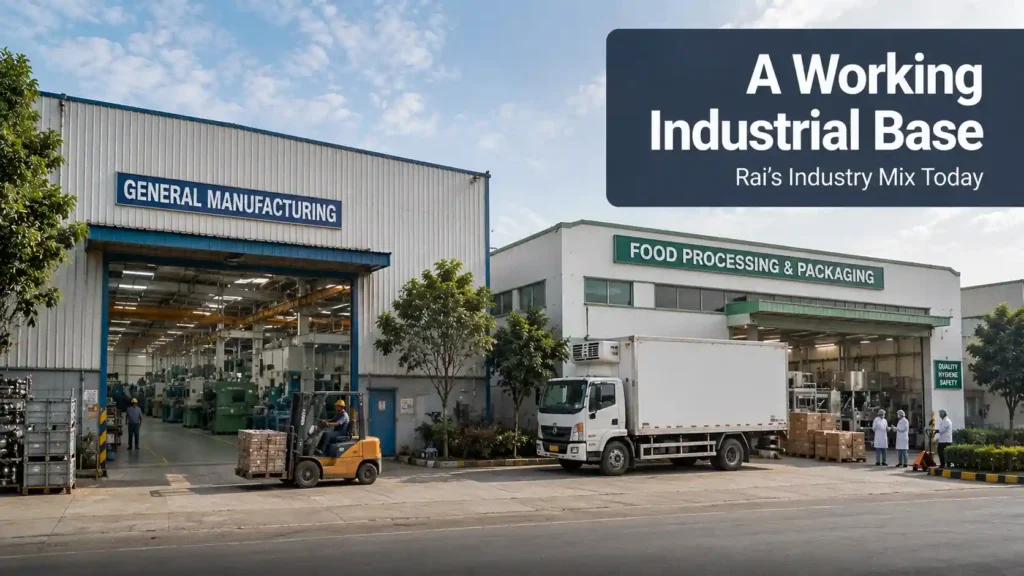
Manufacturing and food-processing facilities side by side, representing Rai Industrial Area's industry mix
Rai Industrial Area

Rai Industrial Area: 800+ Firms, One Established Hub

What Is Rai Industrial Area? Location, Industries & Industrial Development Guide Rai Industrial Area is one of Sonipat district’s oldest and most established industrial estates, sitting almost inside Sonipat city itself. Unlike newer industrial zones still under development nearby, Rai already runs close to 800 operating firms across a built-out, HSIIDC-developed estate. This guide explains what Rai Industrial Area actually is, where it sits, what industries operate there, how it connects to Delhi NCR, and who should realistically consider it today. It also covers the current land market honestly, since very little fresh land remains available here. Quick Answer: What Is Rai Industrial Area? What Is Rai Industrial Area? Rai Industrial Area is a government-developed industrial estate built by HSIIDC (Haryana State Industrial and Infrastructure Development Corporation) in Rai, a town and development block in Sonipat district, Haryana. HSIIDC itself was established in 1967 to drive industrialisation across the state. Unlike IMT Kharkhoda, one of Haryana’s newest industrial townships still filling its plot inventory, Rai is an old, fully built estate. It already has a deep, working base of running firms, organised infrastructure, and an active local industry association. So, Rai functions today as a live industrial city, not a project still under construction. The estate is also organised into distinct phases and sectors, including Phase 1 and Phase 2, with a dedicated Food Park zone inside Sector 38. This structure reflects decades of incremental development rather than a single master-planned rollout. Where Is Rai Industrial Area Located? Rai Industrial Area sits just 1 km from Sonipat city, in Sonipat district, Haryana, roughly 35 km from Delhi along NH-1, now part of the NH-44/GT Road corridor. This puts it close to an established urban base, not an isolated greenfield site. Beyond road access, Rai also falls within the influence zone of the Amritsar-Delhi-Kolkata Industrial Corridor and sits near the Eastern Dedicated Freight Corridor. Therefore, the location carries genuine freight and rail-linked trade advantages beyond its road connectivity alone. Rai also sits close to Kundli, another established industrial area in the same belt. As a result, this stretch of Sonipat district functions as one continuous industrial corridor rather than a series of disconnected estates. Rai Industrial Area Location Map & Connectivity Overview The map below shows Rai Industrial Area’s location in Sonipat district, its connectivity to NH-44 (GT Road), Sonipat city, Delhi NCR, Kundli, and the surrounding industrial corridor. It helps manufacturers and investors understand why Rai remains one of Haryana’s most established industrial estates.  Key Locations Around Rai Industrial Area What Industries Operate in Rai Industrial Area? Rai Industrial Area hosts a wide mix of manufacturing and processing businesses, built up over decades of operation. Close to 800 firms currently run here, according to RS Group Realty’s own market tracking of the estate. A Mega Food Park is also taking shape inside Rai, drawing food-processing and agro-based businesses specifically. This makes Rai a particularly strong fit for that industry segment, alongside its broader manufacturing base. The estate’s scale has also supported organised industry representation. The RAI Industries Association, formed in 2009, works as a bridge between the estate’s MSME businesses and government departments, running skill-development programmes and coordinating with local institutions. Rai is also not the only established option in this corridor, and it isn’t automatically the right fit for every buyer weighing Sonipat’s industrial belt. 📖 Read This Also: Sisana vs Rai Industrial Area: Complete Investment Comparison 2026 For a full side-by-side breakdown of pricing, connectivity, and growth trajectory against a newer zone like Sisana, this comparison is worth reading alongside the connectivity and land-market details below. Not sure whether Rai Industrial Area matches your business requirements? Get expert guidance based on your industry, budget, and expansion plans. How Well Is Rai Industrial Area Connected? Rai Industrial Area connects to Delhi primarily through NH-1, now designated NH-44, running roughly 35 km along the GT Road corridor. This gives it long-established road access, unlike newer zones still waiting on infrastructure upgrades. However, this maturity has a real trade-off. GT Road traffic can run heavy at peak hours, so distance on paper does not always translate into a fast trip in practice. Businesses evaluating Rai should factor in actual peak-hour drive times, not just the map distance. Beyond road access, the estate’s position inside the Amritsar-Delhi-Kolkata Industrial Corridor and near the Eastern Dedicated Freight Corridor adds a freight and logistics advantage that newer, road-only industrial zones don’t yet have. What Is the Current Land and Investment Landscape in Rai? Rai’s land market today is defined by scarcity, not fresh supply. Because HSIIDC allotted most of the estate’s original plots years ago, new buyers are mainly looking at resale plots or already-built units rather than direct government allotment. Factor Current Status in Rai Fresh HSIIDC allotment Rare — most original plots sold out years ago Typical entry pricing Often ₹16,000+ per square yard for resale/private plots Core-estate premium plots Can run meaningfully higher than the entry price Plot type available Mostly resale and built-up units, not raw fresh land Due diligence focus Full resale ownership chain, clear title, and any pending HSIIDC dues What Buyers Should Verify Before Buying Resale Land in Rai Because most transactions here involve a resale chain, verify the complete ownership history before committing. Confirm clear title at every transfer, not just the current seller’s paperwork. Also, check for any dues still pending with HSIIDC on the specific plot. Since Rai’s inventory is largely resale, unresolved dues or incomplete transfer records are a more realistic risk here than in a freshly allotted zone. Looking for available industrial plots in the Sonipat region? Compare resale properties in Rai with ready industrial plots near IMT Kharkhoda before making a decision.  Who Should Evaluate Rai Industrial Area? Rai Industrial Area suits buyers who want an instant, working ecosystem over raw growth potential. Businesses in food processing or agro-based industries, in particular, benefit from the estate’s developing Mega Food Park and existing peer network. It also fits companies that need a

Scroll to Top