
How to Calculate ROI on Industrial Land Investment: Formula, Costs & Example
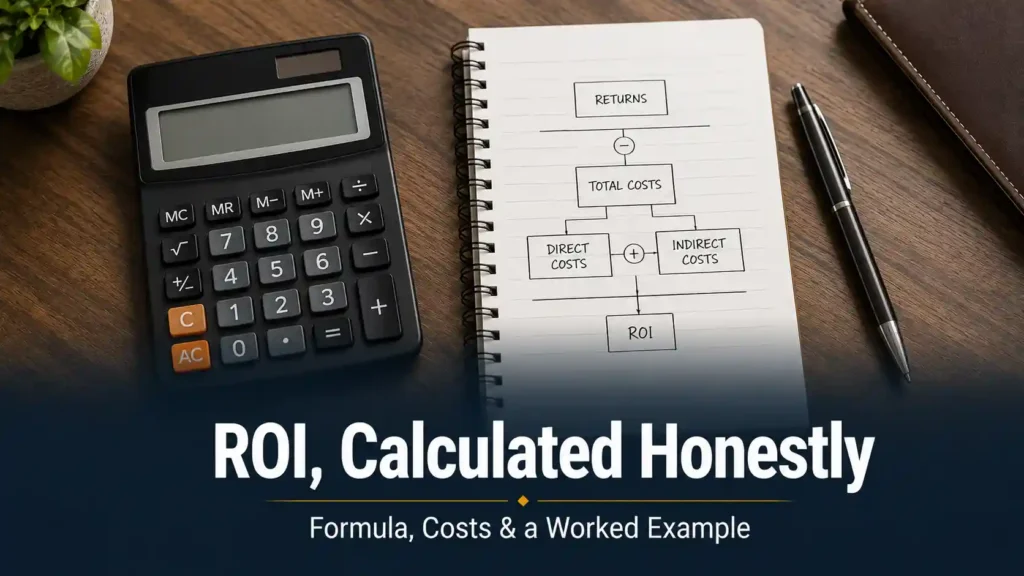
Most “industrial land ROI” content either skips the math entirely or presents a single confident return figure as if it’s guaranteed. Neither approach actually helps you evaluate a real investment.
This guide walks through the actual formula, what belongs in each cost category, and how to think about appreciation without pretending it’s predictable. It includes a fully worked example, built entirely on stated, hypothetical assumptions, not a projection or promise of what any specific plot will return.
Quick Answer: How Industrial Land ROI Is Calculated
- The basic formula is: Net ROI = (Exit Value − Total Investment) ÷ Total Investment, where Total Investment includes acquisition and holding costs together.
- Acquisition cost includes the plot price plus stamp duty, registration, and legal or documentation fees, not just the quoted rate.
- Holding cost includes any maintenance or association charges, applicable authority dues, and financing interest if the purchase is financed.
- Appreciation is an assumption you choose to model, not a guaranteed outcome — this guide shows the calculation using multiple illustrative rates, not one confident prediction.
- Exit value is your assumed future sale price minus selling costs, including brokerage and applicable capital gains tax considerations.
What Is the Basic ROI Formula for Industrial Land?
The basic ROI formula for industrial land is: Net ROI = (Exit Value − Total Investment) ÷ Total Investment, expressed as a percentage. Total Investment itself combines acquisition cost and holding cost, not just the plot’s purchase price.
For a multi-year hold, it’s often more useful to convert this into an annualised figure using CAGR: CAGR = (Exit Value ÷ Total Investment)^(1 ÷ number of years) − 1. This matters because a simple ROI percentage doesn’t distinguish between a return earned over 2 years versus 10, while CAGR does.
Industrial land differs from many other real estate investments in one important way: it typically generates no rental income during the hold period, unlike a leased commercial property. That means the entire return depends on the gap between what you pay and what you eventually sell for, minus everything spent in between.
What Counts as Acquisition Cost?
Acquisition cost is more than the quoted plot rate, and treating it as just “price per square yard times area” understates your real investment. Start with the plot price itself, calculated from the actual rate and size.
Add stamp duty and registration charges, which vary by state and are calculated on whichever is higher between your transaction value and the applicable government benchmark rate. Add legal and documentation fees for title verification and registration support, and brokerage costs where a broker is involved in the transaction.
Together, these additional costs commonly add a meaningful percentage on top of the quoted plot price, which is why any ROI calculation starting from the plot price alone will overstate your actual return.
What Counts as Holding Cost?
Holding cost covers everything spent between purchase and sale, and it’s easy to underestimate because these costs are spread out rather than paid upfront. Estate maintenance or association charges, where applicable, are a recurring cost worth including even if individually modest.
Where the purchase is financed rather than self-funded, loan interest becomes a significant holding cost and directly reduces net ROI, since that interest is a real cash outflow over the hold period. Property tax or authority dues, where applicable to the specific estate, should also be included.
For a purely self-funded purchase with no ongoing charges, holding cost may be minimal. For a financed purchase, it can meaningfully change the final ROI figure, which is worth modeling explicitly rather than assuming away.
How Should You Think About Appreciation Assumptions?
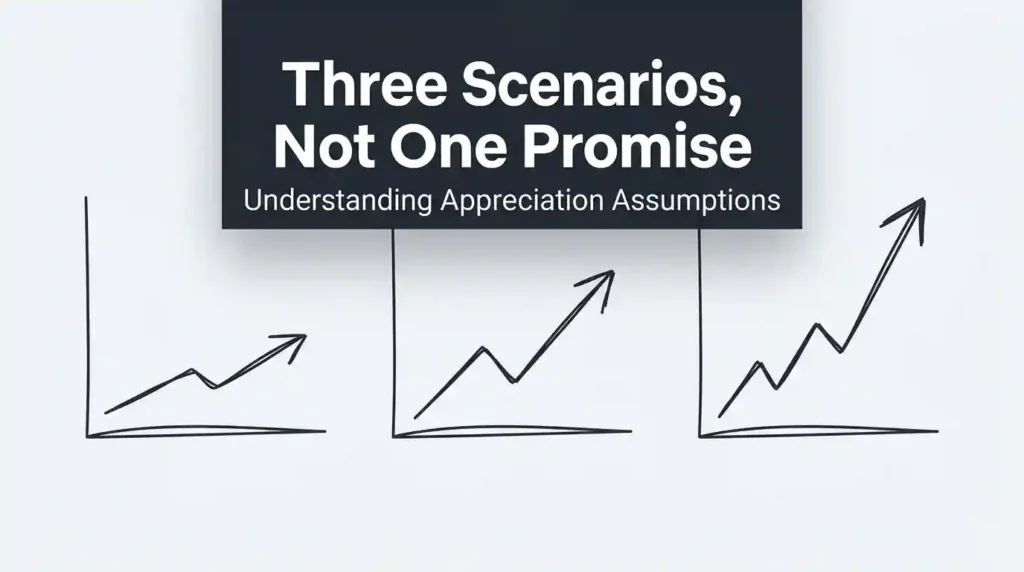
Appreciation is the single most important input in any industrial land ROI calculation, and it’s also the input you least control or can predict with confidence. Any specific appreciation rate you use in a calculation is an assumption you’re choosing to model, not a fact about the future.
Because of this, the more useful approach is to calculate ROI under a few different illustrative assumptions rather than committing to one. This shows you how sensitive your return actually is to the appreciation rate, rather than hiding that sensitivity behind a single confident number.
Past price movements for a specific corridor or estate can inform a reasonable range of assumptions, but they don’t guarantee future appreciation will follow the same pattern. Market conditions, infrastructure delivery, and broader economic factors all affect actual outcomes.
📖 Read This Also: Why Invest in IMT Kharkhoda Industrial Plots? ROI Guide For how this general framework applies to a specific, current investment case, this guide walks through the Kharkhoda-Sisana corridor’s actual growth story and pricing context in detail.
Want to evaluate an industrial plot using the same ROI framework?
How Do You Calculate Exit Value and Net ROI?
Exit value starts with your assumed future sale price, based on whichever appreciation assumption you’re modeling, then subtracts the real costs of actually selling. Brokerage on the sale side reduces your proceeds just as it may have on the purchase side.
Capital gains tax also applies to land sales in India, with rules that depend on your specific holding period and current tax provisions, which change over time and should be confirmed with a qualified chartered accountant rather than assumed from general guidance. Once you’ve netted out these selling costs, you arrive at your actual exit value, not just the gross assumed sale price.
From there, Net ROI compares this real exit value against your Total Investment, which itself already includes both acquisition and holding costs. Skipping any of these deductions makes a calculation look more favourable than it actually is.
A Hypothetical Industrial Land ROI Example

The example below is entirely hypothetical, built to illustrate the calculation method, not to project or promise what any specific plot will return. All figures are illustrative and rounded for clarity.
Assumed purchase: A 1,000 sq yard plot at an illustrative rate of ₹14,000 per square yard.
| Cost Component | Illustrative Amount |
| Plot price (1,000 sq yd × ₹14,000) | ₹1,40,00,000 |
| Stamp duty, registration, legal fees (illustrative ~7%) | ₹9,80,000 |
| Total acquisition cost | ₹1,49,80,000 |
| Holding costs over 5 years (illustrative, self-funded, minimal maintenance) | ₹5,00,000 |
| Total investment | ₹1,54,80,000 |
Exit value under three illustrative appreciation assumptions, over a 5-year hold:
| Illustrative Assumption | Assumed Exit Value (Gross) | Less Selling Costs (illustrative ~3%) | Net Exit Value | Net ROI |
| 8% annual appreciation (illustrative) | ₹2,05,60,000 | ₹1,99,43,000 | ₹1,99,43,000 | ~29% total / ~5.2% CAGR |
| 12% annual appreciation (illustrative) | ₹2,46,70,000 | ₹2,39,30,000 | ₹2,39,30,000 | ~55% total / ~9.2% CAGR |
| 18% annual appreciation (illustrative) | ₹3,20,20,000 | ₹3,10,60,000 | ₹3,10,60,000 | ~101% total / ~15% CAGR |
What This Example Does Not Tell You
This example does not tell you what appreciation rate is realistic, likely, or guaranteed for any specific plot or corridor. The 8%, 12%, and 18% figures above are illustrative inputs chosen to show how sensitive the final ROI is to the appreciation assumption, nothing more.
It also excludes capital gains tax, since exact treatment depends on current rules and individual circumstances best confirmed with a qualified chartered accountant. It assumes a fully self-funded purchase; a financed purchase would show a different, generally lower, net ROI once loan interest is included as a holding cost.
Looking for an industrial plot in the Kharkhoda–Sisana corridor to evaluate for your investment plan?
RS Group Realty’s Role in Investment Education
RS Group Realty built this framework to help investors evaluate industrial land honestly, including on its own projects like Sisana. The company does not promise or guarantee any specific rate of return, since real appreciation depends on market conditions no seller can control.
For an investor wanting to apply this exact methodology to a current, specific opportunity, RS Group Realty’s Kharkhoda-Sisana ROI content walks through the real pricing and growth context for that corridor directly, using the same honest, assumption-transparent approach as this general guide.
Calculating industrial land ROI properly means separating what you know, your actual acquisition and holding costs, from what you’re assuming, future appreciation and exit value. Being explicit about that difference is what turns a rough guess into a genuinely useful investment calculation.
Frequently Asked Questions About Industrial Land ROI
Q1. What is the formula for industrial land ROI? Net ROI = (Exit Value − Total Investment) ÷ Total Investment, where Total Investment includes both acquisition cost and holding cost, not just the purchase price.
Q2. What counts as acquisition cost for industrial land? The plot price itself, plus stamp duty, registration charges, legal and documentation fees, and brokerage where applicable — together, these typically add a meaningful amount beyond the quoted rate.
Q3. What counts as holding cost for industrial land? Estate maintenance or association charges, applicable authority dues, and, if the purchase is financed, loan interest over the hold period.
Q4. How do you estimate exit value for industrial land? Start with an assumed future sale price based on a chosen appreciation assumption, then subtract selling costs like brokerage and applicable capital gains tax.
Q5. Is industrial land appreciation guaranteed? No. Appreciation is an assumption used for illustration and planning, not a guaranteed or predictable outcome; actual results depend on market conditions, infrastructure delivery, and broader economic factors.
Understanding Industrial Land ROI in Practice
Q6. How long should you hold industrial land for good ROI? There’s no universal answer; longer holds generally allow more time for potential appreciation but also carry more holding cost and market uncertainty, which is why modeling multiple time horizons is more useful than assuming one.
Q7. Does financing affect industrial land ROI? Yes, significantly. Loan interest becomes a real holding cost that reduces net ROI compared to an equivalent self-funded purchase, which is why financed and self-funded scenarios should be modeled separately.
Q8. How is industrial land ROI different from rental yield? Industrial land typically generates no income during the hold period, unlike a leased commercial property, so its entire return depends on the price gap at sale rather than ongoing rental income.
Q9. What’s a realistic way to think about appreciation without guessing? Model several illustrative appreciation rates rather than committing to one, so you can see how sensitive your ROI actually is to that single, uncertain assumption.
Q10. Does RS Group Realty guarantee returns on its projects? No. RS Group Realty does not promise or guarantee any specific rate of return on any project, since actual appreciation depends on market conditions no seller can control.
