
Why Invest in IMT Kharkhoda Industrial Plots? ROI, Connectivity & Industrial Growth Analysis
“Should I invest in IMT Kharkhoda?” is a fair question, and it deserves a fair answer. Not every hyped-up industrial belt earns the attention it gets. So, let’s look at this one honestly.
This analysis covers why IMT Kharkhoda draws serious investor interest, the actual logic behind its ROI case, which buyer profile fits best, and the risks worth weighing before you commit any capital.
Why IMT Kharkhoda Is on Every Serious Investor’s Radar
Most industrial land pitches lean on a future promise. This one leans on something already happening.
IMT Kharkhoda is a government-developed industrial township in Sonipat, Haryana, built by HSIIDC across roughly 3,200 acres. Inside it, Maruti Suzuki’s plant began commercial production in February 2025. Therefore, this isn’t a speculative announcement waiting to materialize — it’s an operating anchor plant already pulling in supplier demand.
Also, Maruti’s board has since approved a third-phase expansion worth ₹7,410 crore, targeted for 2029, which would push the plant’s total capacity to 7.5 lakh vehicles a year. As a result, the demand case keeps strengthening rather than fading.
Location and Connectivity: The Foundation of Any ROI Case
No ROI case survives bad connectivity. So, this is always the first thing to verify, not the last.
IMT Kharkhoda sits directly on the KMP Expressway, the second toll point from the expressway’s northern end, just after Kundli. This places it within easy reach of NH-44, the Delhi-Amritsar-Katra Expressway, and the broader Haryana industrial network, all without routing through central Delhi traffic.
IMT Kharkhoda Location Map & Connectivity Overview
The map below shows the strategic location of IMT Kharkhoda along the KMP Expressway and its connectivity to Delhi, Sonipat, Kundli, and major industrial corridors.
This matters for ROI specifically because connectivity is what converts cheap land into usable, in-demand land. Without it, low prices simply stay low. With it, low prices become an entry point ahead of a re-rating.
Industrial Growth Drivers Behind the Investment Thesis
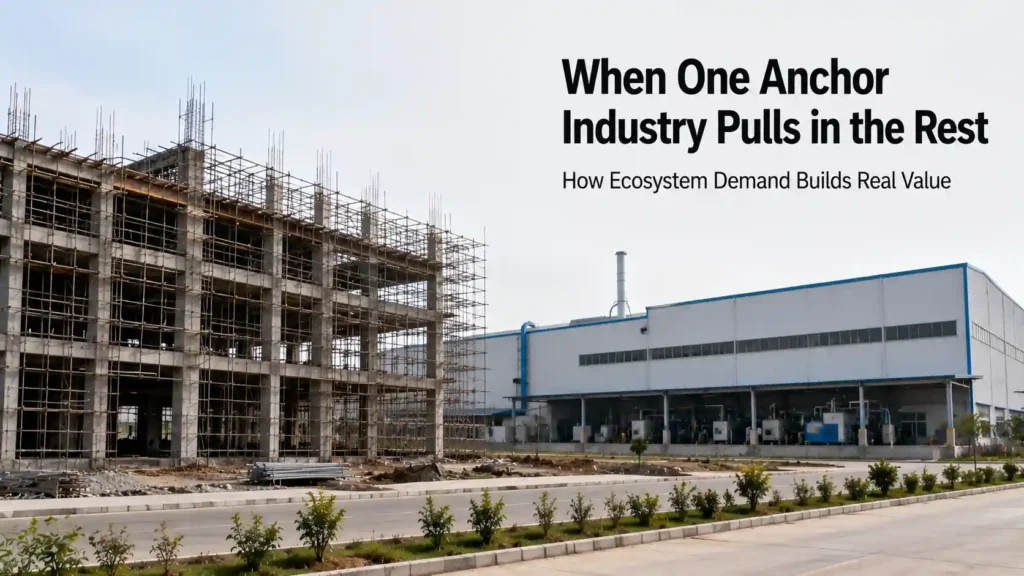
A real investment thesis needs more than one growth driver. IMT Kharkhoda currently has several, working at once.
Maruti Suzuki’s ramp-up is the clearest one, pulling in auto-component suppliers, packaging firms, and logistics operators that need to sit close to the plant. Auto-parts major Minda has already set up units inside the estate, confirming this supplier pull is already underway, not theoretical.
Meanwhile, the state highway serving this corridor is being widened from 66 feet to 200 feet, a direct infrastructure upgrade that increases the value of frontage land once complete. Also, Haryana media reported in late 2025 that HSIIDC has begun land-valuation work for a further ~5,800-acre expansion of the IMT, which signals continued institutional commitment to this belt, even though that expansion itself is still years from plot allotment.
The ROI Logic: How Industrial Land Value Actually Grows Here
Industrial land doesn’t generate ROI the way rented property does. There’s no monthly yield to point to. So, the logic works differently, and it’s worth spelling out clearly.
First, there’s the value gap. Fresh private plots in this belt, like Sisana’s entry rate of ₹14,000 per square yard, sit far below pricing in a mature hub like IMT Manesar, where land commonly runs ₹60,000 to ₹80,000 per square yard. That gap exists because Kharkhoda is earlier in its growth cycle, not because the location is weaker.
Second, there’s demand-driven appreciation. Historically, land near anchor manufacturing plants in places like Manesar and Bawal climbed meaningfully once those plants scaled to full output, a process that played out over several years, not months.
Third, there’s infrastructure-completion repricing. Once the 200-foot highway upgrade finishes, frontage land on that corridor typically gets repriced upward, since the asset itself has materially changed.
Therefore, the honest ROI case here is a multi-year value-gap-closing thesis, not a guaranteed return figure. Anyone promising a specific percentage return on industrial land is skipping past real uncertainty that deserves your attention.
Which Buyer Profile Gets the Best Value From IMT Kharkhoda?
Not every investor extracts the same value from this opportunity. So, match your profile honestly before you commit.
Manufacturers and factory owners gain the most direct benefit, since owned land near an active anchor plant beats renting space further away. Auto-ancillary suppliers gain an even sharper edge, given direct proximity to Maruti’s growing supply chain needs.
Warehouse and logistics operators benefit from the KMP Expressway’s reach across Delhi, Haryana, Punjab, and Rajasthan from a single site. Long-term land investors and HNIs comfortable with a three-to-seven-year horizon are positioned to benefit from the value-gap-closing thesis described above.
First-time industrial buyers and growing SMEs, meanwhile, often do best entering through a fixed-rate, fresh-title route rather than a more complex, bid-driven government process.
The Nearby Industrial Ecosystem Effect
IMT Kharkhoda doesn’t create value in isolation. It sits on a connected industrial spine, and that matters more than most buyers realize.
Kundli, just north along the KMP Expressway, anchors its own industrial estate and sits within the Amritsar-Delhi-Kolkata Industrial Corridor. Further south, Bahadurgarh, IMT Manesar, and IMT Sohna each add their own established demand pools, all linked through the same expressway network.
As a result, suppliers, logistics firms, and skilled labour move along this entire corridor, not just within Kharkhoda’s boundary. So, an investment here benefits from demand generated well beyond Kharkhoda’s own footprint, which is a genuine structural advantage over a standalone, disconnected industrial pocket.
Risks Every Investor Should Weigh Before Committing
A fair investment case names its risks. Here are the ones that matter most for this specific opportunity.
What Could Slow This Thesis Down
The 200-foot highway upgrade is announced, not finished, so frontage-value gains tied to it haven’t fully materialized yet. Also, industrial land carries real liquidity risk; it doesn’t trade as quickly as residential property, so plan for a genuine multi-year hold rather than a short flip.
Furthermore, the reported Phase 2 expansion is still in land-valuation stage, years from formal allotment, so it shouldn’t be priced into any decision today. Finally, government-route plots involve competitive bidding and possession timelines tied to infrastructure completion, which adds process risk that private fresh plots don’t carry.
How to Protect Your Investment
Verify title and land-use category independently before committing to any plot, government or private. Also, confirm connectivity claims against the actual road network rather than a brochure’s straight-line distance, and choose the entry route — government auction or private fresh title — that actually matches your timeline and risk tolerance.
Finally, work with a team that tracks this specific micro-market daily, since local nuance often decides whether a “good deal” is genuinely good.
How RS Group Realty Supports Your Investment Decision
RS Group Realty treats industrial land as the business decision it actually is, not a one-time transaction.
Therefore, every plot recommendation comes with clear pricing, a full legal and title check, a guided site visit with someone who knows the micro-market, and real comparable transaction data instead of estimates. This is the same standard the team applies across its IMT Kharkhoda and Sisana coverage.
If the belt-level case above makes sense for your goals, our IMT Kharkhoda industrial plots page and our dedicated Why Invest in Sisana Industrial Area guide walk through the specific project, pricing, and next steps.
Frequently Asked Questions About Investing in IMT Kharkhoda
Q1. Why should I invest in IMT Kharkhoda industrial plots? IMT Kharkhoda combines a confirmed, already-operating anchor plant in Maruti Suzuki, strong expressway connectivity, and an early-stage entry price relative to mature hubs like Manesar, creating a genuine, if multi-year, value-gap-closing opportunity.
Q2. What is the ROI logic behind IMT Kharkhoda industrial land? The case rests on three factors: a price gap versus mature hubs, demand-driven appreciation as the anchor plant scales, and repricing once the 200-foot highway upgrade completes — not a guaranteed return figure.
Q3. How does the Maruti Suzuki plant affect IMT Kharkhoda’s investment case? Maruti’s plant is already in commercial production and approved for further expansion through 2029, which is pulling in real supplier and logistics demand rather than relying on a future announcement alone.
Q4. Which buyer profile suits IMT Kharkhoda best? Manufacturers, auto-ancillary suppliers, warehouse and logistics operators, long-term land investors comfortable with a multi-year horizon, and SMEs entering through a fixed-rate private route all find a clear fit here.
Q5. What connectivity supports the IMT Kharkhoda investment case? The KMP Expressway, NH-44, and the Delhi-Amritsar-Katra Expressway connect the belt to Delhi NCR and beyond, while IMT Kharkhoda’s position near the expressway’s northern end keeps it close to Kundli and Delhi specifically.
More FAQs on Why Invest in IMT Kharkhoda Industrial Plots
Q6. What risks should investors weigh before buying in Kharkhoda? Key risks include the still-incomplete highway upgrade, lower liquidity than residential property, the early-stage status of the reported Phase 2 expansion, and process timelines tied to government plot allotment.
Q7. How does the nearby industrial ecosystem affect land value? IMT Kharkhoda sits on a connected industrial spine alongside Kundli, Bahadurgarh, Manesar, and Sohna, so demand for labour, suppliers, and logistics flows across the whole corridor, not just within Kharkhoda’s own boundary.
Q8. Is IMT Kharkhoda a good long-term investment? For investors with a three-to-seven-year horizon comfortable with industrial land’s lower liquidity, the combination of confirmed anchor demand and ongoing infrastructure upgrades supports a reasonable long-term thesis, though no specific return is guaranteed.
Q9. How does the Sisana micro-market fit into the IMT Kharkhoda investment story? Sisana sits inside the established Sonipat-side Kharkhoda belt, offering a fixed-rate, fresh-title entry point into the same growth thesis described in this article, without the government allotment process.
Q10. How do I evaluate an IMT Kharkhoda plot before investing? Verify the official boundary and title, confirm real road connectivity rather than brochure distance claims, match the entry route to your timeline, and work with a team that tracks this specific micro-market closely.
