
Industrial Plot vs Warehouse Investment: Which Is Better for Investors?
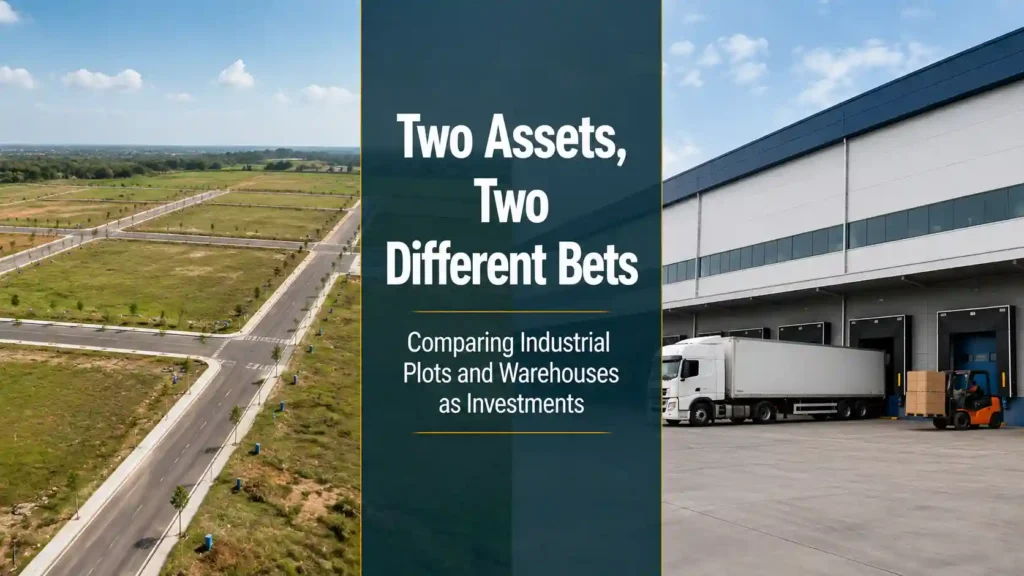
Both get called “industrial real estate.” That’s about where the similarity ends.
An industrial plot is raw land, valued mainly on appreciation and future development potential. A warehouse is a built, operating asset, valued mainly on the rental income it can generate today. Treating them as interchangeable is one of the most common mistakes investors make when comparing the two.
This guide compares both across capital structure, management involvement, income potential, and holding strategy, then leaves the actual choice where it belongs: with your specific goals, not a single universal answer.
Quick Answer: Industrial Plot vs. Warehouse Investment
- An industrial plot typically needs lower upfront capital than a warehouse, since you’re paying for land alone, not construction or a built structure.
- A warehouse can generate rental income from early on; an industrial plot generates no income until it’s developed, leased, or sold.
- Warehouse ownership involves active management, tenant sourcing, lease renewals, maintenance, unless outsourced; an industrial plot mostly just needs to be held.
- India’s warehouse leasing market grew to 34.8 million square feet of absorption in H1 2026, with rental yields commonly cited in the 7–10% range, though this varies by tenant and location.
- Neither is universally better. The right choice depends on your capital, your appetite for active management, and whether you need income now or are building toward appreciation later.
Capital Structure: What You’re Actually Paying For
The two assets ask for fundamentally different amounts of capital, because you’re buying fundamentally different things.
An industrial plot’s price reflects land value alone. A warehouse’s price reflects land plus construction, or the premium of buying an already-built, tenant-ready structure. That difference alone can mean a multiple-times gap in entry capital for a comparable footprint.
| Factor | Industrial Plot | Warehouse |
| Entry Capital | Lower (land value only) | Higher (land plus construction, or built-asset premium) |
| Income While Holding | None, until developed or leased | Rental income from tenancy, often from early on |
| Management Involvement | Minimal (holding, compliance) | Active (tenants, maintenance, lease renewals) |
| Typical Holding Period | Longer, appreciation-driven | Shorter-to-medium, income-driven, though long-term holds are common too |
| Exit Path | Resale as land, or develop before selling | Resale as a leased or vacant income asset |
📖 Read This Also: Best Industrial Plots in Kharkhoda for Manufacturers, Warehouses & Logistics Businesses If you’re planning to actually operate a business rather than purely invest, that’s a different question this guide covers separately.
Management Involvement: Passive Holding vs. Active Operation
This is often the most underestimated difference between the two, especially for first-time industrial investors.
An industrial plot is close to a passive hold. Beyond paying any dues, keeping documentation current, and monitoring the surrounding area’s development, there’s little ongoing work required. A warehouse is an active asset. Sourcing and retaining tenants, structuring leases, handling maintenance, and managing vacancy risk all require either your own time or a professional property manager’s fee.
Neither level of involvement is wrong. It depends entirely on whether you want real estate as a background asset or as something closer to an operating business.
Income Potential: Appreciation vs. Rental Cash Flow

Income potential is where the two assets diverge most sharply, and where a lot of comparison confusion comes from.
An industrial plot’s return comes almost entirely from appreciation, the difference between what you paid and what the land is worth later, plus any value added if you develop it before selling. A warehouse’s return comes from two sources at once: ongoing rental income during the hold, and any appreciation in the asset’s value by the time you exit.
India’s warehousing sector gives a genuine sense of current income potential. Net leasing demand reached 34.8 million square feet in the first half of 2026, up 2.4% year-on-year, driven primarily by manufacturing and third-party logistics tenants, with e-commerce and FMCG demand adding further support. Rental yields on Indian warehouse assets are commonly cited in the 7% to 10% range, though the actual figure depends heavily on tenant quality, lease structure, and location.
Holding Strategy: Time Horizon and Exit Path
The two assets also suit different time horizons and exit strategies, which matters as much as the numbers themselves.
An industrial plot generally rewards patience. Since there’s no income offsetting your holding costs, the investment case depends on the land’s value rising enough, over your specific holding period, to justify the wait. A warehouse can work over a shorter horizon precisely because rental income offsets the holding period while you wait for any appreciation, and Built-to-Suit warehouse leases in India increasingly run nine to fifteen years, giving long-term income visibility that raw land simply can’t offer.
Exiting a plot generally means selling to another investor or an operational buyer. Exiting a warehouse means selling either a vacant asset or one with an existing lease attached, which can support or complicate the sale depending on how favourable that lease is to a buyer.
Which Investor Profile Fits Which Asset

Neither asset class is right for every investor. The fit comes down to capital, involvement, and what you actually need the investment to do for you.
Choose an Industrial Plot If…
You have a longer time horizon and don’t need income from the asset immediately. You want a lower entry capital requirement and minimal ongoing management. You’re comfortable with a return that depends primarily on future appreciation and, potentially, your own development decision later.
Choose a Warehouse If…
You want income during the holding period, not just at exit. You have the capital, or access to financing, for a materially larger upfront investment. You’re prepared to manage tenants directly or budget for professional property management to do it for you.
Considering an industrial plot as your next investment? Get the latest project and plot details.
Making the Decision for Your Own Portfolio
Neither choice is a mistake on its own. The mistake is choosing one without being honest about which factors actually matter most to you.
Questions to Ask Before Committing
Ask how much capital you can commit today versus what a comparable warehouse would actually cost. Ask whether you need income now, or whether you can wait years for appreciation instead. Ask how much time or budget you can dedicate to active management, or whether you’d rather hold something closer to passive. Ask what your realistic exit timeline looks like, and whether that favours a rental-income asset or a patient land hold.
Where This Leaves Investors
Industrial plots and warehouses aren’t competing versions of the same investment. They’re different tools for different goals, and the right one depends on your own capital, timeline, and appetite for active involvement, not on which asset class sounds more sophisticated.
If the industrial-plot side of this comparison fits your situation, our ROI guide for IMT Kharkhoda plots walks through that specific investment case, and our current IMT Kharkhoda industrial plots page shows what’s actually available today.
Want to compare a specific industrial plot with your investment goals?
Frequently Asked Questions About Industrial Plot vs. Warehouse Investment
Q1. Is an industrial plot or a warehouse a better investment? Neither is universally better. An industrial plot suits investors prioritising lower entry capital and appreciation over a longer horizon; a warehouse suits investors who want rental income during the hold and can commit more capital and management involvement.
Q2. How much capital does a warehouse investment need compared to a plot? Meaningfully more, since a warehouse’s price includes construction or a built-asset premium on top of land value, while an industrial plot’s price reflects land alone.
Q3. Does an industrial plot generate any income while I hold it? Generally no, unless you develop and lease it yourself. Its return comes primarily from appreciation, not ongoing income.
Q4. How much management does owning a warehouse actually require? Meaningfully more than a plot. Warehouse ownership involves tenant sourcing, lease structuring, maintenance, and vacancy management, either directly or through a paid property manager.
Q5. What is the typical rental yield on an Indian warehouse investment? Commonly cited in the 7% to 10% range as of recent industry reporting, though the actual figure depends heavily on tenant quality, lease terms, and location.
More Questions on Choosing Between Industrial Plot and Warehouse Investment
Q6. Which has a longer holding period, land or a warehouse? Industrial plots generally reward a longer, more patient hold since there’s no income offsetting the wait. Warehouses can work over shorter horizons because rental income offsets the holding period.
Q7. Which is easier to exit, an industrial plot or a warehouse? Both are exitable, but differently. A plot is sold as land to another investor or operational buyer; a warehouse is sold as either a vacant or tenanted income asset, which shapes its buyer pool differently.
Q8. What investor profile fits an industrial plot best? Investors with a longer time horizon, lower entry capital, and a preference for minimal ongoing management, comfortable with a return that depends on future appreciation.
Q9. What investor profile fits a warehouse investment best? Investors who want income during the holding period, have access to larger capital, and are prepared for active management or the cost of professional property management.
Q10. Can I convert an industrial plot into a warehouse investment later? In principle, yes, since developing a warehouse on land you already own is one common path. It depends on the plot’s zoning, permitted use, and your own capital for construction at that stage.
