KMP Expressway Kharkhoda 2026: Freight & Investment Impact
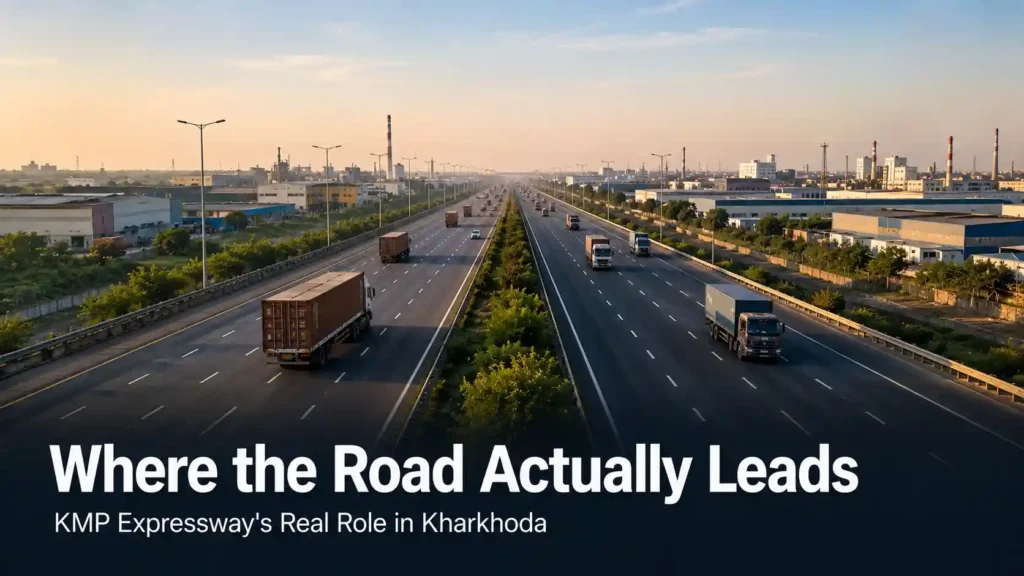
KMP Expressway & IMT Kharkhoda: Connectivity Impact on Industrial Investment A highway on a map means very little to a factory owner. What matters is which direction your trucks can go, how fast, and whether you can avoid Delhi entirely on the way there. That is the real question behind “IMT Kharkhoda connectivity.” The KMP Expressway does not just run near the estate. It shapes how goods, workers, and supply chains actually move through this corridor. This guide breaks that down from a manufacturer’s and logistics planner’s point of view, not a highway enthusiast’s. Expect toll points, freight direction, and site-selection logic, not a construction timeline. Quick Answer: KMP Expressway’s Role in IMT Kharkhoda Connectivity Why the KMP Expressway Matters More Than “Being Near a Highway” “Near an expressway” is a weak sentence on its own. What actually matters is what that expressway lets your business avoid, and what it connects you to. The KMP Expressway, also called the Western Peripheral Expressway, was built for one specific reason: to pull heavy, inter-state traffic away from central Delhi. Delhi traffic police still actively enforces this today, regularly directing commercial and heavy vehicles onto KMP and its eastern counterpart instead of the city core. That single fact changes how a Kharkhoda-based factory operates. A truck leaving your plot does not need to fight through Delhi’s inner roads to reach Punjab, Rajasthan, or western India. It joins a six-lane, access-controlled bypass instead, built for exactly this kind of movement. How KMP Connects IMT Kharkhoda to Multiple Freight Directions IMT Kharkhoda’s position on KMP determines which markets a business here can reach quickly. This is the part a brochure rarely spells out. Kharkhoda sits at the second toll point from KMP’s northern end, right after Kundli. As a result, three separate national highways become reachable in different directions along the same expressway: NH-44 near Kundli, heading toward Punjab and further north; NH-10 at Bahadurgarh, heading toward Rajasthan; and NH-8 at Manesar, heading toward Jaipur and, further along, Mumbai. Furthermore, KMP meets the Delhi-Mumbai Expressway at the Khalilpur interchange in Nuh district. Therefore, a Kharkhoda plot has a genuine, single-corridor road path toward western India’s largest ports and manufacturing markets, not just toward Delhi NCR. Meanwhile, the Delhi-Amritsar-Katra Expressway runs a further 5 kilometres from Kharkhoda town, adding a second high-speed corridor toward the north. 📖 Read This Also: IMT Kharkhoda Map, Layout & Connectivity Guide See the full official boundary, toll-point sequence, and road-class detail behind these routes. KMP Expressway Map: How IMT Kharkhoda Connects to India’s Major Freight Corridors This map highlights how IMT Kharkhoda connects to the KMP Expressway, NH-44, NH-10, NH-8, the Delhi-Mumbai Expressway, Delhi-Amritsar-Katra Expressway, and the upcoming Haryana Orbital Rail Corridor (HORC), making it one of North India’s best-connected industrial locations for manufacturing and logistics. Beyond Road: How Rail Adds a Second Freight Layer at Kharkhoda Road connectivity is only half of Kharkhoda’s freight story. Rail is catching up fast, and it changes the calculation for heavier, bulkier freight. The Haryana Orbital Rail Corridor, or HORC, is a 121.7-kilometre line under construction between Palwal and Sonipat, running through Kharkhoda with its own dedicated station. It is designed for speeds up to 160 kmph, and it carries both passengers and freight, with capacity for up to 50 million tonnes of freight a year. Crucially, HORC connects directly to the Dedicated Freight Corridor at Prithala, near Palwal. So, once operational, freight from Kharkhoda can move onto national rail freight networks, reaching markets as far as Mumbai without switching to road transport for the long haul. The Haryana Cabinet backed this with a revised budget of ₹11,700 crore in March 2026. For manufacturers weighing road against rail for high-volume shipments, this is the detail that matters: Kharkhoda is being built for both, not just one. What KMP Access Means for Manufacturer and Logistics Site Selection Connectivity data only helps once you translate it into a decision. Here is how the KMP factor should actually weigh into a site evaluation. Decision Factor Why KMP Matters Here What to Verify Before You Commit Outbound freight routing Reach 3 national highways without entering Delhi Actual driving route and road class from the specific plot to the nearest toll point Inbound raw material transport Multiple entry corridors reduce single-route dependency Whether internal estate roads can handle the same heavy-vehicle traffic Long-haul western reach Khalilpur interchange links to the Delhi-Mumbai Expressway Real transit time, not straight-line map distance High-volume or bulky freight HORC’s rail link to the Dedicated Freight Corridor HORC’s current construction timeline and station readiness Workforce commute KMP and nearby roads connect to established labor markets Local transport availability for shift-based workforces So, the expressway itself is only the starting point. The plot’s actual position relative to it decides whether that advantage is real or theoretical. Not sure whether a specific plot offers the connectivity your business needs? Get a location assessment before making your investment decision. Industrial Hubs Along the KMP Corridor: Supply Chain and Labor Access Kharkhoda does not operate as an isolated industrial pocket. It sits on a corridor already dense with established manufacturing hubs, and that changes what’s available to a new unit here. What This Means for Component Sourcing and Ancillary Access Kundli, just north on the same expressway, anchors part of the Amritsar-Delhi-Kolkata Industrial Corridor. Bahadurgarh, a few toll points south, already carries a significant manufacturing base of its own. Further along, IMT Manesar remains one of Haryana’s most established auto and ancillary hubs, while IMT Sohna has grown into a newer electronics cluster. For a Kharkhoda-based unit, this means suppliers, ancillary manufacturers, and buyers are often a short KMP drive away, not a multi-state logistics project. See our list of confirmed companies already operating in IMT Kharkhoda for the anchor-tenant side of this ecosystem. Workforce Availability Along the Corridor Manesar and the wider KMP belt already carry decades of industrial workforce experience. Therefore, a Kharkhoda unit can draw on semi-skilled and skilled labor that already understands factory