
Manufacturing Growth in Haryana: Key Industries, Hubs & Emerging Locations
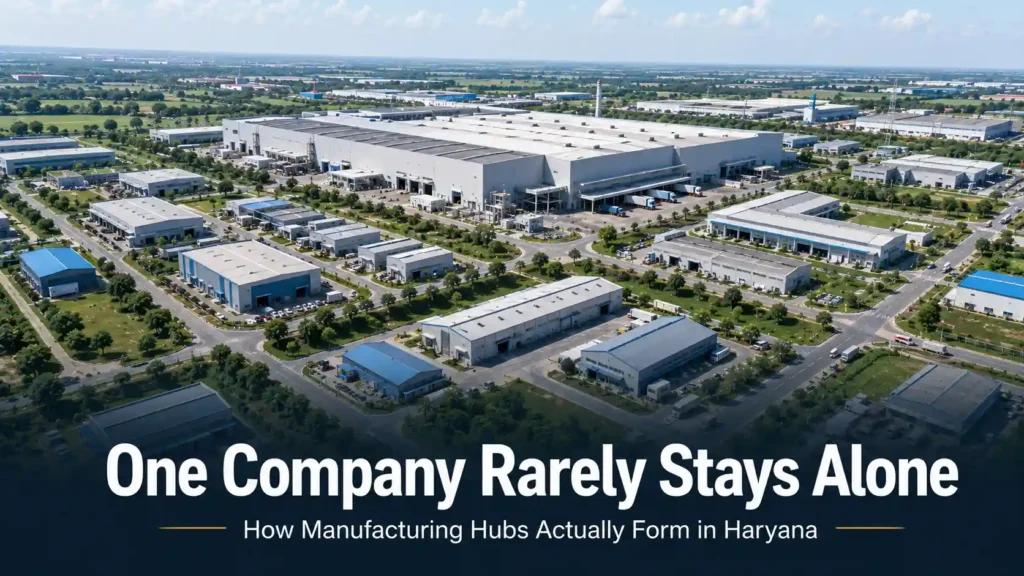
“Manufacturing growth in Haryana” isn’t one story. It’s several specific industries expanding in specific places, usually because one anchor company moved in first and pulled a whole supply chain in behind it.
Understanding that mechanism matters more than memorising a list of factory types. Once you see how an anchor industry actually builds a hub around itself, you can spot which emerging locations are genuinely growing and which are just marketing themselves as if they are.
This guide covers both: the key manufacturing categories active across Haryana today, and the real process by which a location turns into a manufacturing hub in the first place.
Quick Answer: Manufacturing Growth in Haryana
- Haryana’s manufacturing growth concentrates around a handful of anchor-industry categories: automobiles and auto-ancillary components, textiles, food processing, light engineering, and electronics assembly.
- Hubs form through a repeatable sequence: an anchor industry commits first, supporting infrastructure follows, and a supplier ecosystem builds in behind it, typically over one to three years.
- Maruti Suzuki’s Kharkhoda plant is Haryana’s clearest current example of this in motion, with confirmed suppliers already following its 2022 foundation stone.
- Emerging hubs offer lower entry cost and ground-floor positioning; established hubs offer a settled ecosystem and proven infrastructure.
- Matching your specific manufacturing category to the right stage of hub development matters more than chasing the most famous location name.
The Key Manufacturing Categories Driving Haryana’s Growth
Haryana’s manufacturing base isn’t one industry wearing different labels. It’s genuinely distinct categories, each concentrated in its own part of the state.
Automobiles and auto-ancillary components anchor Gurugram-Manesar and are now building a second major base around Kharkhoda in Sonipat district. Textiles concentrate around Panipat, one of India’s largest centres for carpets, blankets, and handloom weaving. Food processing and agro-based manufacturing cluster around Rai’s Mega Food Park and the broader Sonipat belt’s access to the Delhi NCR consumer market. Light engineering and general manufacturing spread widest around Faridabad, which never built around a single sector. Two-wheeler manufacturing and its ancillary base concentrate around Rewari-Bawal.
Each category clusters where it does for a specific reason, usually tracing back to one early anchor decision that everything else followed.
How an Anchor Industry Actually Builds a Manufacturing Hub
Hub formation isn’t random, and it isn’t just about cheap land. It follows a fairly consistent three-step pattern.
First, an anchor industry commits to a location, usually a large manufacturer capable of generating its own supplier demand. Second, infrastructure gets built or upgraded specifically to support that anchor: roads widened, power capacity added, sometimes new rail links planned. Third, a genuine supplier ecosystem forms around the anchor, as component makers and service providers move in to shorten their own supply chains.
This sequence typically plays out over one to three years from the anchor’s initial commitment to a recognisable, self-sustaining ecosystem. Recognising which stage a location is actually in, rather than which stage its marketing claims, is the real skill in evaluating an “emerging hub.”
A Live Example: How Maruti Suzuki Built an Ecosystem at Kharkhoda
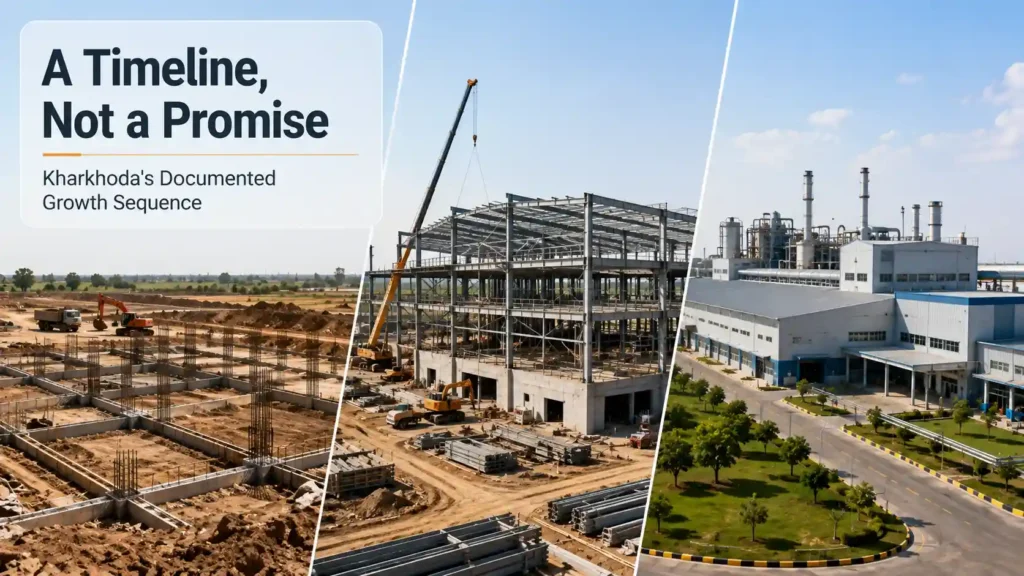
IMT Kharkhoda is Haryana’s clearest current example of this three-step pattern actually happening, with dates specific enough to verify yourself.
| Date | Milestone | Stage |
| August 2022 | Maruti Suzuki’s foundation stone laid | Anchor commits |
| Late 2023 | Jay Bharat Maruti lays its own foundation stone inside the plant’s supplier park | Suppliers begin following |
| January 2024 | UNO Minda’s alloy-wheel plant land approved | Suppliers begin following |
| February 2025 | Maruti’s first production line goes commercial | Anchor operational |
| May 2025 | Suzuki Motorcycle India begins construction of its own plant | Ecosystem widens |
| July 2026 | Full facility formally inaugurated, confirming ₹35,000 crore total investment | Hub matures |
For the full detail behind this anchor’s investment and production numbers, see our Maruti Suzuki Kharkhoda plant guide.
📖 Read This Also: IMT Kharkhoda Companies List: Verified & Updated See exactly which suppliers have already followed Maruti Suzuki into this corridor, and which are still under construction.
Which Manufacturing Categories Fit Emerging Hubs Like Kharkhoda-Sisana
Not every manufacturing category benefits equally from an emerging hub. Some fit the early stage well; others do better waiting for a more settled ecosystem.
Auto-ancillary units fit earliest and most directly, since they can supply the anchor plant itself from day one, similar to how UNO Minda and Suzuki Motorcycle India moved into Kharkhoda’s own case. Logistics and warehousing operators fit early too, since multi-directional highway access matters more than a settled local supplier base. Food processing and packaging units fit well once the surrounding population and consumer base start growing alongside the industrial base. Light engineering and electronics assembly fit once basic infrastructure, especially power reliability, is confirmed rather than just planned.
For a detailed breakdown of which specific factory types suit one such emerging corridor today, our manufacturing units guide for Sisana covers auto-ancillary, logistics, food processing, and light engineering fits in full.
Not sure whether your factory type fits an emerging industrial location? Compare your manufacturing requirements with available industrial corridors before making a land investment.
Established vs. Emerging Manufacturing Hubs: What Changes for a New Entrant
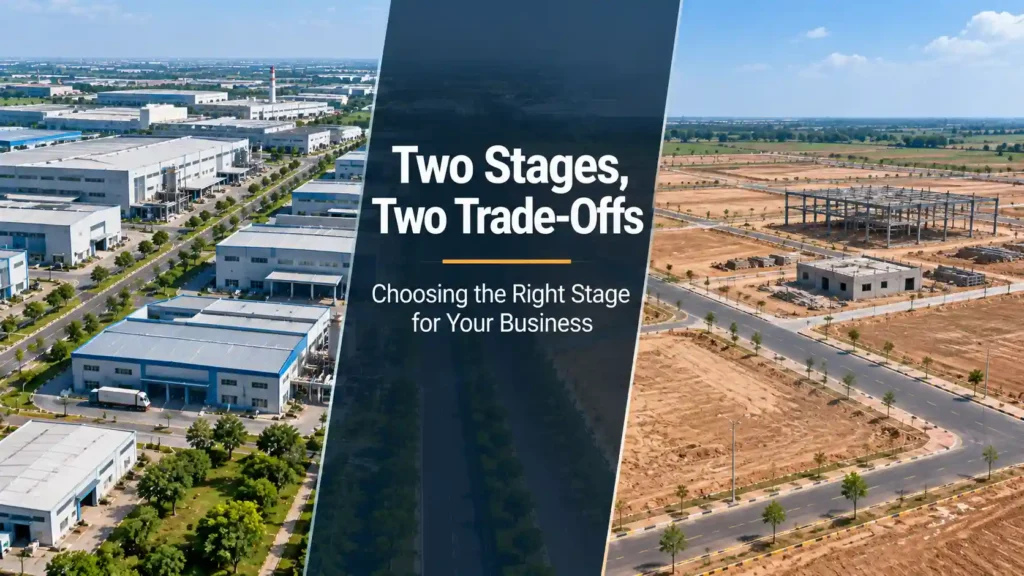
Neither an established hub nor an emerging one is automatically the better choice. Each suits a different kind of manufacturer.
What You Gain in an Established Hub
Places like Gurugram-Manesar or Faridabad offer decades of supplier relationships already in place, proven infrastructure with no construction uncertainty, and an available, experienced workforce that already understands factory operations. The trade-off is cost: land and resale prices reflect that maturity, and available plots are scarcer.
What You Gain in an Emerging Hub
Places like Kharkhoda offer meaningfully lower entry pricing, more available land, and genuine ground-floor positioning inside an ecosystem that’s still forming. The trade-off is timing risk: some infrastructure may still be under construction, and the supplier base is younger and thinner than an established hub’s.
Matching Your Manufacturing Business to the Right Haryana Hub
The right hub depends on your specific manufacturing category and how much risk your business can absorb while an ecosystem is still forming.
Questions to Ask Before Choosing a Location
Ask whether your product can supply a confirmed anchor industry directly, or whether you depend on a wider, more diversified customer base. Ask whether your equipment can tolerate any infrastructure still being completed, or whether you need fully settled power and road access from day one. Ask whether your budget favours established-hub pricing or emerging-hub entry cost. Ask how many verified suppliers, not just the anchor company, are already committed to the location you’re considering.
Need help selecting the right manufacturing location based on your industry, investment budget, and expansion plans? Speak with our industrial property specialists.
Where This Leaves Manufacturers
Manufacturing growth in Haryana isn’t evenly spread, and it never has been. It follows anchor industries, and it rewards the manufacturers who recognise that pattern early, rather than after a hub is already fully priced in.
RS Group Realty tracks exactly this pattern across Kharkhoda and Sisana, since it directly shapes which plots make sense for which kind of manufacturer. If your business fits the auto-ancillary, logistics, food-processing, or light-engineering categories building around this corridor, explore our current IMT Kharkhoda industrial plots, or see our ROI case for this corridor for the fuller investment argument.
Frequently Asked Questions About Manufacturing Growth in Haryana
Q1. What are the key manufacturing categories driving growth in Haryana? Automobiles and auto-ancillary components, textiles, food processing, light engineering, and electronics assembly, each concentrated in its own part of the state around a specific anchor industry.
Q2. How does an industrial hub actually form around a manufacturing anchor? Through a three-step pattern: an anchor industry commits first, supporting infrastructure gets built or upgraded, and a supplier ecosystem forms around it, typically over one to three years.
Q3. What’s a real, current example of this hub-formation process in Haryana? Maruti Suzuki’s Kharkhoda plant, where confirmed suppliers including UNO Minda, Jay Bharat Maruti, and Suzuki Motorcycle India have followed the 2022 foundation stone in a documented, dated sequence.
Q4. Which manufacturing categories fit an emerging hub best? Auto-ancillary and logistics units generally fit earliest, since they can serve an anchor plant or highway network directly. Food processing and electronics assembly tend to fit better once infrastructure is more settled.
Q5. Is it better to set up in an established hub or an emerging one? Neither is automatically better. Established hubs offer settled infrastructure and supplier networks at a higher cost; emerging hubs offer lower entry cost and ground-floor positioning with more timing risk.
More Questions on Manufacturing Location Decisions in Haryana
Q6. What industries define Gurugram-Manesar’s manufacturing base? Automobiles and auto components, built around decades of supplier relationships anchored initially by Maruti Suzuki’s original large-scale plant.
Q7. What industries define Faridabad’s manufacturing base? A genuinely diversified base spanning tractors, auto components, textiles, and light engineering, since Faridabad was never built around one dominant sector.
Q8. How long does it typically take a hub to form around a new anchor industry? Roughly one to three years from the anchor’s initial commitment to a recognisable, self-sustaining supplier ecosystem, based on documented cases like Kharkhoda’s.
Q9. What infrastructure typically follows an anchor industry into a new hub? Road widening, added power capacity, and sometimes new rail links, generally timed to support the anchor’s own production ramp-up.
Q10. How do I know if an “emerging manufacturing hub” claim is genuine? Check for a confirmed, operating anchor industry and at least a few dated, verifiable supplier commitments, not just a marketing claim of future growth.

The three-step pattern you outlined for hub formation is insightful, especially how it hinges on the commitment of an anchor industry followed by infrastructure upgrades and supplier ecosystem development. In my experience, the timing risk associated with emerging hubs like Kharkhoda can be significant. How do you recommend manufacturers best assess the ongoing development of local infrastructure before committing to a location?
Thank you, Kesari Alloys, for sharing your insights and raising a very practical question. You are absolutely right— timing risk is one of the biggest challenges when entering emerging hubs like Kharkhoda.
To mitigate this risk and assess infrastructure development effectively before committing, manufacturers can follow a three-pronged approach:
1. Track Anchor Movement & Commitments: Emerging hubs move rapidly only when the anchor industry starts its structural setup. For instance, monitoring Maruti Suzuki’s actual construction milestones and utility consumption requests in Kharkhoda gives a realistic timeline of when the local administration will be forced to deliver secondary infrastructure.
2. On-Ground Auditing over Official Timelines: Government Master Plans and allotment letters often have a buffer window. It is crucial to conduct independent site audits to check the physical progress of dedicated sub-stations, high-tension power lines, water treatment plants, and connectivity to major highways (like the KMP Expressway).
3. Phased Investment Strategy: Instead of moving full operations at once, manufacturers should opt for a phased rollout. Securing the land early locks in the cost benefits of an emerging hub, while delaying heavy machinery installation until basic utilities (power and water) achieve trial-run status helps manage capital risk.
Evaluating these ground realities ensures that you don’t end up with a ready plant that is waiting six months just for a stable power connection.
Would love to know if your team is currently evaluating Kharkhoda or any similar emerging corridors!