
Top Industrial Areas in Haryana for Manufacturing & Investment in 2026
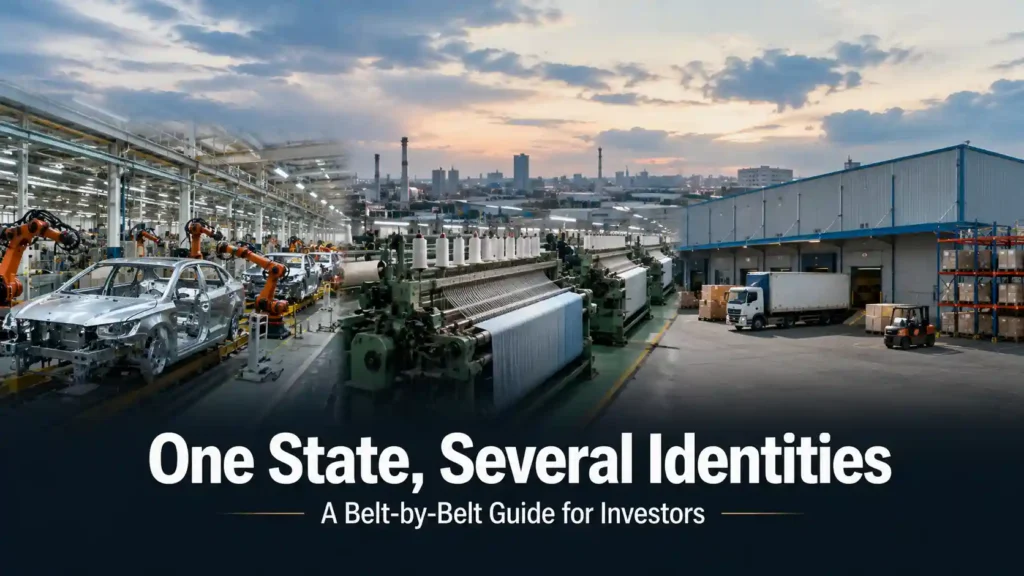
Haryana isn’t one industrial story. It’s several, running side by side across the state, each with its own history, its own anchor industries, and its own reasons to invest there.
Gurugram-Manesar builds cars and components. Faridabad runs on decades of light engineering. Panipat weaves textiles for the world. Sonipat’s belt, including newer names like IMT Kharkhoda, is where most of the fresh growth is happening right now.
This guide maps the major belts by geography, industry ecosystem, and who actually fits best in each one, so you can find your match instead of guessing from a generic list.
Quick Answer: Haryana’s Major Industrial Belts
- Gurugram-Manesar is Haryana’s largest, most established auto and component hub, home to Maruti Suzuki, Honda, and dozens of global suppliers.
- Faridabad is Haryana’s oldest planned industrial town, built for light engineering, auto components, and textiles since the late 1940s.
- Rewari-Bawal-Dharuhera anchors two-wheeler manufacturing and auto ancillaries, on a historic brass-making base dating back centuries.
- Panipat and the northern GT Road corridor run on textiles, carpets, and agro-processing.
- The Sonipat belt, spanning Kundli, Rai, IMT Kharkhoda, Sisana, and Barhana, mixes decades-old estates with Haryana’s newest active growth corridor.
- No single belt is “best” outright — the right one depends on your industry, your budget, and whether you want an established ecosystem or ground-floor growth.
How Haryana’s Industrial Map Is Actually Organized
Nearly every formal industrial estate in Haryana traces back to one body: HSIIDC, the Haryana State Industrial and Infrastructure Development Corporation, formed in 1967. It develops Industrial Model Townships, Industrial Estates, and smaller theme parks across the state, each governed by its own allotment and management rules.
Several of these belts also sit inside the Delhi-Mumbai Industrial Corridor’s zone of influence, including Faridabad, Palwal, Rewari, and the Manesar-Bawal stretch, which brings national infrastructure priority alongside state-level development.
What Grade A Industrial Parks Offer in Haryana
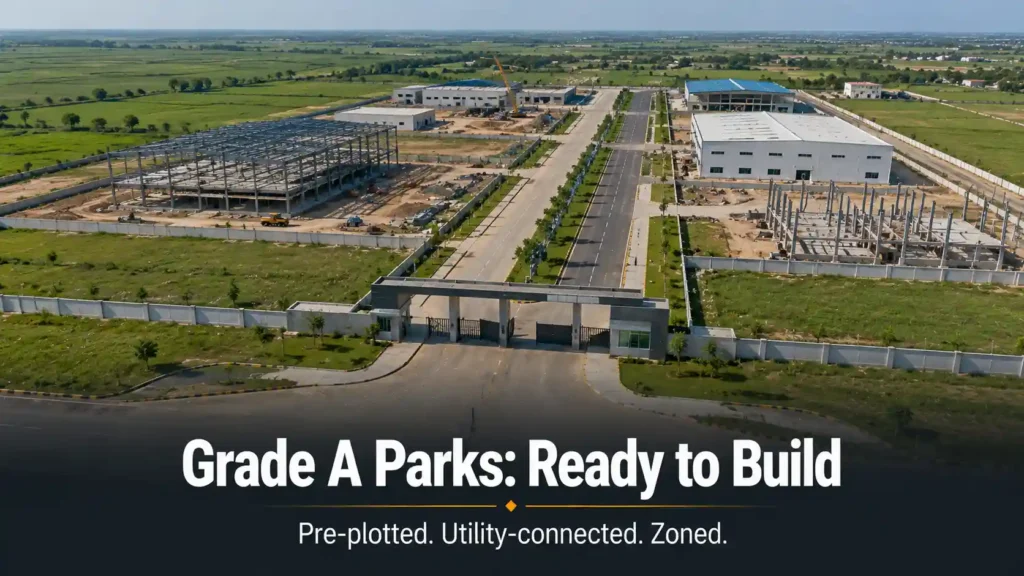
Grade A industrial parks in Haryana are pre-plotted, infrastructure-ready zones with built-in utilities, road networks, and often single-window clearance. Unlike raw industrial land, these parks come with completed internal roads, power substations, water supply, and drainage – so a manufacturer can start construction immediately instead of waiting for basic infrastructure.
HSIIDC operates several of these across the state, while private developers like Reliance Industrial Investments, Adani Logistics, and Embassy Group have also launched Grade A parks in the Delhi-Mumbai Industrial Corridor zone. The key difference from standard industrial estates: Grade A parks typically enforce stricter zoning, maintain common facilities like testing labs and warehousing, and offer leasehold or freehold titles with clearer documentation.
For investors comparing options, Grade A parks near IMT Kharkhoda sit inside Haryana’s fastest-growing corridor, while established Grade A zones in Faridabad and Gurugram offer proximity to existing supplier networks. The trade-off is straightforward: newer parks offer lower entry pricing and growth upside, while established ones offer proven infrastructure and immediate operational readiness.
Haryana Industrial Cluster Map (Official MSME Cluster Overview)
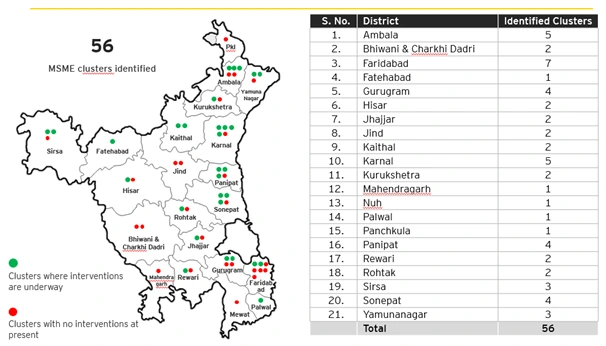
This map shows the official industrial and MSME cluster distribution across Haryana. It provides a geographical overview of manufacturing belts, engineering clusters, textile hubs, food-processing zones, and industrial corridors before exploring each region in detail. The map is based on the Haryana MSME Directorate’s cluster information.
Key Highlights from the Official Cluster Map:
- Haryana has industry-specific manufacturing clusters, not just general industrial estates.
- The state has dedicated clusters for Auto Components, Textile Processing, Food Processing, Light Engineering, Fasteners, Foundry, Sheet Metal, Rice Milling and Apparel Manufacturing.
- Gurugram has multiple specialised clusters including Decorative Lighting, Light Engineering and Apparel Manufacturing.
- Rai (Sonipat) is officially recognised for its Textile & Allied Products Cluster, strengthening Sonipat’s manufacturing ecosystem.
- Panipat-Karnal belt has a strong food and textile ecosystem supported by MSME clusters.
- Ambala, Rohtak, Sirsa and Kaithal each have sector-specific Common Facility Centres (CFCs) that support MSMEs with testing, machining and production facilities.
Source: Cluster | directorate of MSME, Haryana | India
Here’s how the major belts compare at a glance:
| Belt | Primary Industry Identity | Best Fit For |
| Gurugram-Manesar | Automobiles, auto components | Large-scale auto and component manufacturers |
| Faridabad | Light engineering, tractors, textiles | Diversified manufacturers wanting a mature ecosystem |
| Rewari-Bawal-Dharuhera | Two-wheelers, auto ancillaries, brass | Two-wheeler and component suppliers |
| Panipat-Karnal | Textiles, carpets, agro-processing | Textile, food, and agro-based businesses |
| Sonipat Belt | Mixed: established estates plus new growth | Buyers wanting either an established base or early-stage growth |
Looking specifically at IMT Kharkhoda, Sisana, or Barhana? We’re on the ground in this exact corridor every day.
How Haryana Became One of India’s Largest Manufacturing States
- 1967 → HSIIDC established
- 1980s → Gurugram-Manesar Auto Belt
- 1982 → Kundli Industrial Estate
- 1990s → Bawal & Dharuhera Expansion
- 2000s → Rai Food Park
- 2010 onwards → IMT Kharkhoda Planning
- 2025–26 → Phase-2 Expansion
Top Manufacturing Industries Driving Haryana’s Economy
Haryana’s manufacturing sector spans automotive, textiles, food processing, engineering, and IT hardware – with each industry concentrated in specific geographic clusters. The state contributed over Rs 9.5 lakh crore to India’s GDP in 2025-26, making it one of the top five manufacturing states by industrial output.
Here are the leading sectors and their geographic homes:
| Manufacturing Sector | Key Districts | Major Companies | Est. Share of Output |
| Automobiles & Auto Components | Gurugram, Manesar, Faridabad | Maruti Suzuki, Honda, Denso, JCB | ~30% |
| Textiles & Handloom | Panipat, Ambala, Karnal | Vardhman, Lumax, local exporters | ~18% |
| Food & Agro-Processing | Rai, Karnal, Kaithal | Veetee, PepsiCo, Dabur | ~12% |
| Light Engineering & Fasteners | Faridabad, Rohtak, Ambala | Escorts, Lakshmi Machine Works | ~15% |
| IT & Electronics | Gurugram, Faridabad | Samsung, Vivo, Oppo | ~10% |
| Two-Wheelers & Ancillaries | Rewari, Bawal, Dharuhera | Hero MotoCorp, Harley-Davidson | ~8% |
For a manufacturer evaluating where to set up, the practical question isn’t just “which industry is biggest” but “which cluster already has my specific supply chain.” An auto-component supplier will find faster buyer access in Gurugram-Manesar’s established ecosystem than in a newer corridor, while a food processor benefits more from Rai’s Mega Food Park infrastructure.
Gurugram-Manesar: Haryana’s Largest Auto and Component Hub
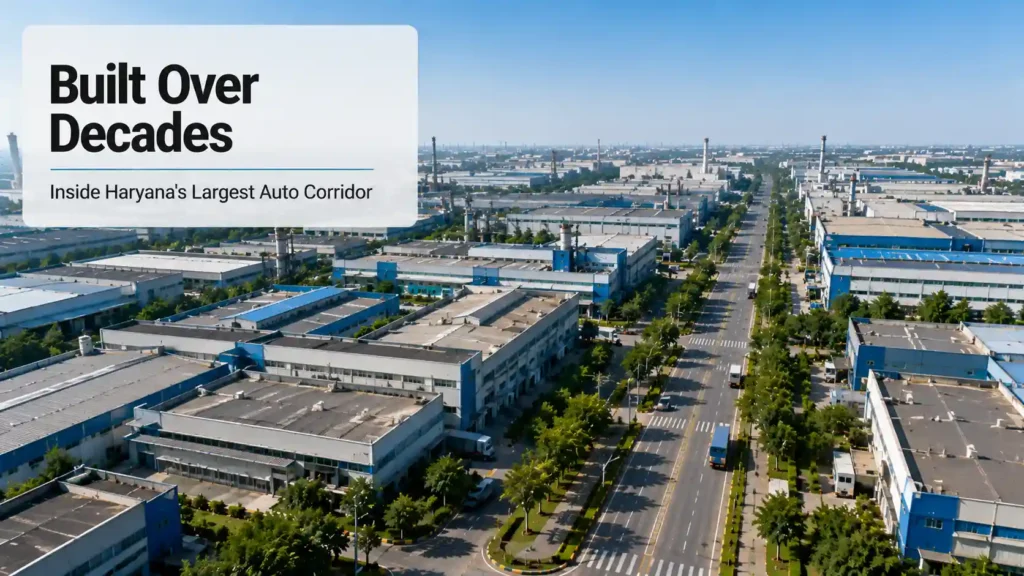
Gurugram-Manesar is Haryana’s biggest, most globally recognized industrial belt, built almost entirely around the automobile industry. IMT Manesar alone spans several thousand acres across multiple development phases.
Maruti Suzuki’s original large-scale plant sits here, alongside Honda Motorcycles and Scooters, Denso, Johnson Matthey, Mitsubishi, and dozens of other component makers supplying automakers across India. This depth of supplier ecosystem is Manesar’s real advantage: a new auto-ancillary unit here plugs into decades of existing buyer relationships immediately.
The trade-off is scarcity and cost. Manesar’s older phases are largely built out, and some expansion land remains tied up in legal or planning delays, so fresh plots are rare and resale prices reflect that maturity.
Faridabad: Haryana’s Oldest and Most Diversified Industrial Base
Faridabad’s industrial identity goes back to the late 1940s, when the New Industrial Township was built partly to resettle and employ Partition-era migrants. It has grown into one of North India’s largest, most diversified industrial clusters since.
Tractors, auto components, textiles, footwear, and light engineering all have a genuine home here, alongside major names like Escorts and JCB. Faridabad and neighbouring Gurugram together generate roughly half of Haryana’s income tax collection, a rough proxy for just how much economic weight this corridor carries.
For a manufacturer that doesn’t fit neatly into one narrow sector, Faridabad’s diversified base is often the safer bet, precisely because it was never built around a single industry.
Rewari-Bawal-Dharuhera: The Two-Wheeler and Ancillary Corridor
Rewari’s industrial story predates modern Haryana by centuries: the district has produced brass wares since 1535. Its modern identity is different, but the same instinct for specialized manufacturing carried through.
Today, IMT Bawal and the neighbouring Dharuhera industrial area anchor two-wheeler and automotive-ancillary manufacturing, with Hero MotoCorp and Harley-Davidson among the manufacturers established here, backed by hundreds of ancillary units supplying them directly.
This belt sits on NH-8, roughly 100 kilometres from Delhi, putting it further out than Gurugram-Manesar but still squarely inside the Delhi-Mumbai Industrial Corridor’s planning zone, which continues to draw fresh infrastructure investment into the area.
Major Industrial Corridors Driving Haryana
- NH-44
- NH-48
- KMP Expressway
- Eastern Peripheral Expressway
- Delhi Mumbai Industrial Corridor (DMIC)
- Amritsar–Delhi–Kolkata Industrial Corridor (ADKIC)
- Eastern Dedicated Freight Corridor (EDFC)
Other Notable Industrial Areas in Haryana Worth Knowing
Beyond the five major belts, several smaller industrial clusters serve niche manufacturing segments and offer lower entry costs for specific business types.
Hisar hosts an Industrial Model Township (IMT) focused on automobile parts, agricultural equipment, and steel processing. The district benefits from NH-52 connectivity and proximity to Rajasthan’s mining belt, making it suitable for heavy engineering and foundry operations.
Rohtak has emerged as a fastener and sheet-metal hub, with dedicated MSME clusters supported by Common Facility Centres. The city sits on NH-44, giving it direct access to Delhi and Panipat, and offers some of the lowest industrial land prices in the NCR periphery.
Bahadurgarh, often called the “Gateway to Haryana,” straddles the Delhi border on NH-10. Its industrial estate focuses on food processing, plastics, and light manufacturing, benefiting from direct Delhi access without Delhi’s land costs.
Sohna and Farukhnagar in Gurugram district serve as overflow zones for the Gurugram-Manesar belt, attracting warehousing and logistics operations that need proximity to the auto hub but at lower rental yields.
For investors comparing these secondary locations against primary belts, the decision typically comes down to whether your supply chain already exists in the area or whether you’re building buyer relationships from scratch. A detailed checklist for evaluating any industrial land before buying applies equally to these secondary markets.
Panipat, Karnal and the Northern Corridor: Textiles and Agro-Processing
Panipat carries a textile identity unlike anywhere else in Haryana. It’s one of India’s biggest centres for blankets, carpets, and handloom weaving, and is recognised as the world’s largest hub for shoddy yarn specifically.
Further along the same GT Road corridor, Karnal’s industrial base leans agricultural: rice and sugar mills, dairy processing, and related agro-industries, reflecting the region’s strength in basmati rice cultivation. Ambala, further north still, carries its own niche identity in scientific instruments and light manufacturing.
This corridor suits a genuinely different buyer profile than the auto-heavy belts further south: textile exporters, agro-processors, and food-sector manufacturers will find purpose-built ecosystems here that the southern belts simply don’t offer.
The Sonipat Belt: Haryana’s Newest Growth Frontier
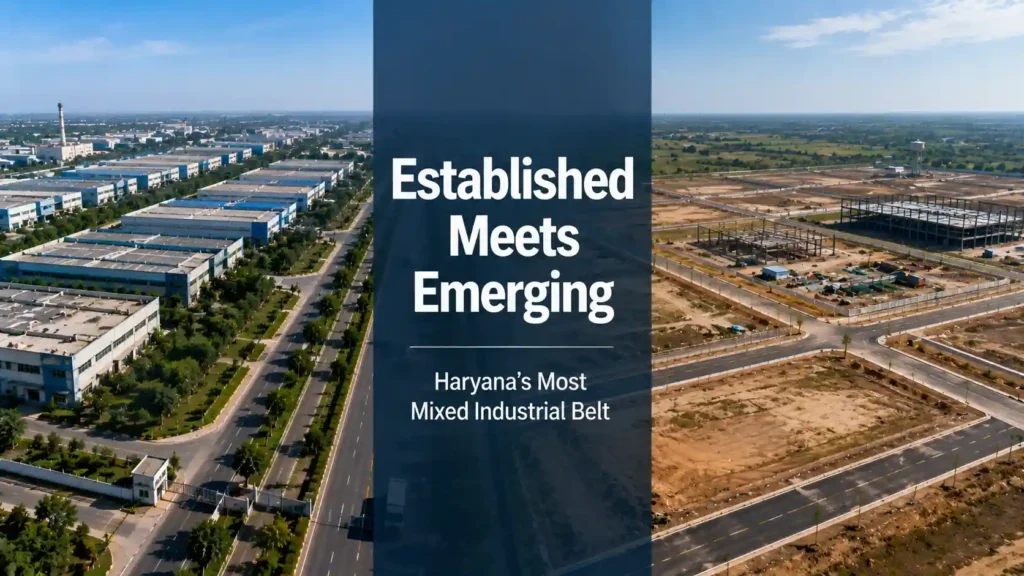
Sonipat district holds a genuinely unusual mix: some of Haryana’s oldest industrial estates sit barely 20 kilometres from some of its newest.
Manufacturing Specialisation Table
| Region | Manufacturing Strength | Major Companies | Investment Stage |
| Gurugram | Auto | Maruti, Denso | Mature |
| Manesar | Auto Components | Suzuki Vendors | Mature |
| Faridabad | Engineering | Escorts, JCB | Mature |
| Panipat | Textile | Textile exporters | Mature |
| Kundli | Warehousing | MSMEs | Mature |
| Rai | Food Processing | Veetee etc. | Mature |
| IMT Kharkhoda | Automobile | Maruti | High Growth |
| Barhana | Industrial Land | MSMEs | Emerging |
| Sisana | Industrial Plots | New Development | Emerging |
Kundli and Rai: The Established, Delhi-Adjacent Core
Kundli sits directly on the Delhi border, developed in phases since 1982, with dense manufacturing, warehousing, and logistics activity. Rai, a little further out along the historic GT Road, built its own identity around food processing, anchored by a Mega Food Park operating for over a decade. Both estates are largely built out today, so most current activity here runs through resale rather than fresh government plots. For a full side-by-side look at how these two compare, see our dedicated Sisana vs Kundli industrial area and Sisana vs Rai industrial area comparisons.
IMT Kharkhoda, Sisana and Barhana: Where the Growth Is Happening Now
Further along the same corridor, IMT Kharkhoda represents Sonipat’s newest active growth chapter, anchored by Maruti Suzuki’s large-scale manufacturing complex and a growing base of auto-ancillary suppliers. Our IMT Kharkhoda industrial area overview covers that estate’s full location and development picture.
Alongside it, private developments like Sisana and the Barhana belt offer land outside HSIIDC’s own allotment process entirely, appealing to buyers who want in on this corridor’s growth without waiting on a government auction cycle. This is the part of Haryana’s industrial map where the ground is still actively shifting, rather than already settled.
Government-Supported MSME Manufacturing Clusters in Haryana
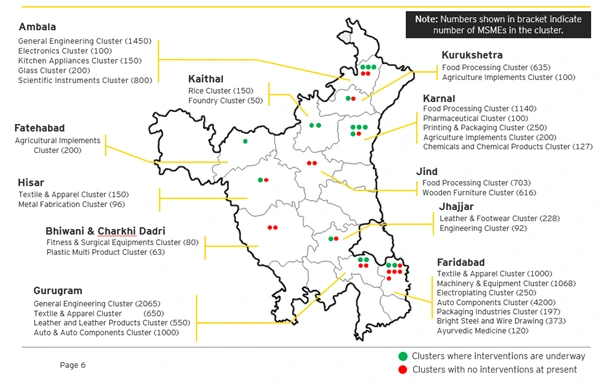
- Rice Cluster – Kaithal
- Bakery Cluster – Karnal
- Textile Cluster – Rai
- Textile Cluster – Faridabad
- Apparel Cluster – Gurugram
- Fastener Cluster – Rohtak
- Sheet Metal – Ambala
- Foundry – Kaithal
- General Engineering – Ambala
- Light Engineering – Gurugram
- Decorative Lighting – Gurugram
Source: Cluster | directorate of MSME, Haryana | India
Why Haryana Attracts Large Manufacturing Investments
- Delhi NCR proximity
- Expressway network
- Freight Corridors
- ICDs
- Airports
- Skilled workforce
- Supplier ecosystem
- Export connectivity
Which Industrial Belt Matches Your Investment Goal?
| Goal | Best Location |
| Lowest Entry Price | Sisana |
| Auto Manufacturing | IMT Kharkhoda |
| Warehousing | Kundli |
| Food Processing | Rai |
| Textile | Panipat |
| Engineering | Faridabad |
| Export Manufacturing | Gurugram |
| Large Factory | Manesar |
Industrial Areas Expected to See Maximum Growth by 2030
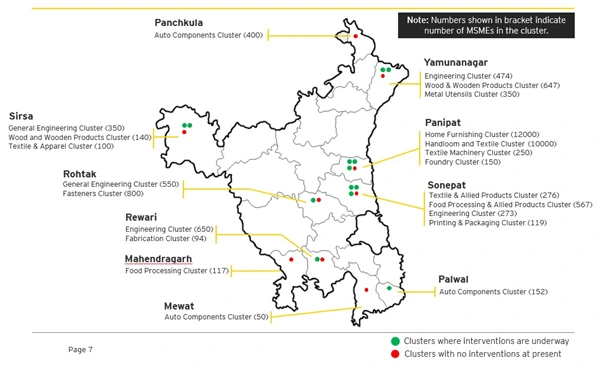
- IMT Kharkhoda
- Sonipat Belt
- Barhana
- Sisana
- New MSME Clusters
- Phase-2 Expansion
- Manufacturing policy
- Cluster development initiatives
Source: Clusters to come up across Haryana to boost industrial growth
Choosing the Right Haryana Industrial Location for Your Business
With this many genuinely different belts, the right choice comes down to matching your specific business against the right region, not picking whichever name is most familiar.
Match Your Industry to Its Natural Cluster
Automotive and component manufacturers generally fit best in Gurugram-Manesar, Rewari-Bawal, or the newer Sonipat belt, all of which already carry auto-sector supply chains. Textile, food, and agro-based businesses fit more naturally around Panipat, Karnal, or Rai’s food-processing base. General or diversified manufacturers often do best in Faridabad, where no single sector dominates the ecosystem.
Match Your Stage and Budget to the Right Belt
If an established ecosystem, existing supplier relationships, and proven infrastructure matter more than price, older estates like Manesar, Faridabad, Kundli, and Rai offer that, generally at a resale premium. If entry cost and ground-floor growth matter more, newer corridors like IMT Kharkhoda and its surrounding private developments offer a different trade-off: lower entry pricing and higher uncertainty, in exchange for genuine early-stage upside.
Not sure which belt actually fits your business? Tell us your industry and budget — we’ll point you in the right direction.
Frequently Asked Questions About Industrial Areas in Haryana
Q1. What are the major industrial areas in Haryana? Haryana’s major industrial belts include Gurugram-Manesar, Faridabad, Rewari-Bawal-Dharuhera, the Panipat-Karnal corridor, and the Sonipat belt, which spans Kundli, Rai, IMT Kharkhoda, Sisana, and Barhana.
Q2. Which is the best industrial area in Haryana? There isn’t one universal answer. Gurugram-Manesar suits large auto manufacturers, Faridabad suits diversified general manufacturing, and the Sonipat belt suits buyers weighing an established base against newer growth.
Q3. What industry is Gurugram-Manesar known for? Automobiles and auto components. It hosts Maruti Suzuki, Honda, and a dense network of global component suppliers built up over decades.
Q4. What makes Faridabad an industrial hub? Faridabad is Haryana’s oldest planned industrial township, built from the late 1940s onward, with a diversified base spanning tractors, auto components, textiles, and light engineering.
Q5. What is Rewari-Bawal known for industrially? Two-wheeler manufacturing and auto ancillaries, including Hero MotoCorp and Harley-Davidson, built on a district with a much older tradition of brass manufacturing.
More Questions on Choosing a Haryana Industrial Location
Q6. Which Haryana industrial areas are newest and still growing? IMT Kharkhoda and the surrounding Sonipat-belt private developments, including Sisana and Barhana, represent the state’s most active current growth corridor, alongside continuing HSIIDC expansion plans.
Q7. Is Sonipat a good location for an industrial plot? Sonipat district offers a genuine mix: established, resale-heavy estates like Kundli and Rai, and newer, lower-entry-cost growth corridors like IMT Kharkhoda, so the answer depends on which stage fits your business.
Q8. What is Panipat’s main industry? Textiles. Panipat is one of India’s largest centres for blankets, carpets, and handloom weaving, and is recognised globally for shoddy yarn production specifically.
Q9. How do I choose the right industrial area in Haryana? Match your industry to its natural cluster first (auto, textile, or general manufacturing), then match your budget and risk appetite to an established estate or a newer growth corridor.
Q10. Which Haryana industrial areas have fresh HSIIDC plots available? Fresh government-allotted plots are increasingly rare in older estates like Manesar, Faridabad, Kundli, and Rai, since most are built out. Newer or expanding zones, including IMT Kharkhoda and its Phase 2 expansion, carry more fresh-plot availability today.
