
Industrial Corridors in Haryana: Routes, Manufacturing Hubs & Investment Impact
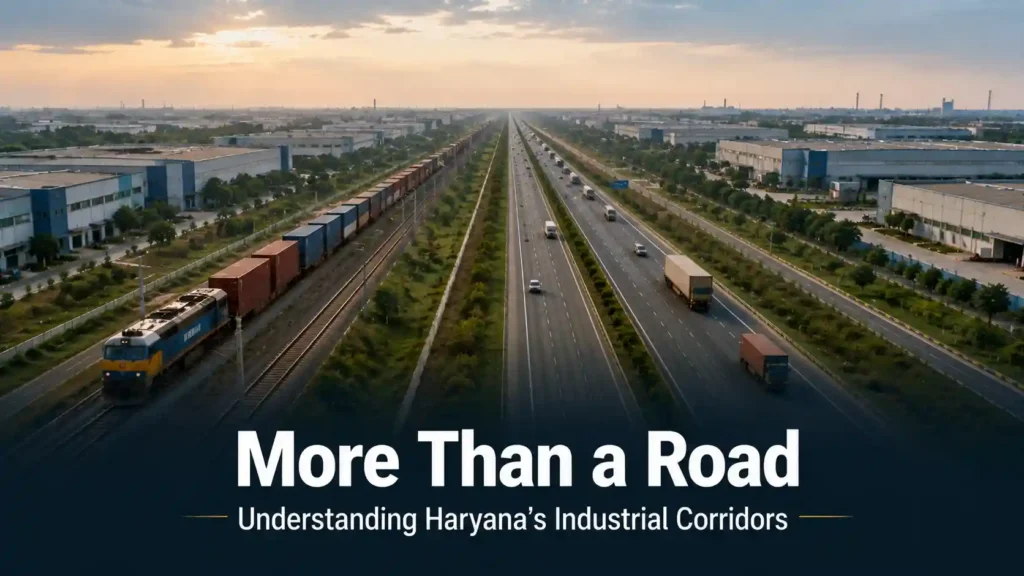
A corridor is not just a road. It’s a planned band of infrastructure, land, and policy designed to pull manufacturing toward it, deliberately, over decades.
Haryana sits inside more of these corridors than almost any other state in India, largely because of where it sits: right next to Delhi, on the path between two of the country’s biggest ports, and along the route of both of India’s dedicated freight rail networks.
This guide explains what these corridors actually are, which ones run through Haryana, and what that connectivity really means when you’re deciding where to put a factory or a warehouse.
Quick Answer: Haryana’s Industrial Corridors, at a Glance
- Haryana sits inside two of India’s 11 national industrial corridors: the Delhi-Mumbai Industrial Corridor, backboned by the Western Dedicated Freight Corridor, and the Amritsar-Kolkata Industrial Corridor, backboned by the Eastern Dedicated Freight Corridor.
- As of March 2026, both of India’s dedicated freight corridors are fully operational end to end, for the first time.
- Hisar hosts Haryana’s designated node on the Amritsar-Kolkata corridor: a nearly 3,000-acre Integrated Manufacturing Cluster, distinct from cities that merely sit within the corridor’s wider influence zone.
- Inside the state, the KMP and Eastern Peripheral Expressways form their own connectivity ring, built specifically to move freight around Delhi rather than through it.
- The under-construction Haryana Orbital Rail Corridor will link directly into the now-complete Western DFC at Prithala, adding a rail-freight option to several industrial belts, including Sonipat’s.
- Sitting inside a corridor’s boundary matters less than sitting close to its actual node or junction point — the two are often confused, and only one changes your real logistics cost.
What Is an Industrial Corridor, and Why Does Haryana Have So Many?
An industrial corridor is a government-planned development band built around a high-capacity transport backbone, usually a dedicated freight rail line or a major expressway, designed to attract manufacturing investment along its length.
India’s national programme currently recognises 11 such corridors, run through the National Industrial Corridor Development Corporation. Two of them touch Haryana directly: the Delhi-Mumbai Industrial Corridor and the Amritsar-Kolkata Industrial Corridor.
Haryana’s position explains why it appears in both. The state sits directly between Delhi and the routes toward Mumbai’s and Kolkata’s ports, so both of India’s major west-facing and east-facing freight corridors pass through or near it.
| Corridor | Backbone | Approx. Length | Haryana’s Role |
| Delhi-Mumbai Industrial Corridor (DMIC) | Western Dedicated Freight Corridor | ~1,500 km | Manesar-Bawal, Faridabad, Rewari, Palwal, and Kundli-Sonipat fall within its zone |
| Amritsar-Kolkata Industrial Corridor (AKIC) | Eastern Dedicated Freight Corridor | ~1,839 km | Hisar hosts Haryana’s designated Integrated Manufacturing Cluster |
The Delhi-Mumbai Industrial Corridor (DMIC) and Haryana’s Role In It
The DMIC runs roughly 1,500 kilometres from Delhi to Mumbai’s Jawaharlal Nehru Port, built around the Western Dedicated Freight Corridor as its transport backbone. It’s a roughly $100 billion project, backed partly by Japanese government loans and investment.
Haryana’s Manesar-Bawal stretch, Faridabad, Rewari, Palwal, and Kundli-Sonipat all sit inside DMIC’s planning zone, a major reason these belts have attracted sustained industrial investment for years.
Sitting inside a corridor’s zone differs from sitting on its literal backbone, though. The Western DFC physically crosses the Delhi-Mumbai Expressway at two specific points inside Haryana, in Gurgaon and Palwal districts, and that literal crossing matters more for actual freight movement than the zone boundary alone.
The Amritsar-Kolkata Industrial Corridor (AKIC) and Haryana’s Hisar Node
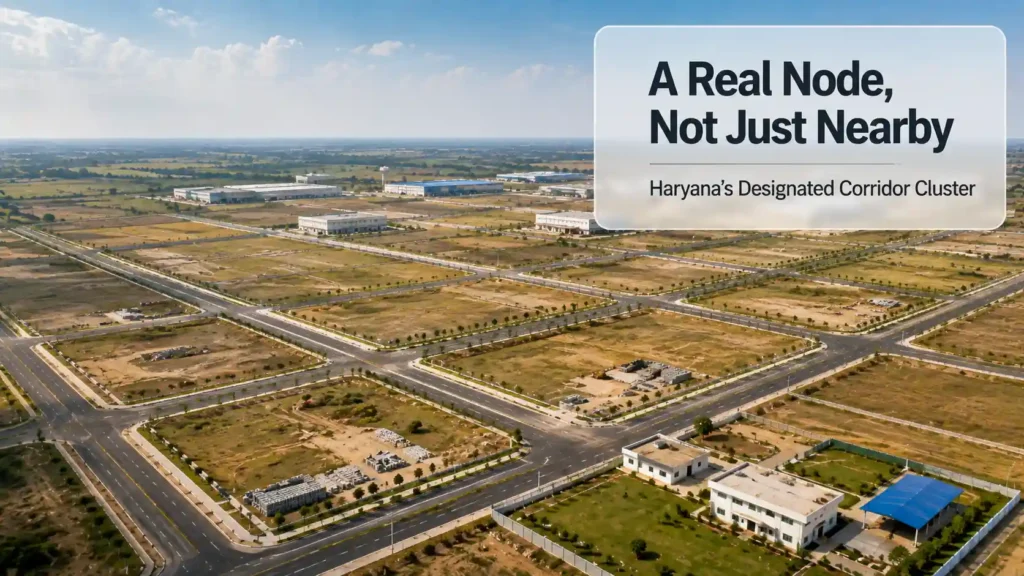
The AKIC runs about 1,839 kilometres from Amritsar to Dankuni, near Kolkata, built around the Eastern Dedicated Freight Corridor. It spans seven states and 20 named cities, including Ambala in Haryana.
Haryana’s actual designated development node on this corridor sits at Hisar: an Integrated Manufacturing Cluster spanning close to 3,000 acres, the largest single node anywhere on the AKIC route. That’s a meaningfully different thing from simply being a city the corridor’s planning zone happens to pass near.
This distinction matters for site selection. A location inside AKIC’s broad, roughly 150-to-200-kilometre-wide influence band, such as Sonipat or Ambala, benefits from the corridor’s general economic pull. A location at Hisar itself benefits from a specific, funded, master-planned cluster built to attract anchor industries directly.
How Haryana’s Expressways Function as Their Own Connectivity Corridor
National freight corridors aren’t the only kind that matter here. Haryana’s own expressway network forms a second, more immediate connectivity layer.
📖 Read This Also: IMT Kharkhoda Map, Layout & Connectivity Guide See exactly where one growing estate sits relative to this expressway ring, toll point by toll point.
The KMP Expressway and its eastern counterpart, the Eastern Peripheral Expressway, together form a ring around Delhi, built specifically to move heavy, inter-state traffic away from the city rather than through it. Delhi’s traffic authorities still actively enforce that diversion today, which makes this ring a genuine freight-routing asset, not just a bypass road.
Rail is catching up to this road network too. The Haryana Orbital Rail Corridor, under construction between Palwal and Sonipat, is designed to connect directly into the Western Dedicated Freight Corridor at Prithala, near Palwal. Since the Western DFC’s full completion in March 2026, that connection now leads into an already-operational, JNPT-to-Dadri freight backbone, not a future promise. For the fuller road, rail, and power picture behind one specific estate on this network, see our Sisana infrastructure guide.
Planning to set up a factory near a major industrial corridor? Compare locations before making your investment.
What Corridor Connectivity Actually Means for Manufacturing and Location Decisions

All of this national and state-level infrastructure eventually reduces to one practical question: does it actually lower your cost or risk of doing business here?
Freight Cost and Modal Choice
A location with genuine rail-freight access, not just road access, gives a manufacturer options. Bulky or high-volume freight often costs less to move by rail over long distances, and having both a functioning expressway and a route into a Dedicated Freight Corridor means you aren’t locked into one mode when fuel prices or road congestion shift the calculation.
Land Value and Growth Timing
Corridor status tends to move land value in a predictable order: first the national corridor designation, then physical construction milestones, then completion, each step typically pushing nearby land prices up. Buying near a corridor before its key infrastructure is finished carries more risk, but also more upside, than buying after completion, once the price has usually already absorbed that certainty.
How to Evaluate a Haryana Location’s Real Corridor Access
Corridor names get used loosely in marketing. Separating a genuine, decision-relevant connection from a passing mention takes a specific set of questions.
Questions That Separate Real Corridor Access from Marketing Claims
Ask exactly which corridor a location sits in, and whether that means the designated node or just the wider influence zone. Ask how far the nearest physical junction, whether road or rail, actually is in drive time, not straight-line distance. Ask whether the specific freight infrastructure being cited is complete and operational, or still under construction. Ask whether the claimed corridor backbone genuinely passes through the district in question, or a neighbouring one.
Where This Leaves Investors
Haryana’s genuine advantage isn’t that it has corridors — most industrial states can claim that now. It’s that Haryana sits inside two national corridors and a state-level expressway ring at the same time, with freight rail now fully operational on both national backbones as of 2026.
RS Group Realty tracks these corridor milestones specifically because they shape where industrial demand concentrates next, not just where it already sits. For a concrete look at how this plays out on the ground at one growing estate, our ROI guide for IMT Kharkhoda plots and our list of companies already operating there show what corridor-driven growth looks like in practice.
Not sure which industrial corridor fits your business? Our experts can help you compare locations based on budget, industry, and logistics requirements.
Frequently Asked Questions About Industrial Corridors in Haryana
Q1. What is an industrial corridor? An industrial corridor is a government-planned development band built around a high-capacity transport backbone, usually a dedicated freight rail line or major expressway, designed to attract manufacturing investment along its length.
Q2. Which national industrial corridors run through Haryana? Two of India’s 11 national corridors touch Haryana: the Delhi-Mumbai Industrial Corridor, backboned by the Western Dedicated Freight Corridor, and the Amritsar-Kolkata Industrial Corridor, backboned by the Eastern Dedicated Freight Corridor.
Q3. Is Haryana’s Dedicated Freight Corridor connectivity actually complete? Yes, as of March 2026. The Eastern Dedicated Freight Corridor was fully operational by October 2023, and the Western Dedicated Freight Corridor reached full end-to-end operation in March 2026.
Q4. What is Haryana’s designated node on the Amritsar-Kolkata Industrial Corridor? Hisar, where an Integrated Manufacturing Cluster spanning close to 3,000 acres makes it the largest single development node anywhere on that corridor’s route.
Q5. Do the KMP and Eastern Peripheral Expressways count as an industrial corridor? They function as one in practice, even though they aren’t part of the national programme. Together they form a ring around Delhi built specifically to move freight around the city rather than through it.
More Questions on Corridor Connectivity and Investment
Q6. How does the Haryana Orbital Rail Corridor connect to national freight networks? It’s designed to link directly into the Western Dedicated Freight Corridor at Prithala, near Palwal, once construction completes, giving several Haryana industrial belts a rail route into a corridor that is now fully operational nationally.
Q7. Does being inside a corridor’s zone guarantee good connectivity? No. A corridor’s influence zone can span 150 to 200 kilometres on either side of its backbone, so a location can sit within that zone without being close to any actual junction or node.
Q8. Why does corridor connectivity affect land value? Because it typically arrives in stages — designation, construction, then completion — each of which tends to push nearby land prices up. Buying earlier in that sequence generally carries more risk and more potential upside.
Q9. How do I check if a location’s corridor claim is genuine? Confirm which specific corridor and node it refers to, check the actual drive time to the nearest real junction, and verify whether the cited infrastructure is complete or still under construction.
Q10. Does corridor access matter more than local highway access? Not necessarily instead of it — the two work together. National corridor status shapes long-term investment and freight-rail options, while local highway and expressway access determines daily, practical logistics.
