
History of Industrial Development in Kharkhoda: From Town to Manufacturing Hub
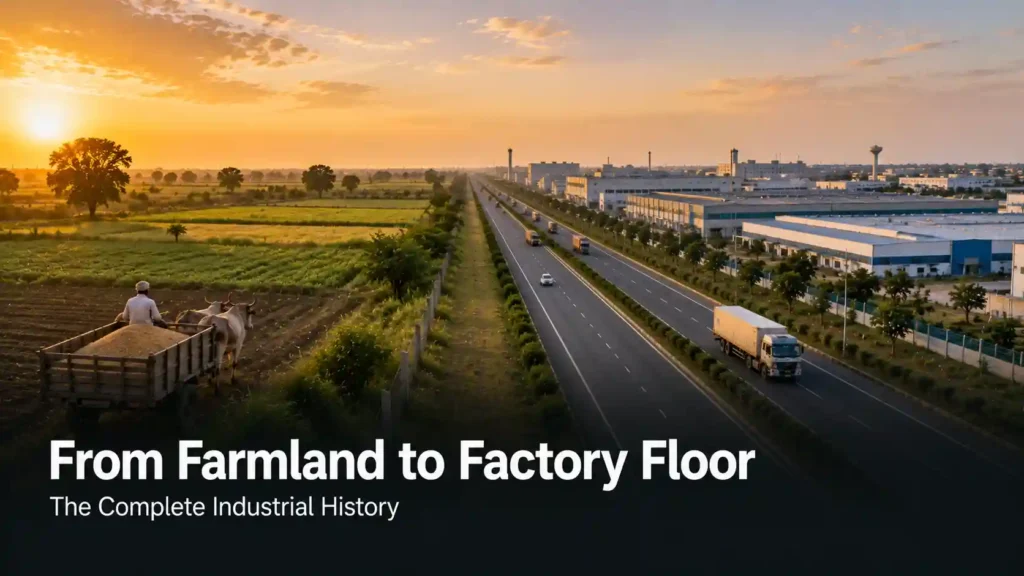
Ten years ago, Kharkhoda was best known for its grain market, not its factories. Today, it hosts one of Asia’s largest car manufacturing plants and a 3,200-acre industrial township. That shift did not happen by accident — it followed a specific sequence of land acquisitions, government decisions, and corporate investments.
This guide traces the industrial development history of Kharkhoda, from its agrarian roots to its current status as a manufacturing hub. It covers the institutions that planned it, the land deals that built it, and the timeline that carried it from a 2013 land acquisition to a fully inaugurated automobile plant in 2026.
Quick Answer: Kharkhoda’s Industrial Development History
- Kharkhoda’s industrial story begins with HSIIDC, the Haryana state agency formed in 1967 to drive industrialisation statewide.
- Formal planning for Industrial Model Township (IMT) Kharkhoda started in 2013, when HSIIDC acquired more than 3,200 acres in Kharkhoda tehsil, Sonipat district.
- The turning point arrived between 2021 and 2022, when the state government allotted 900 acres inside IMT Kharkhoda to Maruti Suzuki and Suzuki Motorcycle India.
- Commercial production began in February 2025, and the plant was formally inaugurated in July 2026, with output reaching 5 lakh vehicles a year and a target of 10 lakh.
- Before all this, Kharkhoda functioned mainly as an agrarian trading town, built around its grain market rather than manufacturing.
What Was Kharkhoda Before It Became an Industrial Hub?
Before industry arrived, Kharkhoda was an agrarian town built around trade, not manufacturing. It sat inside what later became Sonipat district, roughly 19 km from Sonipat town and about 16 miles west of Rohtak.
Sonipat itself only became a full district on 22 December 1972, when it was carved out of Rohtak district. Kharkhoda became one of its constituent blocks, alongside Ganaur, Rai, Gohana, and others nearby. Local trade centred on the town’s grain market, which still operates near Khanda Mod today.
Even the town’s name reflects this earlier economy. Local tradition traces “Kharkhoda” to the word “Kharak,” meaning a cattle stall — a small detail that says a lot about the area’s agricultural character before industrial planning began. So, for most of the 20th century, Kharkhoda remained a modest tehsil headquarters, not an investment destination.
How Did Haryana’s Industrial Push Reach the Kharkhoda Region?
Kharkhoda’s industrial potential traces back to HSIIDC, the state agency Haryana created specifically to build industrial infrastructure. The Haryana government established HSIIDC on 8 March 1967, under the state’s Department of Industries and Commerce.
Over the following decades, HSIIDC built industrial estates across Haryana, including early projects near Gurgaon that eventually grew into hubs like Udyog Vihar. Meanwhile, closer to Kharkhoda, HSIIDC also developed a smaller industrial estate at Kundli, within the same Sonipat district, housing textile, rubber, and footwear units.
This mattered for Kharkhoda specifically because it established the institutional template Haryana would later apply here. HSIIDC already had land-acquisition experience, an infrastructure playbook, and state backing. As a result, when planners began scouting the next major township site, Kharkhoda’s location and available land made it a natural candidate.
When Was IMT Kharkhoda Officially Established?
IMT Kharkhoda was formally planned in 2013, when HSIIDC acquired more than 3,200 acres of land in Kharkhoda tehsil under the state’s land acquisition framework. This acquisition set the boundary for what would become IMT Kharkhoda.
Haryana’s town-planning authorities had already been mapping a broader development blueprint for the wider Kharkhoda area before this point, but the 2013 acquisition is what formally created the industrial estate itself. The site sits bounded by the KMP Expressway to the north and State Highway-18 to the east, on the Delhi-Haryana border near Auchandi.
HSIIDC’s layout eventually divided the site into 2,528 industrial plots, split between general allotment and rehabilitation-and-resettlement categories for the original landowners. The plan allowed for a wide industry mix from the outset — automobiles, food and beverage, metal products, textiles, chemicals, machinery, and footwear among them.
IMT Kharkhoda Map: Location of Haryana’s Industrial Transformation
This map shows the location of IMT Kharkhoda in Sonipat district, its connection to the KMP Expressway, NH-44, State Highway-18, Maruti Suzuki’s manufacturing plant, Sisana industrial belt, and nearby industrial corridors that transformed Kharkhoda from an agricultural town into one of Haryana’s fastest-growing manufacturing hubs.
Kharkhoda’s Industrial Timeline at a Glance
The table below lays out Kharkhoda’s industrial development chronologically, from HSIIDC’s founding to today’s operating plant.
| Year | Milestone |
| 1967 | Haryana government establishes HSIIDC to drive statewide industrialisation |
| 2013 | HSIIDC acquires 3,200+ acres in Kharkhoda tehsil to develop IMT Kharkhoda |
| Nov 2021 | Government allots 900 acres inside IMT Kharkhoda to Maruti Suzuki and Suzuki Motorcycle India |
| Aug 2022 | PM Narendra Modi lays the foundation stone for the plant |
| Feb 2025 | First production line starts commercial output, building the Brezza |
| May 2026 | Second production line begins, adding the Victoris |
| Jul 2026 | Plant formally inaugurated; combined output reaches 5 lakh vehicles a year |
Each milestone built directly on the one before it. Therefore, understanding this sequence matters more than memorising any single date — it explains why Kharkhoda’s growth has accelerated rather than stalled.
Why Did Maruti Suzuki Choose Kharkhoda for Its Newest Plant?
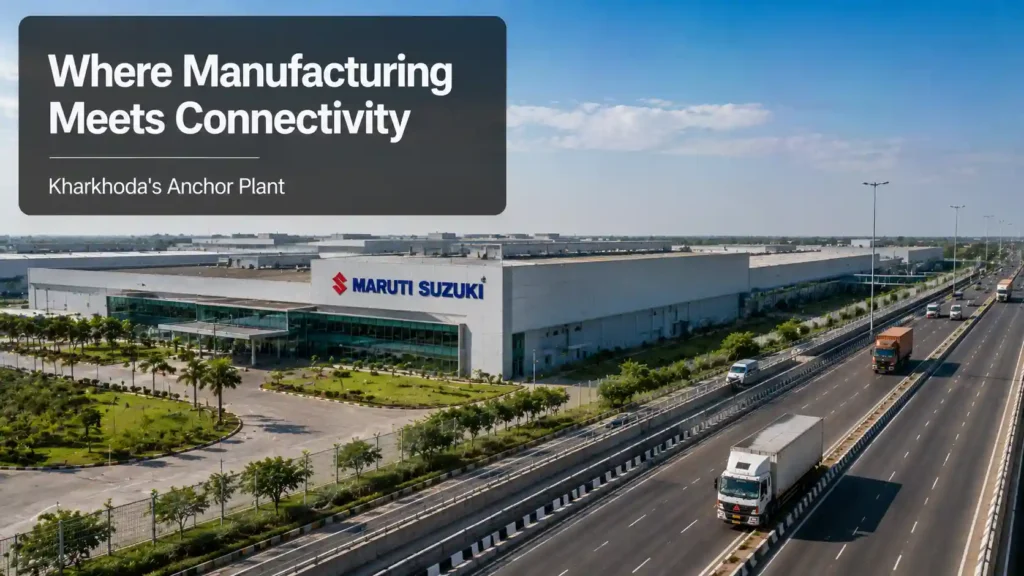
The Maruti Suzuki Kharkhoda plant exists because Kharkhoda extended a manufacturing base the company already knew, along a corridor with direct expressway access. The company’s two earlier Haryana plants, Gurugram (1983) and Manesar (2007), sit on this same broad industrial belt.
Kharkhoda is Maruti Suzuki’s third plant in Haryana and its fourth production site in India overall, counting the Hansalpur facility in Gujarat. Also, the location avoids central Delhi traffic entirely, since the KMP Expressway rings the city’s western side. The plant sits at the expressway’s second toll point from the north, just after Kundli, with NH-44 and the Delhi-Amritsar-Katra Expressway both close by.
This pattern is not new for Haryana, either. Gurugram grew into a major industrial hub largely because Maruti chose it first, back in the 1980s. Manesar then followed a similar path after Maruti expanded there in the 2000s. Haryana officials have pointed to this same history when discussing Kharkhoda’s own prospects.
The Smart Factory Approach
Unlike its older plants, Kharkhoda runs on what Maruti Suzuki calls its Smart Factory model. The plant draws 100% of its power from renewable sources, mixing on-site solar with purchased green power. It also uses cobots — robots that work alongside people rather than replacing them — on parts of the assembly line.
Furthermore, the facility recycles its water fully, operating as a zero-discharge site. Maruti Suzuki is also building a rail siding on-site, so finished vehicles can eventually leave by train instead of relying only on road transport.
📖 Read This Also: Why Invest in IMT Kharkhoda Industrial Plots? ROI Guide Once you see how Kharkhoda’s anchor plant has scaled in phases, the natural next question is what that growth is actually worth to an investor — this guide breaks down the ROI logic in full.
How Is the Supplier Ecosystem Taking Shape Around the Plant?
A plant this size rarely operates alone, and Kharkhoda’s supplier ecosystem is already forming around confirmed, named companies operating in IMT Kharkhoda. UNO Minda has built an alloy-wheel plant on roughly 94 acres near the main site, already up and running.
Separately, Jay Bharat Maruti Limited, a long-time Tier-1 partner to Maruti Suzuki, laid the first stone for its own unit in late 2023. This unit sits inside the plant’s dedicated MSIL Supplier’s Park, covering just over 6.7 acres, and will build body and chassis parts.
Beyond direct auto-component suppliers, HSIIDC has also allotted close to 1,000 smaller plots to MSME-scale manufacturers feeding this same supply chain. In addition, HSIIDC is developing a dedicated 676-acre footwear park inside IMT Kharkhoda, with around 414 plots reserved specifically for footwear manufacturing and trading companies — one of the largest such zones planned anywhere.
HSIIDC’s 2026 Plot Auctions Keep the Momentum Going
HSIIDC has kept allotment activity moving through 2026. A June 2026 e-auction round opened registration from June 1 to June 22, with bidding starting July 2, covering IMT Kharkhoda plots alongside estates like IMT Manesar, Kundli, and Rai.
So far, HSIIDC has allotted 1,083 of the 2,528 total plots carved from the township’s acquired land, according to the corporation’s own project data. That leaves a meaningful share of the township still open through future allotment rounds.
What Does Kharkhoda’s Industrial Ecosystem Look Like Today, and What’s Next?
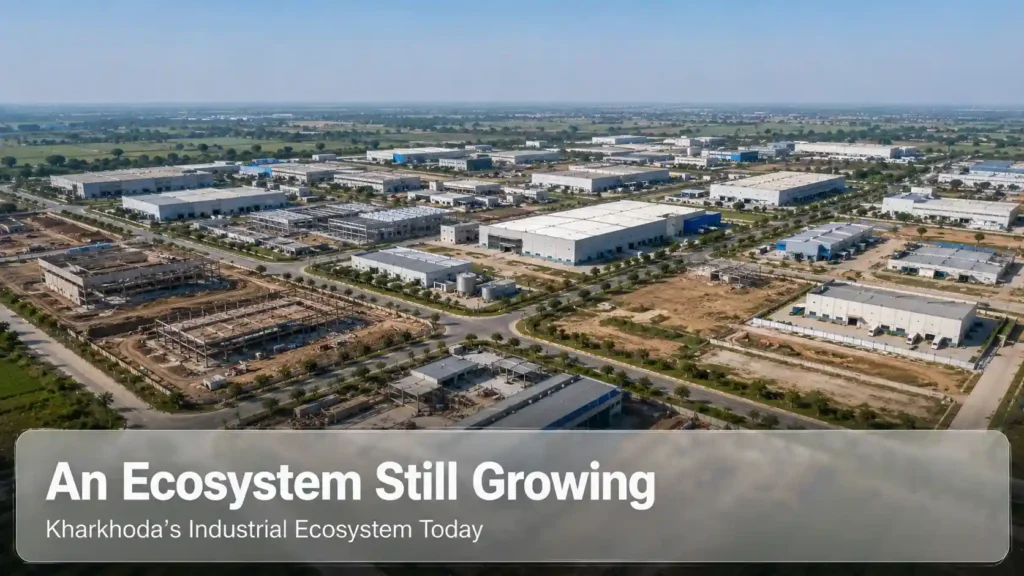
Today, Kharkhoda blends an operating automobile anchor, a forming supplier base, and infrastructure upgrades still underway. At the same time, HSIIDC has already begun laying groundwork for the township’s next phase.
Meanwhile, Suzuki Motorcycle India’s own 100-acre, ₹1,200-crore two-wheeler unit next door is targeted for completion in 2027. Also, the Haryana Orbital Rail Corridor, planned from Palwal to Harsana Kalan, is set to pass close to the plant, adding another logistics layer once complete.
Infrastructure is catching up too. The state highway serving this corridor is being widened from 66 feet to 200 feet, though that work remains under construction. Separately, media reports from late 2025 indicated HSIIDC has begun land-valuation work for a further expansion of roughly 5,800 acres — a sign of continued institutional commitment, even though that expansion sits years from formal plot allotment.
The Land-Price Gap Between Kharkhoda and Mature Hubs
This gradual build-out shows up clearly in land prices. Fresh private plots in the Kharkhoda belt, such as in Sisana, currently start around ₹14,000 per square yard. In IMT Manesar, a hub that followed this same growth pattern decades earlier, land now commonly runs ₹60,000 to ₹80,000 per square yard.
That gap exists mainly because Manesar simply had more years to mature, not because Kharkhoda’s fundamentals are weaker. History suggests gaps like this tend to close gradually, over years of infrastructure delivery and ancillary industry growth, rather than overnight.
RS Group Realty’s Role in the Kharkhoda-Sisana Corridor
RS Group Realty is an industrial land development and real estate consultancy working specifically within the Kharkhoda-Sisana industrial corridor in Haryana. The company focuses on industrial plots in IMT Kharkhoda’s surrounding belt, serving manufacturers, auto-ancillary suppliers, and long-term land investors entering this market.
Because RS Group Realty tracks only this specific corridor, its team follows HSIIDC’s allotment patterns, Maruti Suzuki’s expansion timeline, and village-level land records here on an ongoing basis. That focus is what distinguishes its approach from generalist brokers covering multiple, unrelated micro-markets across Haryana.
Kharkhoda’s industrial development history is still being written. From a grain-trading town to an HSIIDC-planned township to an operating automobile hub with a growing supplier base, each phase has built directly on the last. For investors and business owners tracking this corridor, understanding that sequence is the clearest way to judge where it goes next.
Frequently Asked Questions About Kharkhoda’s Industrial Development History
Q1. When did Kharkhoda’s industrial development history begin? Kharkhoda’s formal industrial development began in 2013, when HSIIDC acquired more than 3,200 acres to plan IMT Kharkhoda. The institutional groundwork traces back further, to 1967, when Haryana created HSIIDC itself.
Q2. Who developed IMT Kharkhoda? The Haryana State Industrial and Infrastructure Development Corporation (HSIIDC), a Haryana government undertaking, planned and developed IMT Kharkhoda. HSIIDC has built industrial estates across the state since 1967.
Q3. What was Kharkhoda like before it became industrial? Before industrialisation, Kharkhoda was an agrarian trading town in Sonipat district, known mainly for its grain market. It functioned as a tehsil headquarters rather than an investment destination.
Q4. Why did Maruti Suzuki choose Kharkhoda for its newest plant? Maruti Suzuki chose Kharkhoda because it extends a manufacturing corridor the company already knew from Gurugram and Manesar, with direct KMP Expressway access that avoids central Delhi traffic entirely.
Q5. When did production start at the Maruti Suzuki Kharkhoda plant? Commercial production began on February 25, 2025, with a single line building the Brezza. A second line followed in May 2026, and the full plant was formally inaugurated in July 2026.
Kharkhoda’s Industrial Growth — What Investors Ask Most
Q6. How big is IMT Kharkhoda today? IMT Kharkhoda spans more than 3,200 acres, divided into 2,528 planned industrial plots. HSIIDC has allotted 1,083 of these so far, leaving a meaningful share still open for future allotment.
Q7. What industries operate in IMT Kharkhoda besides automobiles? Beyond Maruti Suzuki and its suppliers, IMT Kharkhoda hosts a dedicated 676-acre footwear park with around 414 plots, plus food and beverage, metal products, textile, and chemical units under HSIIDC’s original industry mix.
Q8. Is IMT Kharkhoda still expanding? Yes. HSIIDC continues to allot plots through periodic e-auctions, and media reports from late 2025 indicate the corporation has begun land-valuation work for a further expansion of roughly 5,800 acres.
Q9. How does Kharkhoda’s growth compare to Gurugram and Manesar’s industrial history? Kharkhoda is following a similar pattern. Gurugram grew into a major hub after Maruti’s original 1983 plant, and Manesar followed the same path after Maruti expanded there in 2007. Haryana officials have pointed to this same history when discussing Kharkhoda’s trajectory.
Q10. Does Kharkhoda’s industrial history affect land prices in the area? Yes. Fresh private plots in the Kharkhoda belt, including Sisana, currently start around ₹14,000 per square yard — well below the ₹60,000 to ₹80,000 per square yard seen in the more mature IMT Manesar, a gap tied directly to how much longer Manesar has had to develop.
