
Industrial Infrastructure in Haryana: Roads, Rail, Power & Logistics Connectivity
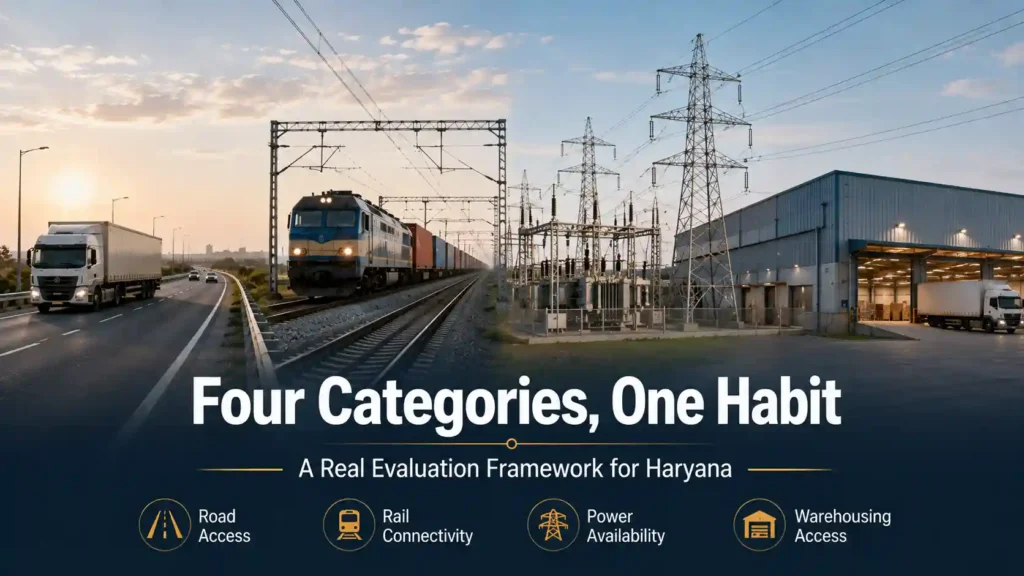
Every industrial brochure claims “excellent connectivity.” Almost none of them tell you what that actually means, or how to check it yourself.
Real infrastructure evaluation comes down to four things: roads, rail, power, and how well those three connect into your actual logistics chain. Each has its own specific checks, and skipping any of them is how buyers end up with a plot that looks connected on paper and isn’t in practice.
This guide walks through all four, with real Haryana examples for each, so you know exactly what to verify before you commit to a location.
Quick Answer: Evaluating Industrial Infrastructure in Haryana
- Road access means checking the actual road class connecting your plot to the nearest highway or expressway, not just distance on a map.
- Rail access matters differently depending on your freight volume: a nearby passenger station isn’t the same as genuine freight-rail capacity.
- Power reliability in Haryana runs through one of two state discoms, UHBVN in the north and DHBVN in the south, and “dedicated feeder” promises still need capacity verification.
- Logistics connectivity is the sum of the first three, not a separate category: a location only works logistically if roads, rail, and power all hold up together.
- Location examples across Sonipat district show how these factors play out differently even within the same district, let alone across the state.
How Industrial Businesses Actually Evaluate Infrastructure
Most infrastructure evaluation mistakes come from taking a brochure’s word for it. The fix is simple: verify each claim against something checkable, not a marketing adjective.
“Excellent road connectivity” should become a specific road name, a toll point, and a drive time. “Reliable power” should become a discom name, a substation, and a confirmed feeder capacity. “Rail-linked” should become a specific station or freight corridor, with an actual distance.
This distinction matters more in Haryana specifically, because the state’s industrial belts vary hugely in infrastructure maturity, from decades-old estates with settled utilities to newer corridors where some of this is still under construction.
Roads: What to Actually Check Beyond “Near a Highway”
Road evaluation starts with the connecting road, not the highway itself. A plot can sit near a major expressway and still be hard to reach if the connecting road is narrow or unpaved.
In Sonipat district, for example, IMT Kharkhoda sits directly against the KMP Expressway, with the estate positioned at a specific toll point along that corridor rather than just generally “near” it. That precision matters: knowing your plot’s actual toll-point position tells you which national highways you can reach without extra local driving, something a general “near KMP” claim doesn’t.
Internal road width matters just as much as the connecting highway. A road wide enough for two heavy trucks to pass without slowing is a meaningfully different asset than a road that forces single-file traffic during loading hours.
Rail Access: When It Matters and How to Verify It
Rail access only matters if your freight profile actually benefits from it. High-volume, bulky, or long-distance freight benefits from rail; smaller, frequent, local shipments usually don’t need it.
The first check is whether “rail access” means a passenger station nearby or genuine freight-rail capacity. These are not the same thing. A location might sit a few kilometres from a passenger station while having no practical freight-rail route at all.
Sonipat district shows this contrast well. Rai Industrial Area has no railway station directly inside it, with the nearest options several kilometres away. Meanwhile, the newer Kharkhoda corridor is being built with a dedicated station on the Haryana Orbital Rail Corridor, designed to connect directly into the national Dedicated Freight Corridor network. Same district, genuinely different rail-freight positions.
📖 Read This Also: Sisana Infrastructure: Roads, Rail & Power Near Kharkhoda See a full, location-specific breakdown of all three physical categories for one growing estate.
Power Supply: The Infrastructure Factor Most Buyers Skip
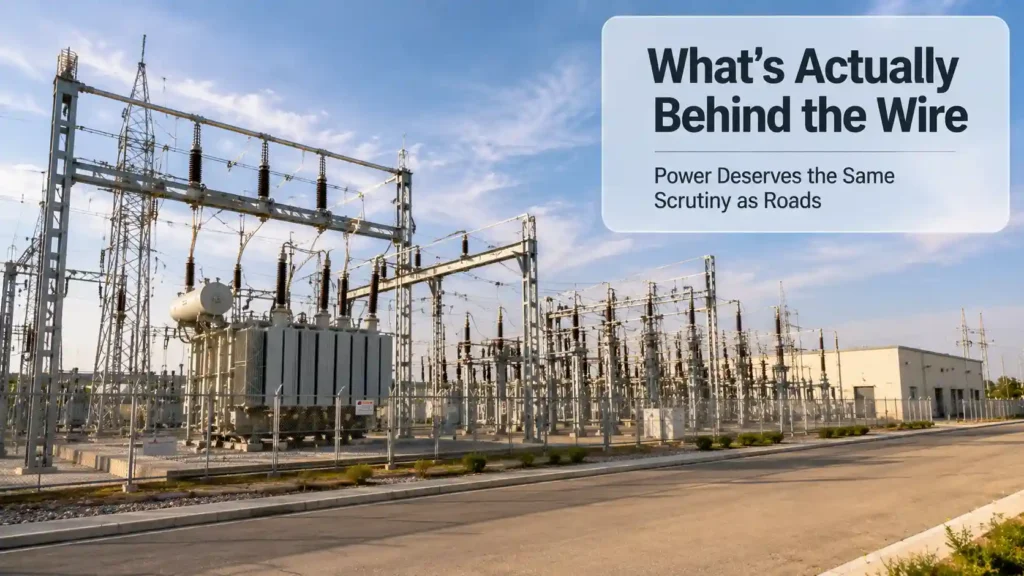
Power gets the least scrutiny of the four categories, and it’s often the one that causes real operational problems later.
Haryana’s power distribution runs through two state-owned discoms: Uttar Haryana Bijli Vitran Nigam, covering northern districts including Sonipat, and Dakshin Haryana Bijli Vitran Nigam, covering southern districts including Gurugram and Faridabad. Knowing which discom serves your specific location is the first real check, since service quality and process can differ between them.
The second check is capacity, not just presence. A “dedicated feeder” promise sounds reassuring, but a recent Haryana regulatory case showed a developer’s dedicated feeder ending up shared across several other projects without full disclosure, years after the original commitment. So, ask for the actual sanctioned load and substation capacity, not just confirmation that a connection exists.
Not sure whether a location has reliable roads, power, and logistics infrastructure? Let our experts help you evaluate it before you invest.
Logistics Connectivity: Putting Roads, Rail and Power Together
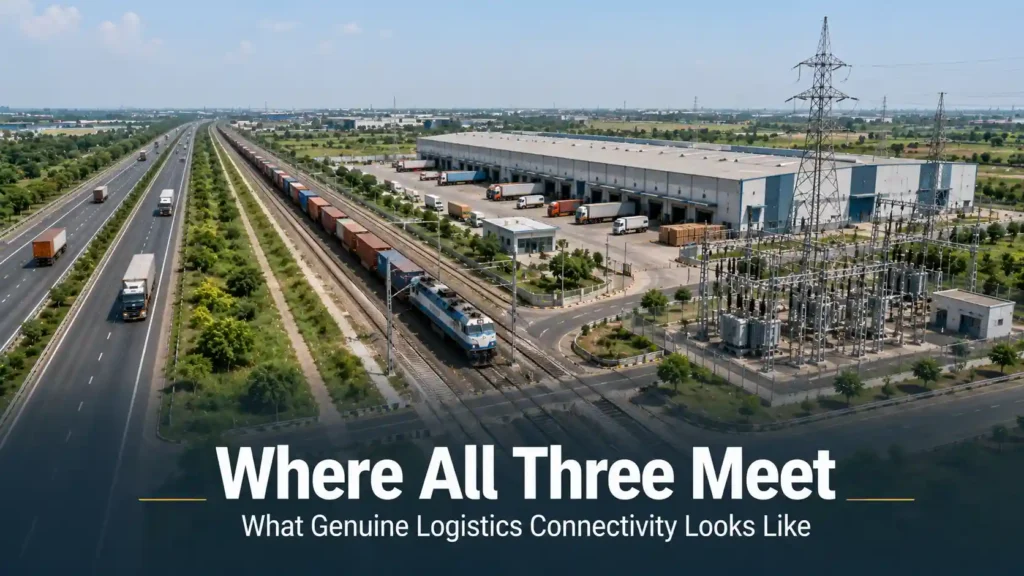
Logistics connectivity isn’t a fourth, separate thing to check. It’s what happens when roads, rail, and power actually work together at one specific plot.
A Worked Example: One Location’s Full Infrastructure Profile
Take the Kharkhoda-Sisana corridor as a working example. Roads: direct KMP Expressway access, plus a state highway currently being widened from 66 to 200 feet. Rail: a dedicated Haryana Orbital Rail Corridor station under construction, linking to the national Dedicated Freight Corridor. Power: confirmed 24-hour supply already active on-site, under UHBVN’s jurisdiction. Put together, that’s a genuine multi-modal logistics position, not just one strong category covering for two weak ones.
Red Flags That Signal Weak Infrastructure
Watch for brochures that mention a highway, a station, and power without a single specific detail attached to any of them. Watch for “upcoming” infrastructure with no funding source or construction timeline named. Watch for a connecting road left undescribed entirely, since that’s usually the weakest link being quietly skipped.
A Practical Infrastructure Evaluation Framework
Bringing all four categories together gives you a repeatable framework, not a one-off checklist for a single plot.
The Four-Category Checklist
Confirm the exact connecting road class and drive time to the nearest highway or expressway toll point. Confirm whether rail access means a passenger station or genuine freight-rail capacity, and how far either actually is. Confirm the serving discom, the substation, and the sanctioned feeder capacity, not just a promise of power. Confirm that all three hold up together at the specific plot, not just somewhere within the broader estate.
Where This Leaves Investors
Infrastructure quality varies enormously even within one district, let alone one state, which is exactly why generic claims don’t hold up to scrutiny. The estates that verify well against all four categories tend to be the ones worth paying attention to.
For the full infrastructure picture behind one specific, currently-developing corridor, our IMT Kharkhoda map and layout guide covers the road network in detail, and our ROI guide for IMT Kharkhoda plots ties this infrastructure case to the investment argument directly.
Compare industrial locations based on infrastructure quality, logistics connectivity, and investment potential before making your final decision.
Frequently Asked Questions About Industrial Infrastructure in Haryana
Q1. How do industrial businesses evaluate infrastructure before buying a plot? By checking specifics, not brochure language: the actual connecting road class, whether rail access means a passenger station or real freight capacity, the serving power discom and sanctioned capacity, and whether all three genuinely work together at the specific plot.
Q2. What should I check about road access beyond “near a highway”? Check the connecting road’s actual class and width, and your plot’s specific position relative to the nearest highway or expressway toll point, not just straight-line distance.
Q3. Does rail access always matter for an industrial plot? Only if your freight profile benefits from it. High-volume or long-distance freight benefits most; smaller, frequent, local shipments often don’t need rail access at all.
Q4. Which power distribution company serves my Haryana location? It depends on the district. Uttar Haryana Bijli Vitran Nigam (UHBVN) covers northern districts including Sonipat, while Dakshin Haryana Bijli Vitran Nigam (DHBVN) covers southern districts including Gurugram and Faridabad.
Q5. Is a “dedicated feeder” promise enough to confirm reliable power? Not on its own. Ask for the actual sanctioned load and substation capacity, since dedicated feeders have been shared beyond their original commitment in past cases.
More Questions on Evaluating Haryana Industrial Infrastructure
Q6. What’s the difference between a passenger station and real freight-rail access? A passenger station handles people, not necessarily bulk freight. Genuine freight-rail access means a route built or designated for freight movement, ideally connecting to a Dedicated Freight Corridor.
Q7. What are common red flags in infrastructure claims? Vague mentions of a highway, station, or power without specific names or distances attached; “upcoming” infrastructure with no funding or timeline; and connecting roads left undescribed entirely.
Q8. Is infrastructure quality consistent across a single district in Haryana? No. Sonipat district alone contains estates with very different infrastructure maturity, from decades-old areas with settled utilities to newer corridors still completing their build-out.
Q9. Why does logistics connectivity depend on roads, rail and power together? Because a location with strong roads but weak power, or strong rail but poor connecting roads, still creates a real operational bottleneck. Logistics strength only exists where all three hold up simultaneously.
Q10. What’s the simplest way to verify an infrastructure claim myself? Ask for a specific name, distance, or capacity figure behind every claim, and treat anything that stays vague as unverified until you can check it directly.
