
What is IMT Kharkhoda? Industrial Area Overview, Location & Growth Potential
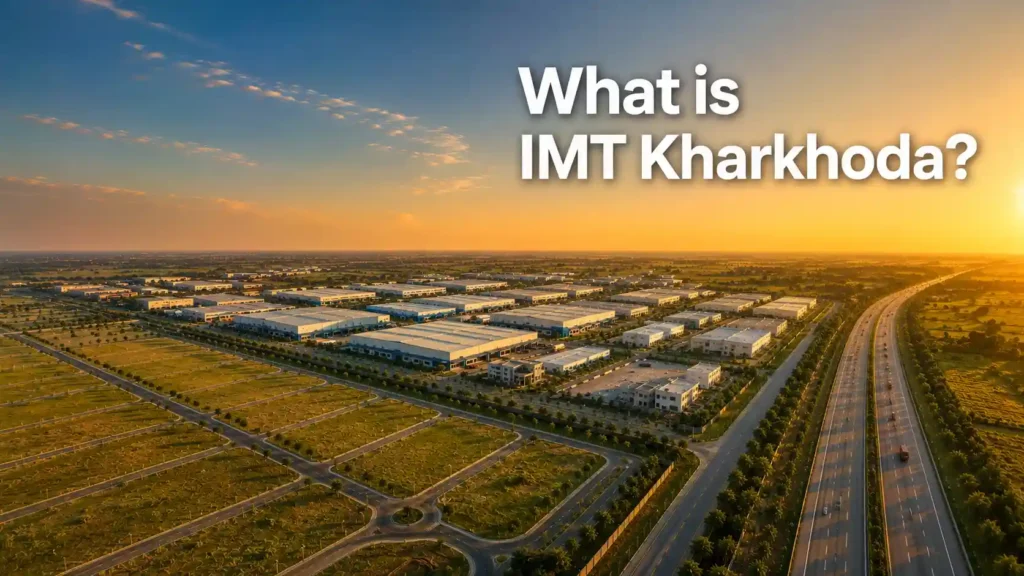
Industrial investors across Delhi NCR keep asking the same question: what is IMT Kharkhoda, and why does everyone suddenly want land here? The answer lies in one word — Maruti Suzuki. But the full story goes deeper than a single carmaker’s plant.
This guide breaks down what IMT Kharkhoda actually is, where it sits, who it suits, and why its growth potential matters for anyone evaluating industrial real estate near Sonipat, Haryana.
What is IMT Kharkhoda? A Quick Snapshot
IMT Kharkhoda stands for Industrial Model Township, Kharkhoda. It is a state-developed industrial estate located in Kharkhoda tehsil, Sonipat district, Haryana. The Haryana State Industrial and Infrastructure Development Corporation (HSIIDC) planned and developed it.
Despite the word “township” in its name, IMT Kharkhoda is not a residential project. It is zoned specifically for industrial and manufacturing use, under HSIIDC’s Industrial Model Township scheme — the same category used for HSIIDC’s other estates across Haryana. The only residential element inside the boundary is a small set of rehabilitation-and-resettlement (R&R) plots reserved for the original landowners whose land HSIIDC acquired, not open-market residential inventory. So, if a search result mentions a “residential township” or a named residential project alongside Kharkhoda’s name, it very likely refers to a separate, unrelated development nearby, not to IMT Kharkhoda itself.
HSIIDC itself is not a new player. The Haryana government set it up in 1967 to drive industrialisation across the state. Since then, it has built several industrial townships, and IMT Kharkhoda is one of its largest. IMT Kharkhoda is one of several Industrial Model Townships HSIIDC operates across Haryana, alongside others such as IMT Manesar, IMT Rohtak, IMT Faridabad, and IMT Bawal — each serving a different industrial corridor in the state.
The project was planned in 2013. HSIIDC acquired more than 3,200 acres of land for it. The final layout carves out over 2,500 industrial plots, split across general allotment and rehabilitation-and-resettlement (R&R) categories for the original landowners.
So why build it here? Kharkhoda sits close to Delhi, yet land here costs far less than inside the capital. As a result, HSIIDC designed the township to host a wide mix of industries — automobiles, food and beverage, metal products, textiles, chemicals, machinery, and footwear, among others. Each unit must still secure its own environmental clearance before starting operations.
In short, IMT Kharkhoda is a planned, government-backed industrial zone built specifically to pull large-scale manufacturing away from congested Delhi and into a more efficient, purpose-built location.
Location and Connectivity of IMT Kharkhoda
Location decides almost everything in industrial real estate. Therefore, understanding where IMT Kharkhoda sits matters more than any other single fact about it.
The township sits right on the Delhi-Haryana border, near Auchandi border. It is bounded by the Kundli-Manesar-Palwal Expressway (KMP Expressway) on the north and State Highway-18 on the east. This is not a minor road. The KMP Expressway is also called the Western Peripheral Expressway, and it forms a 135-km ring around Delhi’s western side.
Because of this, vehicles can move between Kundli, Kharkhoda, Bahadurgarh, Manesar, and Palwal without ever entering Delhi’s city traffic. For an industrial unit, that means faster movement of raw materials and finished goods, lower fuel cost per trip, and fewer delays during peak hours.
According to HSIIDC’s own project data, IMT Kharkhoda sits about 18 km from National Highway-44 (the Delhi-Amritsar highway), about 18 km from Sonepat Railway Station, and roughly 65 km from Delhi’s Indira Gandhi International Airport. Meanwhile, the upcoming Delhi-Amritsar-Katra Expressway also begins on this same corridor, which will add yet another high-speed route once fully operational. For postal and GPS purposes, IMT Kharkhoda falls under PIN code 131402, in Kharkhoda tehsil, Sonipat district.
This combination — expressway access, highway proximity, rail connectivity, and airport reach — explains why large manufacturers keep choosing this stretch of Sonipat over more congested industrial belts closer to Delhi.
IMT Kharkhoda Location Map
Explore the exact location of IMT Kharkhoda and its connectivity to Delhi, KMP Expressway, NH-44, and the upcoming Delhi-Amritsar-Katra Expressway.
The Maruti Suzuki Effect: Why Kharkhoda’s Industrial Profile Is Changing
No conversation about IMT Kharkhoda is complete without Maruti Suzuki. India’s largest passenger-vehicle maker chose this township for its newest manufacturing base, and that single decision has reshaped the entire local market.
Maruti secured roughly 900 acres inside IMT Kharkhoda — about 800 acres for its own plant and 100 acres for Suzuki’s two-wheeler unit. Prime Minister Narendra Modi laid the foundation stone in August 2022. The first phase began commercial production in February 2025, rolling out the Brezza as its debut model, with an initial capacity of 2.5 lakh vehicles a year.
Since then, growth has moved faster than the original timeline suggested. A second line went live on May 18, 2026, adding the Victoris and taking Kharkhoda’s own output to 5 lakh vehicles a year. Maruti Suzuki formally inaugurated the full facility on July 2, 2026, and has confirmed plans to keep scaling toward 10 lakh vehicles a year, on a total investment of ₹35,000 crore across all phases. For the complete production timeline and supplier details, see RS Group Realty’s dedicated Maruti Suzuki Kharkhoda plant profile.
This matters for investors because of what happens next. A plant of this size cannot run alone. It needs auto-component suppliers, packaging units, logistics partners, and third-party warehousing nearby. Auto-parts major Minda has already set up units inside IMT Kharkhoda, and HSIIDC has separately allotted close to 1,000 smaller plots to MSME-scale manufacturers feeding this supply chain.
This pattern is not new. Similar ancillary growth followed Maruti’s earlier plants in Manesar and Gurugram. As those hubs matured, demand for nearby industrial land rose steadily for years. Kharkhoda appears to be following the same trajectory, just at an earlier stage.
Who Should Consider Investing in IMT Kharkhoda?
Not every investor fits every location. So, who actually benefits from this specific industrial belt?
- Auto-ancillary manufacturers gain the most obvious advantage, given direct proximity to Maruti’s expanding production lines.
- Logistics and 3PL operators benefit from KMP Expressway access, which shortens delivery routes across the NCR.
- MSME and factory owners can find smaller, more affordable plot sizes than in saturated hubs like Manesar or Gurugram.
- Warehouse buyers can serve last-mile distribution into Delhi without paying Delhi-level land prices.
- Long-term land investors and HNIs can position early in a corridor that is still in its growth phase rather than its mature phase.
- Commercial property investors can track how residential and support-service demand typically follows industrial employment growth.
In other words, the right fit depends less on budget alone and more on how directly your business model connects to manufacturing, logistics, or the workforce this growth will bring.
Government Plots vs Private Industrial Land Near IMT Kharkhoda
Once an investor decides Kharkhoda is the right belt, the next question is usually: how do I actually buy in?
There are two distinct routes here, and confusing them causes most buyer mistakes.
Route 1: HSIIDC government-allotted plots inside IMT Kharkhoda. These come through a formal allotment process, governed by HSIIDC’s own rules, rates, and eligibility criteria. Because demand is high and allotment is process-driven, waiting periods can run long, and availability depends entirely on HSIIDC’s release schedule.
Route 2: Private freehold industrial land in surrounding villages within the same industrial belt, such as Sisana. Sisana sits inside Kharkhoda tehsil, only minutes from the Maruti Suzuki complex, yet it falls outside HSIIDC’s direct allotment system. As a result, transactions here move faster, and titles are typically clear and freehold from the outset.
This is precisely why our own project, industrial plots in IMT Kharkhoda, focuses on the Sisana micro-location — it gives investors a practical, faster entry point into the same growth corridor without joining a government waiting list. You can explore the Sisana location page for site-specific details.
Neither route is automatically “better.” Government plots suit buyers who can wait and want HSIIDC’s direct backing. Private freehold land suits buyers who want speed, flexibility, and a clear title without the allotment queue.
Future Growth Potential of the Kharkhoda Industrial Belt
Infrastructure Projects Shaping the Next Few Years
Several projects are converging on this corridor at once. The KMP Expressway is already fully operational. The Delhi-Amritsar-Katra Expressway is under construction along the same alignment, which will eventually shorten travel times to Punjab and beyond. Meanwhile, Maruti’s third-phase plant is on track for 2029, and HSIIDC continues to release additional plots — including a dedicated footwear park — to widen the industrial base beyond automobiles alone.
Long-Term Investment Outlook
History offers a useful guide here, even though it never guarantees the future. In Manesar and Gurugram, land near anchor manufacturing plants typically saw gradual, sustained appreciation as ancillary industries, housing, and services matured around them — a process that played out over several years, not months. Broader Sonipat real estate has also shown steady year-on-year price growth as infrastructure and industrial activity expanded.
Kharkhoda appears to be entering that same growth curve. However, any serious investor should treat this as a multi-year thesis tied to infrastructure delivery timelines, not a short-term speculation play. Due diligence — title verification, zoning confirmation, and realistic timeline expectations — remains essential regardless of how strong the growth story looks.
Why Work With RS Group Realty in the Kharkhoda Belt
RS Group Realty works specifically within the Kharkhoda-Sisana industrial corridor, not across every micro-market in Haryana. That focus matters. It means our team tracks HSIIDC’s allotment patterns, Maruti’s expansion timeline, and village-level land records in this exact belt on an ongoing basis.
For investors, that translates into clearer guidance on which route — government allotment or private freehold land — actually fits their timeline and goals, plus practical support through site visits, documentation, and title checks before any commitment is made.
If you are evaluating industrial land in this corridor, our IMT Kharkhoda industrial plots page is the right next step to explore current availability.
Frequently Asked Questions About IMT Kharkhoda
Q1. What does IMT stand for in IMT Kharkhoda? IMT stands for Industrial Model Township. It refers to a planned industrial estate developed by a state industrial corporation — in this case, HSIIDC in Haryana.
Q2. Where is IMT Kharkhoda located? IMT Kharkhoda is located in Kharkhoda tehsil, Sonipat district, Haryana, right along the Kundli-Manesar-Palwal (KMP) Expressway near the Delhi border.
Q3. Who developed IMT Kharkhoda? The Haryana State Industrial and Infrastructure Development Corporation (HSIIDC), a Haryana government undertaking established in 1967, planned and developed IMT Kharkhoda.
Q4. Is Maruti Suzuki’s plant located in IMT Kharkhoda? Yes. Maruti Suzuki secured around 900 acres inside IMT Kharkhoda for its newest manufacturing hub, with production already underway and further expansion approved through 2029.
Q5. What is the difference between IMT Kharkhoda and Sisana industrial plots? IMT Kharkhoda refers to HSIIDC’s government-allotted industrial plots, while Sisana offers private freehold industrial land in the same belt, just minutes from the Maruti plant, without the government allotment process.
Q6. How far is IMT Kharkhoda from Delhi? IMT Kharkhoda sits on the Delhi-Haryana border itself, with Delhi’s IGI Airport roughly 65 km away by road via the KMP Expressway and connecting highways.
Q7. What kind of industries can set up in IMT Kharkhoda? HSIIDC’s plan allows for a wide mix, including automobiles and auto-ancillaries, food and beverage, metal products, textiles, chemicals, machinery, and footwear manufacturing.
Q8. Is IMT Kharkhoda a good investment for small investors? It depends on entry route and timeline. MSME-scale plots and private freehold land in nearby villages like Sisana generally offer a more accessible entry point than larger government-allotted parcels.
Q9. What is the size of plots available in IMT Kharkhoda? HSIIDC’s layout includes plot sizes starting from around 450 square metres and going up to several thousand square metres, depending on the allotment category.
Q10. Is IMT Kharkhoda part of Sonipat or Delhi? IMT Kharkhoda falls administratively under Sonipat district, Haryana, even though it sits immediately adjacent to the Delhi border.
Q11. What is the PIN code of IMT Kharkhoda? IMT Kharkhoda falls under PIN code 131402, in Kharkhoda tehsil, Sonipat district, Haryana.
Q12. Is IMT Kharkhoda a residential township? No. Despite “township” in its name, IMT Kharkhoda is zoned for industrial and manufacturing use under HSIIDC’s Industrial Model Township scheme. The only residential element inside its boundary is a small set of rehabilitation-and-resettlement (R&R) plots for the original landowners, not open-market residential property.
