
Industrial Plot Registration Process in Haryana: Steps, Documents & Buyer Checklist

Most buyers think of “registration” as one event: a single day at the Sub-Registrar’s office where you sign and it’s done. In practice, it’s the final stage of a longer journey, and for HSIIDC-origin plots specifically, there’s an entire extra stage most buyers don’t see coming.
This guide walks through that full journey, from preparation through to what happens after you leave the registration office. Government fees mentioned here are current as of this guide’s research and sourced accordingly, but stamp duty and registration charges are set by state notification and do change, so always confirm the exact current rate before you budget around it.
Think of this as the roadmap for the conversation you’ll have with your lawyer or deed writer, not a substitute for their advice on your specific transaction.
Quick Answer: The Industrial Plot Registration Journey in Haryana
- The general path runs: document and title preparation, deed drafting, stamp duty payment, a registration appointment at the Sub-Registrar’s office, execution, and post-registration mutation.
- HSIIDC-origin plots add a mandatory extra stage before any sale deed can be registered: written transfer permission from HSIIDC itself.
- Stamp duty in Haryana is commonly reported around 7% for male buyers and 5% for female buyers in urban areas, though rates vary by location and are set by state notification, so confirm the current figure before finalising your budget.
- Registration fees are separately charged, commonly cited at 1% of property value with a cap around ₹50,000, a figure that has stayed consistent across the sources reviewed for this guide.
- Registration itself doesn’t complete the process. Mutation, the step that updates Haryana’s revenue records, still needs to follow afterward.
The General Registration Journey, Start to Finish
Registration is the last visible step in a longer sequence, not a standalone event. Here’s the general order most Haryana industrial land purchases follow.
- Preparation and title review — confirming ownership, checking mutation status, and reviewing the documents relevant to your plot’s specific category.
- Deed drafting — preparing the sale deed itself, often using standard formats available through Haryana’s official property registration portal.
- Stamp duty calculation and payment — paying the applicable duty online through Haryana’s e-GRAS portal before registration can proceed.
- Booking a registration appointment — scheduling a slot at the relevant Sub-Registrar’s office.
- Execution at the Sub-Registrar’s office — both parties appear, documents and identity are verified, and the deed is formally registered.
- Post-registration mutation — updating the Jamabandi to reflect the new ownership, a separate step from registration itself.
Each stage depends on the one before it, which is why skipping ahead, or assuming registration alone completes the transfer, causes most of the delays buyers run into.
Before You Register: Preparation and Document Review
Registration day goes smoothly only if the groundwork is already solid. This stage is where most of the real risk in a transaction gets caught, or missed.
At minimum, confirm the seller’s title is clean, mutation on any prior transfer is current rather than pending, and there are no outstanding dues or disputes attached to the plot. The exact documents this involves differ meaningfully between HSIIDC-allotted land and private freehold land, which is worth treating as its own dedicated review rather than rushing through at this stage.
The Extra Step for HSIIDC-Origin Plots: Transfer Permission First

If your plot was originally allotted by HSIIDC, whether you’re buying directly from an existing allottee or further down a resale chain, registration cannot legally proceed until HSIIDC itself grants written transfer permission.
This means submitting an application to HSIIDC, typically including the original letter of allotment, an agreement to sell, and a statement of the buyer’s financing, before a sale deed can even be drafted. Only once HSIIDC’s written permission is in hand does the standard registration process, stamp duty and all, actually begin. Buyers who skip this step, or assume a private agreement to sell is enough on its own, risk a registration that can’t legally be completed later.
Private freehold land, by contrast, generally moves straight into standard registration once title and land-use status are confirmed, without this additional government approval stage.
Buying an industrial plot and want to understand the registration requirements?
Stamp Duty, Registration Fees and How They’re Calculated
Two separate government charges apply at registration, and they’re calculated differently.
Stamp duty is commonly reported around 7% of property value for male buyers and 5% for female buyers in Haryana’s urban areas, with somewhat lower rates typically applying in rural areas, and it’s calculated against whichever is higher: the declared transaction value or the local circle rate. Registration fees are charged separately, commonly cited at 1% of the property’s value, capped at roughly ₹50,000 regardless of how high the transaction value runs.
These figures are current as of this guide’s research and consistent across multiple sources, but Haryana’s stamp duty and registration rates are set by state notification and are explicitly subject to revision. Confirm the exact current rate through Haryana’s e-GRAS portal or your Sub-Registrar’s office before finalising your budget, particularly if you’re planning the purchase months in advance.
📖 Read This Also: IMT Kharkhoda Plot Rates 2026 — Full Price Breakdown See current government-versus-private pricing, so you know what these percentage-based charges would actually apply to.
What Happens at the Sub-Registrar’s Office
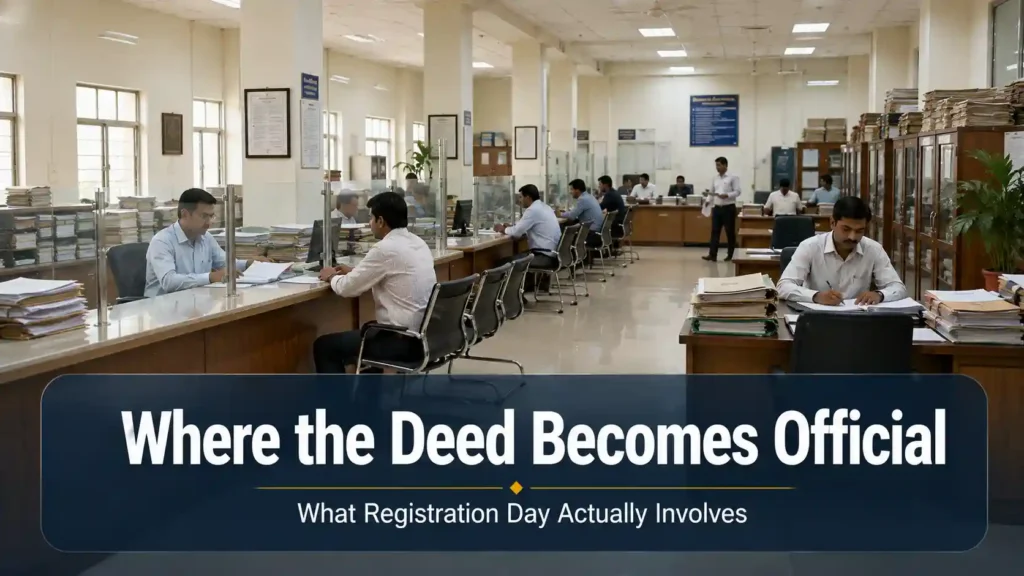
Registration day itself follows a fairly fixed procedure, though the exact experience can vary slightly by office.
Documents and Parties Required on Registration Day
Both buyer and seller, or their authorised representatives if using a power of attorney, typically need to appear in person, along with identity proof, the drafted sale deed, proof of stamp duty payment, and, for entities rather than individuals, authorization documents confirming who can sign on the organisation’s behalf. Witnesses are generally required as well.
What You Receive After Registration
Once the deed is executed and registered, you receive the registered sale deed itself, which serves as your primary legal proof of the transaction. This document is what you’ll need for the mutation process that follows, and for any future resale, financing, or dispute.
After Registration: Why Mutation Still Matters
Registration transfers the legal transaction record. It does not, on its own, update Haryana’s revenue records, which is a separate step buyers sometimes skip or delay.
A Step-by-Step Recap Checklist
Confirm title and mutation status before you begin. Secure HSIIDC’s written transfer permission first, if the plot is HSIIDC-origin. Draft the sale deed and pay stamp duty through the official portal. Book and attend your Sub-Registrar appointment with all required parties and documents. File for mutation immediately after registration, rather than assuming it happens automatically.
Where This Leaves Buyers
The registration process itself is procedural once the groundwork is solid, but that groundwork, title verification, HSIIDC permission where applicable, and accurate current fee figures, is where transactions actually succeed or stall.
If you’re working through this process for a specific plot, our current IMT Kharkhoda industrial plots page is a starting point for project-specific questions, alongside your own lawyer’s guidance on the transaction itself.
Evaluating a specific industrial plot? Get the project and registration details before you proceed.
Frequently Asked Questions About Industrial Plot Registration in Haryana
Q1. What is the general process for registering industrial plot purchases in Haryana? Broadly: title and document preparation, deed drafting, stamp duty payment through e-GRAS, a Sub-Registrar appointment, execution, and post-registration mutation to update the Jamabandi.
Q2. Is there an extra step for HSIIDC-allotted industrial plots? Yes. HSIIDC must grant written transfer permission before a sale deed can be registered, based on an application including the original letter of allotment and an agreement to sell.
Q3. What is the current stamp duty for industrial property in Haryana? Commonly reported figures run around 7% for male buyers and 5% for female buyers in urban areas, though rates are set by state notification and can change, so confirm the current figure before budgeting.
Q4. How much is the registration fee, separate from stamp duty? Commonly cited at 1% of the property’s value, capped at roughly ₹50,000 regardless of transaction size, based on the sources reviewed for this guide.
Q5. Does registration alone complete the ownership transfer? No. Mutation, the separate process of updating Haryana’s Jamabandi revenue record, still needs to follow registration before the change is reflected there.
More Questions on the Haryana Registration Process
Q6. Who needs to be present at the Sub-Registrar’s office for registration? Typically both buyer and seller, or their authorised representatives, along with identity proof, the drafted deed, stamp duty payment proof, and witnesses.
Q7. Can I register a private freehold industrial plot the same way as an HSIIDC plot? The core Sub-Registrar process is similar, but private freehold land generally doesn’t require the additional HSIIDC transfer-permission stage that government-allotted plots do.
Q8. Where do I pay stamp duty in Haryana? Commonly through the state’s e-GRAS portal online, or via physical stamp papers, depending on the transaction and local process.
Q9. What should I do immediately after registration? File for mutation to update the Jamabandi, since registration and mutation are separate steps and the second doesn’t happen automatically.
Q10. Are the fees mentioned in guides like this one guaranteed to be current? No. Stamp duty and registration charges are set by state notification and can change. Always verify the current figure with Haryana’s official portal or your Sub-Registrar’s office before finalising a transaction.
