
How to Verify Industrial Land Before Buying: Site & Document Due Diligence Guide
Most guidance on buying industrial land tells you what to check. Very little explains how to actually verify it, in what order, or when a document alone isn’t enough and a physical site visit matters more. That gap is where real risk hides.
This guide is a general educational framework, not personalized legal advice. It’s built to help you understand the verification process and ask the right questions of your own lawyer, broker, or advisor, not to replace them for your specific transaction.
Quick Answer: How to Verify Industrial Land Before Buying
- Start with ownership review — the complete title chain and encumbrance status — since a legally clean plot is the foundation everything else depends on.
- Confirm permitted use next, including Change of Land Use (CLU) status and pollution-category fit, before assuming the plot suits your business.
- Verify physical access and site conditions in person, since documents alone won’t reveal encroachment, boundary issues, or a road that’s narrower than it looks on paper.
- Independently confirm infrastructure claims like power and water directly with the relevant utility, rather than relying on a seller’s description.
- Apply a separate set of transaction-stage checks, including agreement terms and registration process, right up to the point of purchase.
How Should You Approach Industrial Land Verification?
Industrial land verification works best as a sequence, not a scattered list of checks done in whatever order feels convenient. Document-stage verification should generally come first, since a plot with unresolved ownership issues isn’t worth physically inspecting yet.
Once documents pass an initial review, physical site verification and infrastructure confirmation come next. Only after both of those hold up should you move into transaction-stage checks, since that’s when real capital starts moving.
This sequencing matters because each stage protects the next. Skipping ahead, for example inspecting a site before confirming clean title, risks investing time and money in a plot that fails at an earlier, more fundamental stage.
How Do You Verify Ownership Before Buying Industrial Land?
Ownership verification starts with the complete title chain, not just the current seller’s documents. Request records for every past transfer, and confirm each one is properly registered and consistent with the next.
Alongside the title chain, obtain an encumbrance certificate covering a sufficiently long period, which shows whether the property carries any registered loans, mortgages, or legal claims. Cross-check this against relevant revenue records, since discrepancies between the two are a genuine warning sign worth investigating before proceeding.
For plots originally allotted by a government body, also verify whether any dues remain outstanding, since unresolved dues can sometimes carry forward to a new owner even after a sale.
How Do You Confirm Permitted Use for an Industrial Plot?
Permitted use verification confirms the plot can legally support your specific business activity, not just industrial activity in general. Start with the estate’s or plot’s zoning classification, and compare it directly against your intended use.
If the land was originally agricultural, confirm Change of Land Use (CLU) approval is complete and reflected in official records, not simply promised or described as “in process.” An incomplete CLU can leave a plot’s industrial status legally vulnerable.
Also confirm the pollution-category classification that applies to your specific process. A plot cleared for light assembly may not be cleared for processes involving plating, painting, or heavier chemical use, regardless of what a broker suggests informally.
Evaluating an industrial plot? Get the key details before you move ahead.
What Should You Check About Physical Access During a Site Visit?
Physical access needs verification in person, because maps and brochures routinely overstate real-world usability. Walk the actual access road yourself, and assess whether its width genuinely supports the vehicles your business will use daily, not just passenger cars.
Confirm the route trucks would realistically take from the nearest highway, including any weight or size restrictions along the way. Where access depends on a shared or easement road rather than a direct public road, verify that right of access is documented, not assumed.
📖 Read This Also: Industrial Plot Buying Checklist in India: 15 Things to Verify Before Purchase This guide explains the reasoning and sequencing behind verification; the companion checklist turns it into a 15-point, downloadable resource you can carry into an actual site visit.
What Site Conditions Should You Inspect in Person?
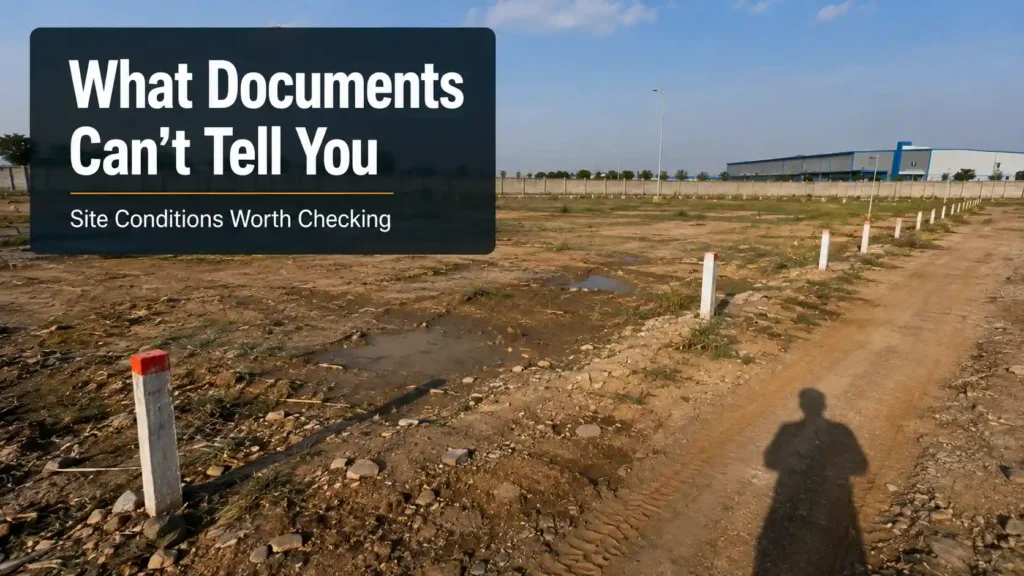
Site conditions are almost impossible to verify from documents alone, which is why an in-person inspection matters even when the paperwork looks clean. Check the physical boundary markers against the plot’s documented dimensions, since discrepancies here are more common than buyers expect.
Look specifically for signs of encroachment, whether from a neighbouring plot or informal use of unallotted land nearby. Also assess ground-level conditions like drainage and soil stability, since these can materially affect construction cost even on a plot with otherwise clean documentation.
Where possible, visit at different times, since a site’s condition, access, and even nearby activity can look different on a weekday morning versus other times.
How Do You Verify Infrastructure Claims Before Buying?
Infrastructure claims deserve independent verification, not just trust in what a seller or broker describes. For power, confirm actual sanctioned load and connection status directly with the relevant electricity provider, rather than relying on an estate-wide figure that may not apply to your specific plot.
For water and drainage, confirm actual provisioned capacity, especially if your process involves washing, cooling, or effluent generation, since these needs vary significantly by business type. Where a common effluent treatment facility is cited as available, confirm your plot is actually connected to it, not simply located within the estate that has one.
What Transaction-Stage Checks Protect You During Purchase?
Transaction-stage checks apply once you’ve decided to proceed, and they matter as much as the checks that came before. Review the agreement to sell carefully, confirming that payment milestones are tied to verified deliverables, such as confirmed clear title, rather than to dates alone.
Confirm the registration process itself, including which authority’s approval or no-objection certificate is required before final transfer, since requirements vary depending on how the plot was originally allotted. Finally, keep independent records of every payment and communication throughout the transaction, since this documentation matters if a dispute arises later.
When Should You Involve a Lawyer or Professional?
A qualified lawyer or property professional should review your specific transaction before you commit funds, regardless of how thoroughly you’ve worked through this framework yourself. This guide explains what to verify and why; it isn’t a substitute for advice tailored to your specific plot, seller, and state.
Involve a professional especially early if the title chain is long, if CLU status is unclear, or if the transaction involves a government-allotted plot with its own specific transfer rules. The cost of proper legal review is almost always smaller than the cost of an issue discovered after purchase.
RS Group Realty’s Role in Buyer Education
RS Group Realty built this framework from the same standard the company applies to verifying its own projects, including Sisana near IMT Kharkhoda, before offering them to buyers. That standard is what this guide is meant to make transparent, not proprietary.
For a buyer working through this process on a specific plot, RS Group Realty can walk through how a project like Sisana holds up against each stage of this framework directly, as one example of what a verifiable plot actually looks like in practice.
Ready to verify a specific industrial plot? Let’s help you review the key details.
Verifying industrial land properly takes real time, and that time is well spent. Working through ownership, permitted use, physical access, site conditions, infrastructure, and transaction checks, in that order, and involving a qualified professional at the right moment, is the clearest way to avoid the mistakes that only become visible after the transaction is complete.
Frequently Asked Questions About Verifying Industrial Land
Q1. How do I verify industrial land ownership? Request the complete title chain across every past transfer, obtain an encumbrance certificate, and cross-check both against relevant revenue records rather than relying on the current seller’s documents alone.
Q2. What documents prove permitted use of industrial land? The plot’s zoning classification, Change of Land Use (CLU) approval where applicable, and its pollution-category clearance together confirm whether your specific business activity is legally permitted.
Q3. How do I check for encroachment on industrial land? Visit the site in person and compare physical boundary markers against the plot’s documented dimensions, checking specifically for informal use of the land by neighbouring plots or unrelated parties.
Q4. How do I verify infrastructure claims before buying? Confirm actual power load and connection status directly with the relevant electricity provider, and confirm water, drainage, or effluent capacity independently rather than relying on a seller’s or broker’s description.
Q5. What should I check during a site visit specifically? Access road width and condition, boundary markers, signs of encroachment, drainage and ground conditions, and, where possible, the site at more than one time of day.
Common Questions About This Framework
Q6. What are transaction-stage checks? These are the checks that apply once you’ve decided to proceed, including reviewing the agreement to sell, confirming the required registration and approval process, and keeping independent records of payments and communication.
Q7. Is this due diligence guide legal advice? No. This is general educational guidance to help you understand the verification process; it isn’t a substitute for advice from a qualified lawyer or professional on your specific transaction.
Q8. When should I involve a lawyer? As early as possible, and especially when the title chain is long, CLU status is unclear, or the plot was originally allotted by a government body with its own transfer rules.
Q9. What order should these checks be done in? Document-stage verification, particularly ownership, should come first, followed by physical site and infrastructure verification, with transaction-stage checks applied last, right up to purchase.
Q10. Does RS Group Realty verify its own plots this way? Yes. RS Group Realty applies this same framework to its own projects, including Sisana near IMT Kharkhoda, before offering them to buyers.
