
Industrial Plot Buying Checklist in India: 15 Things to Verify Before Purchase
Most industrial plot buying mistakes don’t happen at the negotiation table. They happen earlier, when a buyer skips a verification step because a plot looked good on a brochure or during a quick site visit. By the time the mistake surfaces, capital is already committed.
This checklist covers the 15 things worth verifying before you commit to any industrial plot in India, organised into five categories: land use, ownership documents, access, infrastructure, and business suitability. A free, downloadable version is available further down this page, built to actually carry with you on a site visit.
Quick Answer: The Industrial Plot Buying Checklist, Summarised
- Land use and zoning: confirm the plot’s permitted category, CLU status, and pollution-category fit for your specific process.
- Ownership and legal documents: verify the full title chain, confirm no pending litigation or encumbrance, and check for dues owed to the developing authority.
- Access and connectivity: confirm real road width for your vehicles, actual peak-hour drive times, and proximity to your specific supply chain.
- Infrastructure and utilities: verify actual power load, water and effluent provisions, and a realistic possession timeline.
- Business suitability and cost: match plot size to your operational footprint, verify price against official benchmarks, and calculate total cost, not just the quoted rate.
Land Use and Zoning: What to Verify First
Land use and zoning come first because a mismatch here can block everything else, even after you’ve already paid. Before anything else, confirm the plot’s permitted category actually matches your intended activity.
1. Confirm the permitted land-use category. Industrial estates typically zone plots for specific categories — general manufacturing, warehousing, or heavier processing — and a mismatch can delay or block your setup entirely.
2. Verify Change of Land Use (CLU) status. If the land was originally agricultural, confirm CLU approval is complete and on record, not just promised or “in process.”
3. Check the pollution-category fit for your process. Processes like plating, painting, or forging fall under stricter environmental categories than simple assembly or packaging, and the plot’s designation needs to match your actual operation.
Ownership and Legal Documents: The Non-Negotiables
Ownership verification is the category buyers most often under-invest in, usually because it feels like a formality rather than a real risk. It isn’t.
4. Verify the complete ownership chain. Check every past transfer, not just the current seller’s paperwork, especially for resale plots where the chain can run several owners deep.
5. Confirm clear title with no pending disputes. Rule out litigation, encumbrance, or unresolved claims through a proper legal search, not just the seller’s assurance.
6. Check for dues pending with the developing authority. Government-developed estates can carry unpaid dues tied to a specific plot, which can transfer to a new owner if not cleared before purchase.
Access and Connectivity: Beyond the Map Distance
Access looks straightforward on a map and often isn’t in practice. Real-world connectivity depends on details a distance figure alone won’t show you.
7. Confirm actual road width for your vehicles. A plot suited to car traffic isn’t automatically suited to container trucks or trailers — check the real, drivable road width, not just its presence on a map.
8. Verify peak-hour drive times, not just distance. A plot 20 minutes away on paper can take significantly longer during real traffic conditions, particularly near dense urban borders.
9. Check proximity to your specific supply chain. Generic “close to the highway” claims matter less than genuine proximity to your actual suppliers, customers, or anchor industry.
Infrastructure and Utilities: What the Plot Actually Has
Infrastructure claims are often described at the estate level, not the individual plot level, and that distinction matters more than it first appears.
10. Verify actual available power load. Confirm real available capacity against your equipment’s actual draw, not a general estate-wide figure that may not apply to your specific plot.
11. Check water supply and effluent provisions. Processes involving washing, coating, or treatment need dedicated water and effluent-handling capacity, which isn’t automatic on every plot.
12. Confirm a realistic possession timeline. Match the actual, realistic handover date against your own launch goals, since a delayed possession directly delays revenue.
📖 Read This Also: Best Industrial Plots in Kharkhoda for Manufacturers, Warehouses & Logistics Businesses For a deeper look at how these infrastructure factors play out on real, specific plots, this guide walks through site selection for a live industrial corridor in detail.
Business Suitability and Cost: Making the Numbers Work
The final category ties everything back to whether the plot actually makes financial and operational sense for your specific business, not just whether it passes legal and physical checks.
13. Match plot size and shape to your operational footprint. A plot that fits your budget but not your actual layout, including future expansion room, often costs more to correct later than to get right at purchase.
14. Verify price against official benchmarks. Cross-check any asking price against the relevant state’s official collector rate or equivalent benchmark, rather than relying on the listed figure alone.
15. Calculate total cost, not just the plot rate. Stamp duty, registration charges, and legal or documentation fees add materially to the quoted plot price, and skipping this step distorts your actual budget.
Planning to Buy an Industrial Plot?
Share your location, plot size and business requirement, and we’ll help you identify the key checks before you proceed.
Download the Complete 15-Point Checklist
This 15-point checklist is available as a free, downloadable PDF, formatted to print or carry on your phone during an actual site visit. It covers the same five categories above, with space to mark each item as verified.
Use it as a working document, not a one-time read. Bring it to every site visit, and don’t skip a category just because a plot looks strong on the ones you’ve already checked.
How to Use This Checklist During a Site Visit
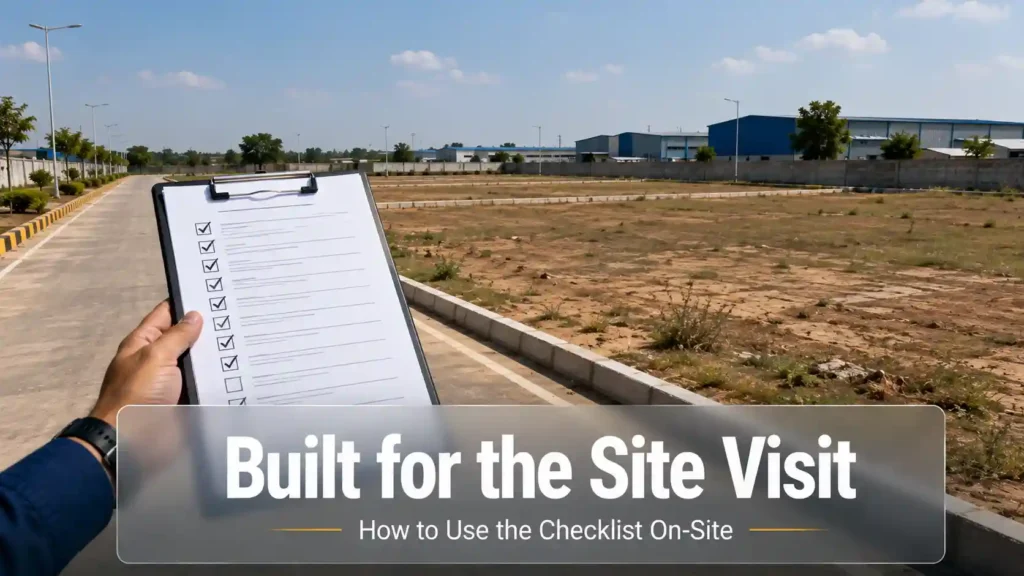
Work through the checklist in order, since each category builds on the last — a legally clean plot with the wrong zoning is still the wrong plot. Bring copies of any documentation you already have, so you can cross-check claims on the spot rather than taking them on trust.
Where you can’t verify an item directly during the visit, note it explicitly and follow up before making any payment. A checklist only protects you if every item gets a genuine answer, not a placeholder.
RS Group Realty’s Role in Industrial Plot Due Diligence
RS Group Realty built this checklist from the same due-diligence standard the company applies to its own projects in Sisana and Barhana. Both are structured to hold up against every category above, from clear title to verified infrastructure.
For a buyer ready to apply this checklist to a specific plot, RS Group Realty can walk through Sisana’s or Barhana’s documentation directly, or offer an honest read on a plot elsewhere, since the checklist matters more than any single project it’s applied to.
Buying an industrial plot rewards patience at the verification stage far more than speed. Working through all five categories above, methodically, is the clearest way to avoid the mistakes that only become visible after the money has already changed hands.
Need Help Evaluating a Specific Industrial Plot?
Share the location and basic plot details, and we’ll help you understand what should be verified before you commit.
Frequently Asked Questions About Buying an Industrial Plot
Q1. What documents should I check before buying industrial land? Verify the complete title chain, confirm no pending litigation or encumbrance, and check for any dues owed to the developing authority, alongside land-use and CLU documentation where applicable.
Q2. How do I verify industrial plot ownership? Check every past transfer in the ownership chain, not just the current seller’s documents, and confirm clear title through a proper legal search rather than relying on assurances alone.
Q3. What is a title chain, and why does it matter? A title chain is the full history of ownership transfers for a plot. A gap or dispute anywhere in that chain can affect your own ownership rights later, even if your immediate purchase paperwork looks clean.
Q4. How do I know if a plot’s power supply is enough for my business? Verify the actual available power load at the specific plot against your equipment’s real draw, since infrastructure claims are often described at the estate level rather than per plot.
Q5. What is CLU, and why does it matter for industrial land? CLU (Change of Land Use) is the official approval converting agricultural land to a different permitted use. Without complete CLU approval on record, a plot’s industrial use may not be legally valid.
Common Questions About This Checklist
Q6. How do I verify a fair price for industrial land? Cross-check the asking price against the relevant state’s official collector rate or equivalent government benchmark, rather than relying on the listed or negotiated figure alone.
Q7. What mistakes do first-time industrial plot buyers make most often? Skipping full ownership-chain verification and underestimating total cost beyond the quoted plot rate are two of the most common, and most expensive, mistakes.
Q8. Can I use this checklist for any state in India? Yes. The 15 points cover universal due-diligence principles; only the specific documentation names and authorities (such as the applicable land records portal) vary by state.
Q9. Is this checklist download free? Yes. The full 15-point checklist is available as a free PDF download, formatted for use during an actual site visit.
Q10. Does RS Group Realty help with plot verification beyond its own projects? RS Group Realty applies this same due-diligence standard to its own projects in Sisana and Barhana, and can offer an honest read on the process for a plot elsewhere as well.
