
Sonipat Industrial Development Guide: IMT Kharkhoda, Rai, Kundli & Emerging Areas
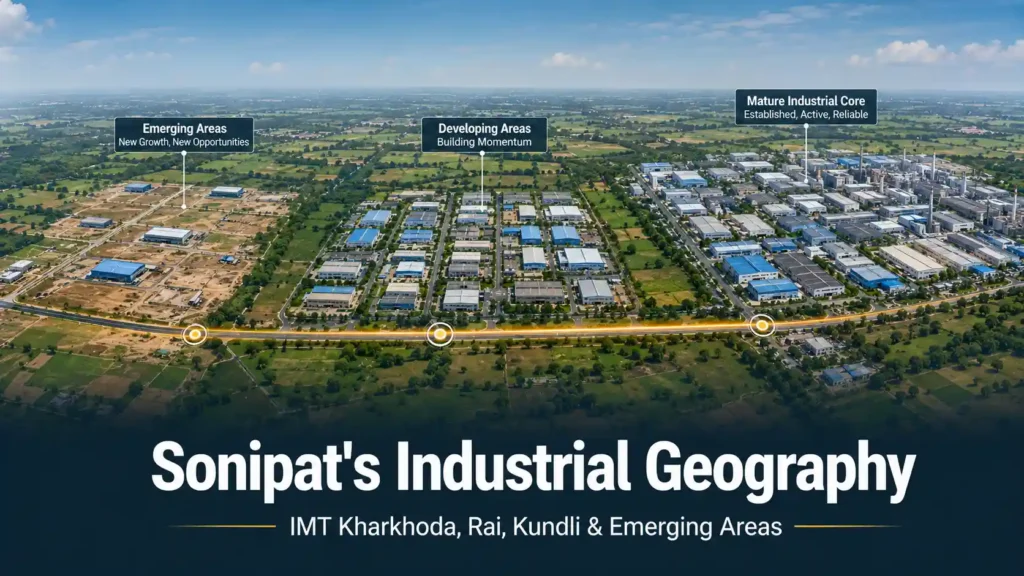
Sonipat district isn’t one industrial market — it’s four distinct ones, each at a different stage of maturity. IMT Kharkhoda and Sisana form a fast-growing corridor, Rai runs as an established manufacturing base, Kundli operates as Delhi’s industrial gateway, and new areas keep entering the pipeline behind them.
This guide explains how these pieces fit together, what role each one plays, and how they compare directly on price, maturity, and fit. Whether you’re new to Sonipat’s industrial geography or already comparing specific zones, this is the map to start from.
Quick Answer: Sonipat’s Industrial Geography
- IMT Kharkhoda and its adjoining Sisana belt form Sonipat’s newest, fastest-growing industrial corridor, anchored by Maruti Suzuki’s expanding plant.
- Rai Industrial Area is Sonipat’s established manufacturing base, home to close to 800 firms and a dedicated Food Park zone, though mostly resale-driven now.
- Kundli functions as Sonipat’s Delhi-border industrial gateway, the district’s oldest and most built-out zone, at the highest price point of the three.
- Together, these three zones sit along a clear maturity gradient — Sisana newest and cheapest, Rai established, Kundli most mature and closest to Delhi.
- Emerging activity, including IMT Kharkhoda’s reported land expansion and continued HSIIDC allotment rounds, is extending this corridor further.
What Makes Sonipat District Haryana’s Industrial Corridor?
Sonipat district functions as one of Haryana’s core industrial corridors because it sits directly between Delhi and the rest of the state, along the NH-44 and KMP Expressway spine. That position has shaped every major industrial zone within it.
HSIIDC has developed multiple estates across the district over different decades, from Kundli’s older, Delhi-adjacent development to IMT Kharkhoda’s much more recent, larger-scale township. As a result, Sonipat doesn’t have one uniform industrial identity; it has several, layered by when each zone was built and how close it sits to Delhi.
Understanding this layering matters practically. A buyer comparing “Sonipat industrial land” without knowing which specific zone they’re looking at is really comparing very different products, at very different price points and maturity stages.
IMT Kharkhoda and Sisana: Sonipat’s Newest Growth Corridor
IMT Kharkhoda and its adjoining Sisana belt form Sonipat’s newest and fastest-growing industrial zone, anchored directly by Maruti Suzuki’s expanding plant. IMT Kharkhoda itself was formally planned in 2013, when HSIIDC acquired more than 3,200 acres to build the township.
That plant now produces 5 lakh vehicles a year and is scaling toward 10 lakh, pulling in confirmed suppliers and a growing MSME base around it. Sisana, the private freehold belt adjoining IMT Kharkhoda, offers fresh plots from around ₹14,000 per square yard, well below Sonipat’s more established zones.
This corridor’s defining feature is that most of its growth story is still ahead of it, not behind it, unlike the district’s older estates.
Rai Industrial Area: Sonipat’s Established Manufacturing Base
Rai Industrial Area functions as Sonipat’s established manufacturing base, built by HSIIDC decades before IMT Kharkhoda existed. Rai Industrial Area hosts close to 800 operating firms today, spanning food processing, auto components, rubber, and metal fabrication.
Its clearest anchor is a dedicated Food Park zone, drawing food-processing and agro-based businesses specifically. However, because HSIIDC allotted most of Rai’s original land years ago, current buyers mostly work through resale plots or built-up units rather than fresh government allotment.
Rai’s role in Sonipat’s geography is straightforward: it offers an immediately operational ecosystem, at a resale premium, for buyers who value that over ground-floor growth potential.
Kundli: Sonipat’s Delhi-Border Industrial Gateway
Kundli functions as Sonipat’s Delhi-border industrial gateway, the district’s oldest and most built-out zone. HSIIDC developed it in phases across more than 560 acres, and it now holds well over a hundred running firms.
Its defining advantage is proximity: Kundli sits right on the Delhi-Haryana border, close to Narela, giving it some of the shortest links to North Delhi anywhere in the district. That proximity, however, comes with a real trade-off, since roads near the border see heavy daily traffic and frequent congestion.
Like Rai, Kundli’s open land is largely gone, so most current transactions run through resale, typically at Sonipat’s highest price point.
Sonipat’s Industrial Locations Compared
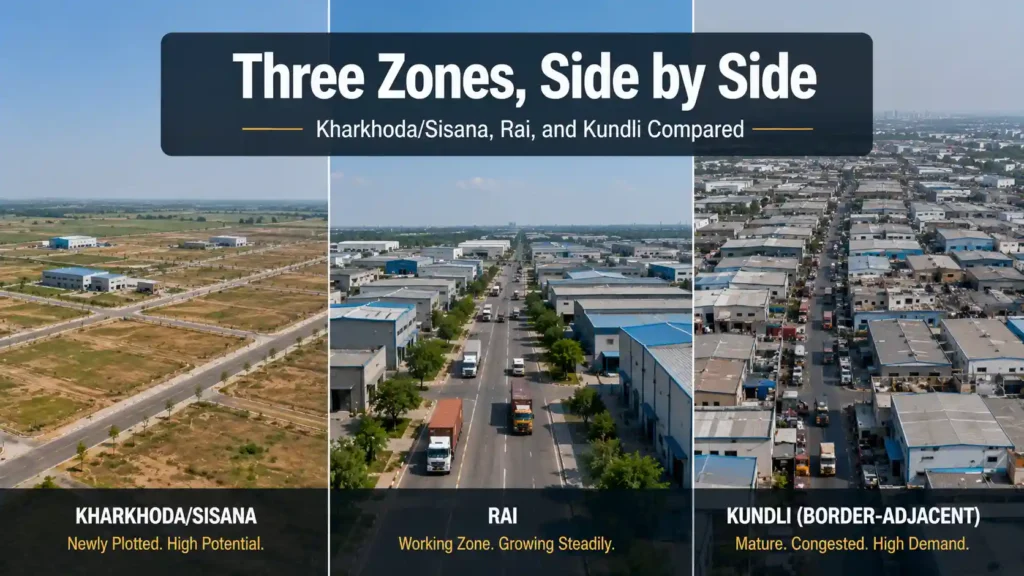
The table below places Sonipat’s three established zones side by side against price, maturity, and best fit.
| Zone | Stage | Starting Price | Managed By | Best Fit For |
| IMT Kharkhoda / Sisana | New, high-growth corridor | ₹14,000 per sq yard (Sisana, fresh) | HSIIDC (IMT) / private developer (Sisana) | Auto-ancillary manufacturers, growth-focused investors |
| Rai Industrial Area | Established, resale-dominated | ₹16,000+ per sq yard (resale) | HSIIDC (original allotment); mostly private resale now | Food processing, immediate operators |
| Kundli | Most mature, Delhi-border | Often ₹28,000–₹50,000+ per sq yard (resale) | HSIIDC (original allotment); mostly private resale now | Buyers prioritising fastest Delhi access, established ecosystem |
Looking for Industrial Land in Sonipat?
Tell us your preferred location, plot size and budget, and we’ll help you identify the most suitable industrial zone.
📖 Read This Also: Sisana vs Kundli Industrial Area: Which Is Better? For a full head-to-head breakdown between Sonipat’s newest and oldest zones specifically, this comparison covers pricing, connectivity, and growth potential in detail.
What’s Emerging Next in Sonipat’s Industrial Geography?
Sonipat’s industrial footprint keeps extending beyond its three established zones. IMT Kharkhoda itself has reportedly begun land-valuation work for a further expansion of roughly 5,800 acres, according to media reports from late 2025, signalling continued institutional commitment well beyond the original 3,200-acre township.
HSIIDC also continues to allot plots across the district through periodic e-auctions, including rounds covering IMT Kharkhoda, Rai, and Kundli together, keeping fresh allotment activity moving even in the district’s more established zones. Separately, Sonipat’s own broader town-planning framework continues to designate land for future industrial use as the district’s population and infrastructure grow.
So, while Kharkhoda, Rai, and Kundli define Sonipat’s industrial geography today, none of them represent a finished picture — each is still evolving, just at different speeds.
Which Part of Sonipat Fits Your Investment Goal?

The right zone within Sonipat depends on where you sit on the trade-off between cost, growth potential, and immediate ecosystem access. There isn’t one correct answer across all three zones, only the one that fits your specific priority.
A buyer chasing the lowest entry cost and the most appreciation runway should look first at Sisana. A buyer needing an operational base immediately, particularly in food processing, should look at Rai. A buyer for whom fastest possible Delhi access outweighs cost should look at Kundli.
A Quick Guide by Priority
- Lowest entry cost, most growth potential: Sisana, near IMT Kharkhoda.
- Immediate ecosystem, food-processing focus: Rai Industrial Area.
- Fastest Delhi access, established firm base: Kundli.
- Auto-ancillary supply chain proximity: IMT Kharkhoda / Sisana specifically.
RS Group Realty’s Role Across Sonipat’s Industrial Belt
RS Group Realty develops and tracks industrial land across Sonipat district, with its own live project in Sisana and ongoing market tracking of Rai and Kundli alongside it. That district-wide view is what allows an honest, zone-by-zone comparison rather than a pitch for a single project.
For a buyer still getting oriented in Sonipat’s industrial geography, RS Group Realty’s role is to match the zone to the actual investment goal, whether that points toward Sisana’s growth story, Rai’s established base, or Kundli’s Delhi-border access.
Sonipat’s industrial belt will keep evolving across all three of its established zones and whatever emerges next. For investors and business owners evaluating this district, understanding each zone’s distinct role is the clearest starting point before narrowing into a specific plot.
Not Sure Which Sonipat Industrial Area Fits Your Business?
Share your business requirement and investment range, and we’ll help you compare the right industrial locations.
Frequently Asked Questions About Sonipat’s Industrial Development
Q1. What industrial areas exist in Sonipat district? Sonipat’s main industrial zones are IMT Kharkhoda with its adjoining Sisana belt, Rai Industrial Area, and Kundli, each at a different stage of development and price point.
Q2. What is the role of IMT Kharkhoda in Sonipat’s industrial belt? IMT Kharkhoda anchors Sonipat’s newest, fastest-growing industrial corridor, built around Maruti Suzuki’s expanding plant and a still-forming supplier ecosystem.
Q3. What is the role of Rai in Sonipat’s industrial belt? Rai functions as Sonipat’s established manufacturing base, hosting close to 800 firms and a dedicated Food Park, though its land market now runs mostly on resale.
Q4. What is the role of Kundli in Sonipat’s industrial belt? Kundli serves as Sonipat’s Delhi-border industrial gateway, the district’s oldest, most built-out zone, offering the fastest Delhi access at the highest typical price point.
Q5. Which Sonipat industrial area is best for investment? It depends on priority. Sisana suits buyers wanting the lowest entry cost and most growth potential; Rai suits those wanting an immediate ecosystem; Kundli suits those prioritising fastest Delhi access.
Comparing Sonipat’s Industrial Zones
Q6. Is Sonipat a good district for industrial investment overall? Yes, given its position between Delhi and the rest of Haryana along the NH-44 and KMP Expressway spine, though the right specific zone within it depends heavily on your priorities.
Q7. What emerging industrial areas exist in Sonipat? IMT Kharkhoda has reportedly begun land-valuation work for a further expansion of roughly 5,800 acres, and HSIIDC continues periodic plot e-auctions across the district’s existing zones.
Q8. How are Kharkhoda, Rai, and Kundli different from each other? They sit at three different maturity stages: Kharkhoda/Sisana is newest and still growing, Rai is established but resale-driven, and Kundli is the oldest and most built-out, closest to Delhi.
Q9. Which Sonipat industrial area is cheapest to enter? Sisana, near IMT Kharkhoda, offers the lowest entry price among Sonipat’s three established zones, starting around ₹14,000 per square yard for fresh plots.
Q10. Does RS Group Realty operate across all of Sonipat’s industrial zones? RS Group Realty’s own live project is in Sisana; the company also tracks Rai and Kundli closely to give buyers an honest, district-wide comparison beyond its own project.
