Author name: Karan

Karan is a dedicated content writer and real estate specialist at RS Group Realty. They create comprehensive blogs and market insights covering the entire spectrum of property investments—from residential projects and commercial spaces to farmhouse lands, luxury farmhouse plots, industrial plots, and factory lands. With a sharp focus on compliance, Karan deeply analyzes real estate regulations, new government policies, and zoning laws to break them down into easy-to-understand guides. Their research-backed comparisons and practical updates empower buyers, investors, and industrial professionals to make confident, risk-free, and highly informed decisions. Connect via LinkedIn for trusted industry insights.

Modern auto-component manufacturing unit with loading dock near an expressway, representing Kharkhoda's supplier ecosystem
Maruti Suzuki

Maruti Vendor Opportunities in Kharkhoda: 2026 Site Guide

Auto Component & Maruti Vendor Opportunities Near IMT Kharkhoda Maruti Suzuki’s Kharkhoda plant now builds 5 lakh vehicles a year and is scaling toward 10 lakh. A plant at that scale cannot run alone — it needs a deep, nearby base of component makers, packaging units, and logistics partners. That need is exactly what’s creating land demand around IMT Kharkhoda right now. This guide is written for auto-component manufacturers and supplier businesses evaluating this corridor. It covers what actually drives location decisions here — land requirements, logistics access, proximity logic, and the questions worth asking before you commit to a plot. It does not claim that any land purchase grants vendor status with Maruti Suzuki; that approval runs through a separate process, explained below. Quick Answer: Auto-Component Opportunities Near IMT Kharkhoda Why Is IMT Kharkhoda Attracting Auto-Component Companies Right Now? IMT Kharkhoda is attracting auto-component companies because its anchor plant has moved from construction to full operation. The Maruti Suzuki Kharkhoda plant currently produces 5 lakh vehicles a year across two lines, building the Brezza and Victoris, with confirmed plans to double output to 10 lakh. That kind of scale creates real, ongoing demand for parts, packaging, and logistics support, not a future promise. This pull is already visible in the companies confirmed inside IMT Kharkhoda so far. UNO Minda operates an alloy-wheel plant on roughly 94 acres near the main site, and Jay Bharat Maruti Limited, a long-time Tier-1 partner to Maruti Suzuki, is building a body-and-chassis-parts unit inside the plant’s own MSIL Supplier’s Park. Beyond these two, HSIIDC has allotted close to 1,000 smaller plots to MSME-scale manufacturers feeding this same supply chain. So, the ecosystem is not hypothetical. It is already forming, plot by plot, around a plant that is currently running, not merely announced. How Does Auto-Component Supply Chain Structure Affect Where You Should Locate? Your position in the supply chain — Tier 1, Tier 2, or Tier 3 — directly affects how close you need to be to the plant. Tier 1 suppliers design and manufacture complete systems or modules, like braking components or wiring harnesses, and deliver them almost directly to the OEM’s assembly line. Because Tier 1 components are often large, complex, or timed to just-in-sequence delivery schedules, these suppliers usually site their factories close to the assembly plant itself. Tier 2 suppliers, by contrast, provide raw materials, smaller parts, or sub-assemblies to Tier 1 companies rather than to the OEM directly, so their proximity requirements are typically more flexible. Tier 3 suppliers sit a step further back again, usually supplying materials or components to Tier 2 businesses. As a result, a Tier 3 packaging or fastener business generally has far more location flexibility than a Tier 1 supplier delivering finished modules on a strict delivery window. Strategic Location of Auto-Component Plots Near Maruti Suzuki Kharkhoda Plant The map below shows how Sisana’s industrial plots connect with the Maruti Suzuki Kharkhoda plant, IMT Kharkhoda, KMP Expressway, NH-44, and other key freight corridors. For auto-component manufacturers, this proximity can significantly reduce transportation time while improving supply-chain efficiency.  Land and Infrastructure Requirements for Auto-Component Units Auto-component units need land that matches their specific process, not just land that’s close to the plant. Power load, pollution-category fit, and access road width typically matter more than raw plot size for most component makers. Requirement Why It Matters for Auto-Component Units Three-phase power connection Machining, welding, and moulding equipment usually need reliable three-phase supply, not single-phase Pollution-category / CLU fit Processes like plating, painting, or forging fall under stricter environmental categories than assembly or packaging Effluent/setback space Units with wet processes such as washing or coating may need dedicated effluent-handling space Access road width Raw-material inbound and finished-parts outbound trucks need road width that supports regular truck movement Plot size flexibility Tier 1 module makers often need larger footprints; Tier 2/3 units frequently do well on smaller, more affordable plots Power backup / uptime Any process feeding a JIT delivery schedule cannot tolerate frequent outages Every one of these factors depends on your specific product and process. Therefore, the right move before buying any plot is matching its permitted category and infrastructure to your actual manufacturing activity, not assuming location alone makes a plot suitable. 📖 Read This Also: Best Industrial Plots in Kharkhoda for Manufacturers, Warehouses & Logistics Businesses The requirements above apply specifically to auto-component units — this guide breaks down how they compare with what warehouse and logistics buyers need from a plot in the same belt. Looking for an industrial plot that matches your manufacturing process, power requirements, and truck access? Get a location recommendation based on your business needs. In-Plant Supplier Park vs. Independent Industrial Land: What’s the Difference? Auto-component businesses near Kharkhoda generally choose between two distinct paths, and confusing them leads to real mistakes. The first is space inside Maruti Suzuki’s own MSIL Supplier’s Park, allocated directly by Maruti Suzuki to select partners it has already qualified. Jay Bharat Maruti Limited’s unit, for example, sits inside this dedicated park, on just over 6.7 acres. This kind of space is limited, allocated directly by the OEM, and generally reserved for suppliers Maruti Suzuki has already brought into its own vendor programme. The second path is independent industrial land in the surrounding belt — inside IMT Kharkhoda’s own HSIIDC-allotted plots, or in nearby private freehold zones like Sisana. This land is open to any qualifying industrial buyer, auto-component or otherwise, and does not depend on any existing relationship with Maruti Suzuki. How Do Companies Actually Become Maruti Suzuki Vendors? Becoming a Maruti Suzuki vendor is a separate qualification process, handled directly by Maruti Suzuki or through its existing Tier-1 partners, not something a land purchase creates. Vendor approval typically involves technical audits, quality certification checks, and a formal onboarding process managed by the OEM’s own procurement team. Owning or leasing land near the plant does not, by itself, grant supplier or vendor status. What proximity does offer is a practical advantage once

KMP Expressway freight corridor connecting IMT Kharkhoda to regional highways
IMT Kharkhoda

KMP Expressway Kharkhoda 2026: Freight & Investment Impact

KMP Expressway & IMT Kharkhoda: Connectivity Impact on Industrial Investment A highway on a map means very little to a factory owner. What matters is which direction your trucks can go, how fast, and whether you can avoid Delhi entirely on the way there. That is the real question behind “IMT Kharkhoda connectivity.” The KMP Expressway does not just run near the estate. It shapes how goods, workers, and supply chains actually move through this corridor. This guide breaks that down from a manufacturer’s and logistics planner’s point of view, not a highway enthusiast’s. Expect toll points, freight direction, and site-selection logic, not a construction timeline. Quick Answer: KMP Expressway’s Role in IMT Kharkhoda Connectivity Why the KMP Expressway Matters More Than “Being Near a Highway” “Near an expressway” is a weak sentence on its own. What actually matters is what that expressway lets your business avoid, and what it connects you to. The KMP Expressway, also called the Western Peripheral Expressway, was built for one specific reason: to pull heavy, inter-state traffic away from central Delhi. Delhi traffic police still actively enforces this today, regularly directing commercial and heavy vehicles onto KMP and its eastern counterpart instead of the city core. That single fact changes how a Kharkhoda-based factory operates. A truck leaving your plot does not need to fight through Delhi’s inner roads to reach Punjab, Rajasthan, or western India. It joins a six-lane, access-controlled bypass instead, built for exactly this kind of movement. How KMP Connects IMT Kharkhoda to Multiple Freight Directions IMT Kharkhoda’s position on KMP determines which markets a business here can reach quickly. This is the part a brochure rarely spells out. Kharkhoda sits at the second toll point from KMP’s northern end, right after Kundli. As a result, three separate national highways become reachable in different directions along the same expressway: NH-44 near Kundli, heading toward Punjab and further north; NH-10 at Bahadurgarh, heading toward Rajasthan; and NH-8 at Manesar, heading toward Jaipur and, further along, Mumbai. Furthermore, KMP meets the Delhi-Mumbai Expressway at the Khalilpur interchange in Nuh district. Therefore, a Kharkhoda plot has a genuine, single-corridor road path toward western India’s largest ports and manufacturing markets, not just toward Delhi NCR. Meanwhile, the Delhi-Amritsar-Katra Expressway runs a further 5 kilometres from Kharkhoda town, adding a second high-speed corridor toward the north. 📖 Read This Also: IMT Kharkhoda Map, Layout & Connectivity Guide See the full official boundary, toll-point sequence, and road-class detail behind these routes. KMP Expressway Map: How IMT Kharkhoda Connects to India’s Major Freight Corridors This map highlights how IMT Kharkhoda connects to the KMP Expressway, NH-44, NH-10, NH-8, the Delhi-Mumbai Expressway, Delhi-Amritsar-Katra Expressway, and the upcoming Haryana Orbital Rail Corridor (HORC), making it one of North India’s best-connected industrial locations for manufacturing and logistics. Beyond Road: How Rail Adds a Second Freight Layer at Kharkhoda Road connectivity is only half of Kharkhoda’s freight story. Rail is catching up fast, and it changes the calculation for heavier, bulkier freight. The Haryana Orbital Rail Corridor, or HORC, is a 121.7-kilometre line under construction between Palwal and Sonipat, running through Kharkhoda with its own dedicated station. It is designed for speeds up to 160 kmph, and it carries both passengers and freight, with capacity for up to 50 million tonnes of freight a year. Crucially, HORC connects directly to the Dedicated Freight Corridor at Prithala, near Palwal. So, once operational, freight from Kharkhoda can move onto national rail freight networks, reaching markets as far as Mumbai without switching to road transport for the long haul. The Haryana Cabinet backed this with a revised budget of ₹11,700 crore in March 2026. For manufacturers weighing road against rail for high-volume shipments, this is the detail that matters: Kharkhoda is being built for both, not just one. What KMP Access Means for Manufacturer and Logistics Site Selection Connectivity data only helps once you translate it into a decision. Here is how the KMP factor should actually weigh into a site evaluation. Decision Factor Why KMP Matters Here What to Verify Before You Commit Outbound freight routing Reach 3 national highways without entering Delhi Actual driving route and road class from the specific plot to the nearest toll point Inbound raw material transport Multiple entry corridors reduce single-route dependency Whether internal estate roads can handle the same heavy-vehicle traffic Long-haul western reach Khalilpur interchange links to the Delhi-Mumbai Expressway Real transit time, not straight-line map distance High-volume or bulky freight HORC’s rail link to the Dedicated Freight Corridor HORC’s current construction timeline and station readiness Workforce commute KMP and nearby roads connect to established labor markets Local transport availability for shift-based workforces So, the expressway itself is only the starting point. The plot’s actual position relative to it decides whether that advantage is real or theoretical. Not sure whether a specific plot offers the connectivity your business needs? Get a location assessment before making your investment decision. Industrial Hubs Along the KMP Corridor: Supply Chain and Labor Access Kharkhoda does not operate as an isolated industrial pocket. It sits on a corridor already dense with established manufacturing hubs, and that changes what’s available to a new unit here. What This Means for Component Sourcing and Ancillary Access Kundli, just north on the same expressway, anchors part of the Amritsar-Delhi-Kolkata Industrial Corridor. Bahadurgarh, a few toll points south, already carries a significant manufacturing base of its own. Further along, IMT Manesar remains one of Haryana’s most established auto and ancillary hubs, while IMT Sohna has grown into a newer electronics cluster. For a Kharkhoda-based unit, this means suppliers, ancillary manufacturers, and buyers are often a short KMP drive away, not a multi-state logistics project. See our list of confirmed companies already operating in IMT Kharkhoda for the anchor-tenant side of this ecosystem. Workforce Availability Along the Corridor Manesar and the wider KMP belt already carry decades of industrial workforce experience. Therefore, a Kharkhoda unit can draw on semi-skilled and skilled labor that already understands factory

Step-by-step HSIIDC e-auction process from registration to plot allotment
IMT Kharkhoda

HSIIDC IMT Kharkhoda E-Auction: 5-Step Buyer Guide

HSIIDC IMT Kharkhoda E-Auction Guide 2026: Plot Prices, Process & Buyer Checklist Searching for the HSIIDC IMT Kharkhoda e-auction usually turns up scattered, conflicting information. Some pages quote old reserve prices. Others blur the line between an official HSIIDC rate and a broker’s asking price. This guide fixes that. It explains what the HSIIDC e-auction actually is, where to find real notices, what “reserve price” means, who can bid, and exactly how the process works, step by step. One rule guides everything below: HSIIDC’s own portal and advertisements are the only source for official prices. Market and resale figures are not the same thing, and this guide keeps that distinction clear throughout. Quick Answer: HSIIDC IMT Kharkhoda E-Auction, Explained Simply What Is the HSIIDC IMT Kharkhoda E-Auction? The HSIIDC e-auction is the official online process Haryana uses to allot government industrial plots, including those inside IMT Kharkhoda. HSIIDC, the Haryana State Industrial and Infrastructure Development Corporation, runs it directly through its own portal, hsiidc.bidx.in. This system replaced older, paper-based allotment. As a result, every registered bidder can now see competing bids in real time, from anywhere in India. So, the process runs on transparency, not on who knows whom. This auction covers HSIIDC’s existing, already-notified estate. It is not the same as the separately reported IMT Kharkhoda Phase 2 expansion, which remains in land-valuation and is not open for bidding yet. For background on the estate itself, see our IMT Kharkhoda industrial area overview. Crucially, this is a government auction, not a private listing. Therefore, no broker, agent, or reseller can guarantee you a plot outside this exact process, no matter what they promise. HSIIDC Reserve Price vs Market Price: What’s the Real Difference? HSIIDC’s reserve price is the official, government-set starting bid for a plot category. It is not necessarily the price you will pay, and it is not the same thing as a market or resale price. Auction-tracking reports place IMT Kharkhoda’s recent general-category reserve price near ₹39,200 per square metre, or roughly ₹32,500 to ₹33,000 per square yard. However, treat this as a reference point, not a confirmed figure, since sources vary on whether it reflects the FY 2025-26 or FY 2026-27 rate cycle. Always check the exact current reserve price inside HSIIDC’s own e-auction advertisement or on hsiidc.bidx.in before you plan a budget around it. Three separate numbers exist here, and confusing them costs buyers money: So, if a broker quotes you a fixed “HSIIDC price,” ask directly whether that number comes from an official advertisement or from resale chatter. The difference matters, and it is the single most common source of buyer confusion in this market. How to Find Official HSIIDC E-Auction Notices for IMT Kharkhoda Official HSIIDC notices live in exactly two places: the corporation’s own advertisements page and its e-auction portal. Nowhere else carries real authority. Start at hsiidc.org.in/advertisements, where HSIIDC posts each e-auction notice as a dated PDF, often naming several estates together in one combined advertisement. Also, check hsiidc.bidx.in directly, since this is where registration, EMD payment, and live bidding actually happen. A genuine HSIIDC notice always names the specific estate, the registration and auction dates, and a reserve price per square metre. Meanwhile, be cautious of any listing that skips these details, asks for payment outside the bidx.in portal, or promises guaranteed allotment before an auction even happens. For the current price list PDF, look for HSIIDC’s own advertisement document for the relevant estate group, hosted directly on hsiidc.org.in. Our own plot rates guide also tracks these figures against the wider Kharkhoda belt, so you can compare government and private rates side by side. Who Is Eligible to Bid in the HSIIDC IMT Kharkhoda E-Auction? Eligibility is broader than most buyers expect, but a few rules apply strictly. Any person legally competent to enter a contract, holding a valid PAN card, and intending to set up a permissible industrial project can apply. However, HSIIDC excludes two groups outright: companies still under incorporation, and firms still under registration. So, your entity must already be legally formed before you register to bid. For entities beyond an individual, additional paperwork applies: Manufacturers, logistics operators, warehousing firms, pharmaceutical companies, and IT businesses have all qualified in recent Kharkhoda rounds. So, eligibility is not limited to automotive units alone. 📖 Read This Also: IMT Kharkhoda Plot Rates 2026 — Full Price Breakdown See the full government-versus-private rate comparison, plus every extra cost beyond the headline price. How the HSIIDC E-Auction Process Works, Step by Step The HSIIDC e-auction follows a fixed sequence, from registration through final payment. Here is exactly how it runs. Registration, Documents and EMD Payment Registration happens entirely online, through hsiidc.bidx.in, during a fixed window before the auction date. For the 2026 Kharkhoda round, that window ran from June 1 to June 22. During registration, upload your PAN card, identity and address proof, and any entity registration documents your category requires. Then, pay the non-refundable processing fee and the Earnest Money Deposit, or EMD, for each specific auction event you want to join. Note that you can register for multiple plots or estates in the same cycle. However, each auction event needs its own separate EMD payment, so budget accordingly if you plan to bid on more than one. Bidding Rounds, the H-1 Rule, and Payment After Allotment Once registration closes, HSIIDC opens the live auction on the scheduled date. Round one starts at the original reserve price, and each following round runs for a fixed short window, with a minimum bid increment set per square metre. The highest bidder at the end of the process, called the H-1 bidder, wins the plot. Afterward, that bidder must pay the remaining balance to complete the allotment. HSIIDC also offers rebates for fast payment: a larger discount for lump-sum payment soon after the Letter of Allotment, tapering down the longer you take. So, financing speed directly affects your effective final cost, not just your convenience. Buyer Checklist: Verifying Documents and Avoiding Costly Mistakes

Modern automobile manufacturing facility beside an expressway, representing Kharkhoda's anchor plant
IMT Kharkhoda

The Complete History of Industrial Development in Kharkhoda

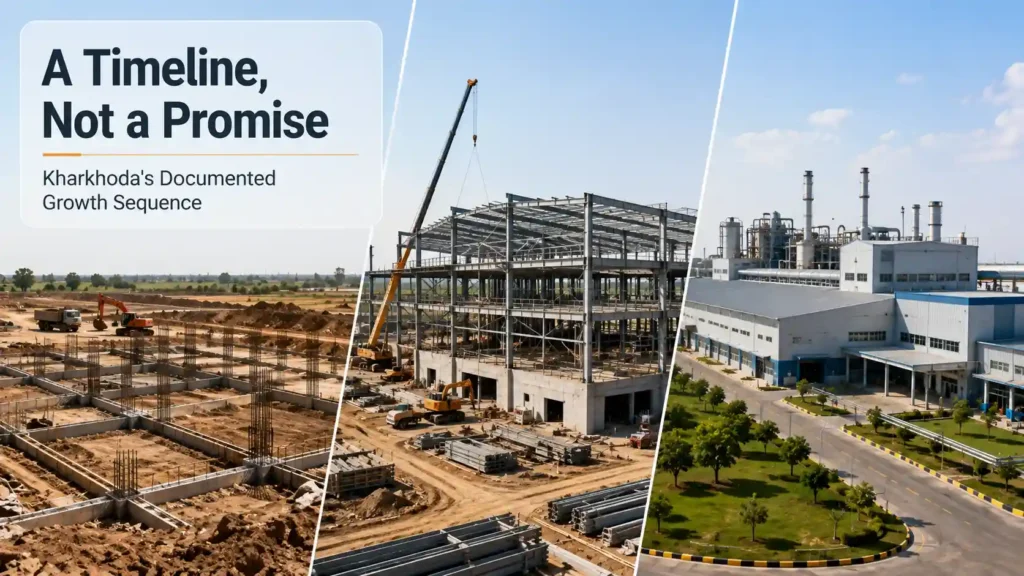
History of Industrial Development in Kharkhoda: From Town to Manufacturing Hub Ten years ago, Kharkhoda was best known for its grain market, not its factories. Today, it hosts one of Asia’s largest car manufacturing plants and a 3,200-acre industrial township. That shift did not happen by accident — it followed a specific sequence of land acquisitions, government decisions, and corporate investments. This guide traces the industrial development history of Kharkhoda, from its agrarian roots to its current status as a manufacturing hub. It covers the institutions that planned it, the land deals that built it, and the timeline that carried it from a 2013 land acquisition to a fully inaugurated automobile plant in 2026. Quick Answer: Kharkhoda’s Industrial Development History What Was Kharkhoda Before It Became an Industrial Hub? Before industry arrived, Kharkhoda was an agrarian town built around trade, not manufacturing. It sat inside what later became Sonipat district, roughly 19 km from Sonipat town and about 16 miles west of Rohtak. Sonipat itself only became a full district on 22 December 1972, when it was carved out of Rohtak district. Kharkhoda became one of its constituent blocks, alongside Ganaur, Rai, Gohana, and others nearby. Local trade centred on the town’s grain market, which still operates near Khanda Mod today. Even the town’s name reflects this earlier economy. Local tradition traces “Kharkhoda” to the word “Kharak,” meaning a cattle stall — a small detail that says a lot about the area’s agricultural character before industrial planning began. So, for most of the 20th century, Kharkhoda remained a modest tehsil headquarters, not an investment destination. How Did Haryana’s Industrial Push Reach the Kharkhoda Region? Kharkhoda’s industrial potential traces back to HSIIDC, the state agency Haryana created specifically to build industrial infrastructure. The Haryana government established HSIIDC on 8 March 1967, under the state’s Department of Industries and Commerce. Over the following decades, HSIIDC built industrial estates across Haryana, including early projects near Gurgaon that eventually grew into hubs like Udyog Vihar. Meanwhile, closer to Kharkhoda, HSIIDC also developed a smaller industrial estate at Kundli, within the same Sonipat district, housing textile, rubber, and footwear units. This mattered for Kharkhoda specifically because it established the institutional template Haryana would later apply here. HSIIDC already had land-acquisition experience, an infrastructure playbook, and state backing. As a result, when planners began scouting the next major township site, Kharkhoda’s location and available land made it a natural candidate. When Was IMT Kharkhoda Officially Established? IMT Kharkhoda was formally planned in 2013, when HSIIDC acquired more than 3,200 acres of land in Kharkhoda tehsil under the state’s land acquisition framework. This acquisition set the boundary for what would become IMT Kharkhoda. Haryana’s town-planning authorities had already been mapping a broader development blueprint for the wider Kharkhoda area before this point, but the 2013 acquisition is what formally created the industrial estate itself. The site sits bounded by the KMP Expressway to the north and State Highway-18 to the east, on the Delhi-Haryana border near Auchandi. HSIIDC’s layout eventually divided the site into 2,528 industrial plots, split between general allotment and rehabilitation-and-resettlement categories for the original landowners. The plan allowed for a wide industry mix from the outset — automobiles, food and beverage, metal products, textiles, chemicals, machinery, and footwear among them. IMT Kharkhoda Map: Location of Haryana’s Industrial Transformation This map shows the location of IMT Kharkhoda in Sonipat district, its connection to the KMP Expressway, NH-44, State Highway-18, Maruti Suzuki’s manufacturing plant, Sisana industrial belt, and nearby industrial corridors that transformed Kharkhoda from an agricultural town into one of Haryana’s fastest-growing manufacturing hubs. Kharkhoda’s Industrial Timeline at a Glance The table below lays out Kharkhoda’s industrial development chronologically, from HSIIDC’s founding to today’s operating plant. Year Milestone 1967 Haryana government establishes HSIIDC to drive statewide industrialisation 2013 HSIIDC acquires 3,200+ acres in Kharkhoda tehsil to develop IMT Kharkhoda Nov 2021 Government allots 900 acres inside IMT Kharkhoda to Maruti Suzuki and Suzuki Motorcycle India Aug 2022 PM Narendra Modi lays the foundation stone for the plant Feb 2025 First production line starts commercial output, building the Brezza May 2026 Second production line begins, adding the Victoris Jul 2026 Plant formally inaugurated; combined output reaches 5 lakh vehicles a year Each milestone built directly on the one before it. Therefore, understanding this sequence matters more than memorising any single date — it explains why Kharkhoda’s growth has accelerated rather than stalled. Why Did Maruti Suzuki Choose Kharkhoda for Its Newest Plant? The Maruti Suzuki Kharkhoda plant exists because Kharkhoda extended a manufacturing base the company already knew, along a corridor with direct expressway access. The company’s two earlier Haryana plants, Gurugram (1983) and Manesar (2007), sit on this same broad industrial belt. Kharkhoda is Maruti Suzuki’s third plant in Haryana and its fourth production site in India overall, counting the Hansalpur facility in Gujarat. Also, the location avoids central Delhi traffic entirely, since the KMP Expressway rings the city’s western side. The plant sits at the expressway’s second toll point from the north, just after Kundli, with NH-44 and the Delhi-Amritsar-Katra Expressway both close by. This pattern is not new for Haryana, either. Gurugram grew into a major industrial hub largely because Maruti chose it first, back in the 1980s. Manesar then followed a similar path after Maruti expanded there in the 2000s. Haryana officials have pointed to this same history when discussing Kharkhoda’s own prospects. The Smart Factory Approach Unlike its older plants, Kharkhoda runs on what Maruti Suzuki calls its Smart Factory model. The plant draws 100% of its power from renewable sources, mixing on-site solar with purchased green power. It also uses cobots — robots that work alongside people rather than replacing them — on parts of the assembly line. Furthermore, the facility recycles its water fully, operating as a zero-discharge site. Maruti Suzuki is also building a rail siding on-site, so finished vehicles can eventually leave by train instead of relying only on road transport. 📖 Read This Also: Why

Reviewing industrial policy documents near an IMT Kharkhoda site
IMT Kharkhoda

IMT Kharkhoda Latest News & Verified Development Updates

IMT Kharkhoda Latest News & Industrial Development Updates 2026 IMT Kharkhoda has produced more real news in the past eight months than most industrial estates see in five years. This page tracks it as it happens — every update dated, every claim sourced, updated as new developments land. Quick Answer: IMT Kharkhoda’s Biggest Recent Developments IMT Kharkhoda News Timeline: Every Update, Dated and Sourced Here is every verified IMT Kharkhoda development on record, newest first. Each row links back to its original source. Date Update Source ~July 10, 2026 Webasto reportedly plans a $400–500 million IPO for its Indian subsidiary by 2027, as its third plant near Kharkhoda approaches its Q4 2026 opening. Just-Auto / Internet Info Agency July 2, 2026 Maruti Suzuki’s Kharkhoda plant formally inaugurated by PM Modi and Japanese PM Takaichi; same day, HSIIDC’s 2026 e-auction bidding opens. Maruti Suzuki official press release; Outlook Business June 22, 2026 HSIIDC’s 2026 e-auction registration window closes. eauctionsindia.com June 1, 2026 Make in Haryana Industrial Policy 2026 formally launched at Grand Hyatt Gurgaon; HSIIDC e-auction registration opens the same day. Inc42; eauctionsindia.com May 26, 2026 Make in Haryana Industrial Policy 2026 officially notified, replacing the Haryana Enterprises and Employment Policy 2020. Grant Thornton India (policy alert) May 18, 2026 A second production line and the Victoris model go live at Maruti’s Kharkhoda plant, lifting site output to 5 lakh vehicles a year. Maruti Suzuki production disclosures Feb 27, 2026 Webasto Group announces its third India manufacturing plant, sited between Manesar and Kharkhoda, targeting Q4 2026 operations. Channel I Am / Webasto press release Dec 2025 Haryana media report HSIIDC starting land-valuation work for an approximately 5,800-acre Phase 2 expansion across 11 villages in Sonipat and Jhajjar; corridor land prices reported at ₹8–10 crore/acre. Multiple Haryana outlets, Dec 2025 Apr 11, 2025 Reporting describes land rates climbing from roughly ₹50 lakh/acre to ₹5–6 crore/acre; Haryana Orbital Rail Corridor (Palwal–Harsana Kalan) reported crossing the plant site; Kharkhoda–Auchandi Border road via Ferozpur Bangar planned for four-laning. The Tribune May 21, 2025 Suzuki Motorcycle India begins construction of its second Kharkhoda plant, with an initial investment of roughly ₹1,200 crore (₹12 billion). The Machine Maker / Automotive Industries Mar 26, 2025 Maruti Suzuki’s board approves ₹7,410 crore for a third plant/phase at Kharkhoda, targeting 7.5 lakh vehicles/year by 2029. Deccan Herald (PTI) Feb 2025 Maruti Suzuki’s first Kharkhoda production line begins commercial output (Brezza), initial capacity 2.5 lakh units/year. The Tribune Jan 4, 2024 Haryana Enterprise Promotion Board approves 94.32 acres to UNO Minda (~₹1,100 crore project) and clears Suzuki Motorcycle India’s proposed ~₹2,000 crore mega plant. The Impressive Times Aug 28, 2022 PM Modi lays the foundation stone for Maruti Suzuki’s Kharkhoda plant via video-conferencing. Wikipedia / Tribune India Note the pattern in the investment figures above: Suzuki Motorcycle’s proposal moved from a reported ₹2,000 crore ambition in January 2024 to a confirmed ₹1,200 crore initial construction investment in May 2025. That is not a contradiction — it is how mega-project figures normally evolve, from early proposal to funded first phase. Treat each figure as accurate for its date, not as a final number. Maruti Suzuki’s Kharkhoda Plant: The Anchor Story So Far Maruti Suzuki’s Kharkhoda facility remains the single biggest reason this corridor makes news at all. The plant now stands fully inaugurated, after four years of staged construction and expansion. What the July 2026 Inauguration Confirmed PM Modi and Japan’s PM Sanae Takaichi virtually inaugurated the plant on July 2, 2026, during the India-Japan Joint Economic Forum in New Delhi. The confirmed numbers: 800 acres, ₹35,000 crore total investment, current capacity of 5 lakh vehicles a year scaling to a planned 10 lakh, and more than 21,000 direct jobs. The site runs on the “Suzuki Smart Factory” concept, draws 100% of its electricity from renewable sources, and currently carries 20 MWp of solar capacity, planned to reach 70 MWp by 2030. For the full location, connectivity, and production breakdown, see RS Group Realty’s dedicated guide to Maruti Suzuki’s Kharkhoda plant. What Comes Next for the Site Maruti’s own board approval from March 2025 already maps out where this goes next: a third plant phase, ₹7,410 crore, targeting 7.5 lakh vehicles a year by 2029. Layer that onto the site’s already-confirmed step from 2.5 lakh to 5 lakh vehicles a year between February 2025 and May 2026, and the trajectory is consistent — Kharkhoda scales in stages, each one publicly disclosed before it happens, not after. Beyond Maruti: Other Confirmed Company Developments Maruti draws the headlines, but three other confirmed manufacturers now anchor different corners of the same corridor. UNO Minda operates an alloy-wheel plant on land the Haryana Enterprise Promotion Board approved in January 2024 (94.32 acres, part of a project reported at roughly ₹1,100 crore). It already supplies Maruti’s Kharkhoda line directly. Suzuki Motorcycle India began construction on its second Kharkhoda plant in May 2025, with a reported initial investment of ₹1,200 crore, targeting a 2027 production start for two-wheelers. Webasto, the German sunroof and roof-systems supplier, announced its third India plant in February 2026, sited between Manesar and Kharkhoda, aimed squarely at supplying nearby automakers including Maruti Suzuki. The company expects the site operational in the fourth quarter of 2026, adding roughly 500,000 units a year of capacity. As of early July 2026, Webasto’s Indian subsidiary was also reportedly preparing a 2027 IPO — a sign the company sees this corridor as a long-term bet, not a one-off expansion. HSIIDC and Policy Updates Shaping IMT Kharkhoda Two government-side developments now shape everything happening at Kharkhoda beyond individual company announcements. First, HSIIDC’s 2026 e-auction. Registration ran June 1–22, 2026, and bidding opened July 2, 2026, covering IMT Kharkhoda alongside Manesar Phase-V, Faridabad, Kundli, and several other estates. Unlike earlier rounds focused heavily on auto-linked units, HSIIDC opened this round to manufacturers, logistics operators, warehousing firms, pharmaceutical companies, and IT businesses. Second, the Make in Haryana Industrial Policy 2026, notified May 26, 2026, and launched publicly on June 1. It

Farmland road leading toward distant industrial development near Kharkhoda, Haryana
IMT Kharkhoda

IMT Kharkhoda Phase 2 Village List & Verified Location Guide

IMT Kharkhoda Phase 2 Village List: Location & Industrial Expansion Guide Search “IMT Kharkhoda Phase 2 village list” and you’ll find the same five or six lines repeated across a dozen news posts. None of them names a single village. This guide does something different. It separates what Haryana media has confirmed from what remains unconfirmed, and it names the villages that do appear on public record — with the date and source attached to each one. Quick Answer: IMT Kharkhoda Phase 2 Villages at a Glance What Is IMT Kharkhoda Phase 2, Exactly? IMT Kharkhoda Phase 2 refers to a government-led expansion plan, not a private project. HSIIDC — the Haryana State Industrial and Infrastructure Development Corporation — is the body behind it. This distinction matters more than it sounds. Some private developers also use “Phase 2” as an internal label for their own township’s next release of plots. That labeling has nothing to do with HSIIDC’s government expansion. So, always confirm which “Phase 2” a listing means before you act on it. For the fuller breakdown of this mix-up and what it means for your money, see RS Group Realty’s guide to industrial plots near IMT Kharkhoda Phase 2. The original estate — often called Phase 1 — was planned back in 2013. HSIIDC acquired roughly 3,200 to 3,300 acres there, carved into over 2,500 industrial plots. Maruti Suzuki, Suzuki Motorcycle India, and UNO Minda already operate inside that boundary today. Phase 2 is the next chapter, and it is still being planned, not built. Which Villages Fall Under the IMT Kharkhoda Phase 2 Expansion? Two different data points try to answer this question, and they don’t fully agree. Here is each one, clearly dated, followed by what the gap likely means. The December 2025 Acreage Report Several Haryana news outlets reported in December 2025 that HSIIDC had begun land-valuation work across eleven villages in two districts. None of these reports named the villages individually — they reported village counts and acreage, not names. District Villages (reported count) Acreage Source basis Jhajjar 6 villages 3,625 acres Haryana media, Dec 2025 Sonipat 5 villages 2,175 acres Haryana media, Dec 2025 Total 11 villages ~5,800 acres Haryana media, Dec 2025 HSIIDC reportedly entrusted the valuation survey to Garg Associates, and designed the expansion zone so it would not need to cross the KMP Expressway — keeping the new land on the same side as the existing industrial estate. The November 2023 Named Village List An earlier HSIIDC notification, reported by Amar Ujala in November 2023, invited farmers to apply under a Land Pooling Scheme covering the same Kharkhoda expansion corridor. Unlike the 2025 reports, this notification named villages individually, on each side of the district border. Sonipat-Side Villages in the Reported Expansion Zone Per the November 2023 notification, five Kharkhoda-area villages in Sonipat district were named: Village (English) Village (Hindi) Barauna बरोणा Kidauli किडौली Pahladpur पहलादपुर Pai पाई Sohti सोहटी Jhajjar-Side Villages in the Reported Expansion Zone The same 2023 notification named five Jhajjar-district villages: Village (English) Village (Hindi) Jasaur जसौर Khedi खेड़ी Kanaunda कानौंदा Kulasi कुलासी Nilothi निलौठी That is five Jhajjar villages, not six. The December 2025 reports cite six Jhajjar villages without naming the additional one. Why the Numbers Don’t Match There are two honest explanations, and neither has been confirmed. Either the scope genuinely grew by one Jhajjar village between 2023 and 2025, or the two reporting rounds are simply counting the same land differently. HSIIDC has not published a document reconciling the two. Also, village names in Haryana revenue records commonly carry spelling variants across different sources — the same village can appear with slightly different transliteration in different newspapers. Therefore, before you act on any of these names, verify the exact revenue-estate (patwar circle) name at the Kharkhoda or Jhajjar tehsil office, rather than relying on spelling alone. Where Does the Phase 2 Zone Sit on the Map? The reported Phase 2 zone sits adjacent to the existing IMT Kharkhoda estate, extending from Kharkhoda’s Sonipat-side villages across the district border into neighbouring Jhajjar. HSIIDC’s own design brief, per the December 2025 reports, keeps the new land on the same side of the KMP Expressway as the current estate — so it links to the same expressway corridor rather than requiring a new crossing. The existing IMT Kharkhoda boundary itself is well documented. It runs along the KMP Expressway to the north and State Highway-18 to the east, roughly one kilometre from Kharkhoda town. For the full boundary and road network — including exact expressway toll points, NH-44 access, and distances to Sonepat Railway Station and IGI Airport — see RS Group Realty’s IMT Kharkhoda map and connectivity guide. 📖 Read This Also: IMT Kharkhoda Map & Layout — Full Connectivity Guide See the existing estate’s exact boundary, expressway toll points, and road network before you evaluate how the Phase 2 zone connects to it. IMT Kharkhoda Phase 2 Expansion Map (Proposed Villages & Existing IMT) This map shows the proposed IMT Kharkhoda Phase 2 expansion area alongside the existing IMT Kharkhoda industrial estate, nearby Sonipat and Jhajjar villages, the Maruti Suzuki plant, Sisana, and the KMP Expressway. It provides an illustrative overview based on publicly reported information. Why Are Industrial Buyers Searching for These Villages Right Now? Buyers are searching because the anchor investment next door has just scaled up sharply. Maruti Suzuki’s Kharkhoda plant — 800 acres, inside the original estate — was inaugurated on July 2, 2026, with a second production line added in May 2026 taking output to roughly 5 lakh vehicles a year. A plant that size pulls component suppliers, logistics operators, and warehousing firms toward everything nearby, including villages just outside the notified boundary. That pull already shows up in prices. After Maruti Suzuki, UNO Minda, and Suzuki Motorcycle established operations in the original estate, land prices in surrounding villages reportedly climbed to ₹8 to ₹10 crore per acre. This is organic, demand-driven appreciation — not a government

Elevated view of an expressway running past an organized industrial zone, representing the Maruti Suzuki Kharkhoda plant's location on the KMP Expressway corridor
Maruti Suzuki

Maruti Suzuki Kharkhoda Plant: The Verified Facts

Maruti Suzuki Kharkhoda Plant: Location, Production & Industrial Growth Impact Where exactly is the Maruti Suzuki Kharkhoda plant, and how big is it really? Also, search results mix old figures with new ones, since this plant has grown fast, in phases. So, this guide fixes that. Specifically, it covers the real location, the current production numbers, and what the plant means for industrial land nearby.  Quick Answer: Maruti Suzuki Kharkhoda Plant at a Glance Where Is the Maruti Suzuki Kharkhoda Plant Located? The Maruti Suzuki Kharkhoda plant sits in IMT Kharkhoda, Sonipat district, Haryana, about 19 km from Sonipat town. It runs on 800 acres, next to a separate 100-acre Suzuki Motorcycle India unit nearby. So, together, the two sites cover 900 acres. Currently, the plant makes 5 lakh vehicles a year, across two production lines, building the Brezza and the Victoris. Also, Maruti Suzuki inaugurated the facility on July 2, 2026, alongside Japan’s Prime Minister Sanae Takaichi. Furthermore, the company has confirmed plans to double output, to 10 lakh vehicles a year. Two named suppliers, UNO Minda and Jay Bharat Maruti, have already set up inside the plant’s own supplier park. Specifically, the plant sits inside IMT Kharkhoda’s official boundary, set by HSIIDC back in 2013. Also, it runs along the Kundli-Manesar-Palwal Expressway. Specifically, it sits at the second toll point from the expressway’s northern end, right after Kundli. So, this gives fast access to NH-44, and to the Delhi-Amritsar-Katra Expressway just 5 km away. Also, Sonepat Railway Station sits about 18 km out, and Delhi’s IGI Airport is roughly 65 km by road. For the full boundary and road network, see RS Group Realty’s IMT Kharkhoda map and connectivity guide. Why Did Maruti Suzuki Choose This Exact Location? Overall, that location was not an accident. In fact, Gurugram and Manesar, Maruti Suzuki’s two older Haryana plants, sit on this same broad corridor. So, Kharkhoda extends a manufacturing base the company already knew well, inside the same IMT Kharkhoda industrial area that HSIIDC built from scratch. So, it did not start fresh in unfamiliar territory. Also, the site skips central Delhi traffic entirely, since the KMP Expressway rings the city’s west side. Maruti Suzuki Kharkhoda Plant Location Map Location of the Maruti Suzuki Kharkhoda Plant inside IMT Kharkhoda, showing KMP Expressway, NH-44, Delhi-Amritsar-Katra Expressway, Sonipat, and nearby industrial areas. How Much Does the Maruti Suzuki Kharkhoda Plant Produce, and Since When? Specifically, production at Kharkhoda began on February 25, 2025. First, a single line started making the Brezza, at 2.5 lakh units a year. Then, a second line followed on May 18, 2026. So, this added another 2.5 lakh units, plus the Victoris model. So, that took Kharkhoda’s own output to 5 lakh vehicles a year. Together, across Gurugram, Manesar, Kharkhoda, and Hansalpur in Gujarat, Maruti Suzuki now builds 26.5 lakh vehicles a year. Also, Kharkhoda alone is planned to reach 10 lakh units once fully built out. So, that would make it one of Suzuki’s largest single manufacturing sites anywhere. Maruti Suzuki Plant State Production Began Focus Gurugram Haryana 1983 Maruti Suzuki’s original India plant Manesar Haryana 2007 Compact and mid-size cars Hansalpur (Suzuki Motor Gujarat) Gujarat 2017 Multiple models, plus the e VITARA export line Kharkhoda Haryana February 2025 Brezza and Victoris; scaling toward 10 lakh units/year So, Kharkhoda is Maruti Suzuki’s third plant in Haryana, after Gurugram and Manesar. Also, it is the company’s fourth production site in India overall, counting the Gujarat facility too. In total, the investment across all phases comes to ₹35,000 crore. Furthermore, the project should create over 21,000 jobs once fully scaled, including work inside the supplier park. 📖 Read This Also: Why Invest in IMT Kharkhoda Industrial Plots? ROI Guide Once you see how fast Kharkhoda’s output is scaling, the next question is what that growth is actually worth to an investor — this guide walks through the ROI logic in full. What Makes the Maruti Suzuki Kharkhoda Plant Different From Its Other Factories? Notably, the Kharkhoda plant runs on what Maruti Suzuki calls its Smart Factory model. Also, it draws 100% of its power from renewable sources, mixing on-site solar with purchased green power. Also, it uses cobots on parts of the line — robots that work alongside people, not instead of them. Furthermore, the site recycles its water fully too, as a zero-discharge facility. In addition, Maruti Suzuki is building a rail siding on-site, so finished cars can leave by train instead of only by road. How Is Maruti Suzuki’s Plant Pulling Suppliers Into Kharkhoda? Indeed, a plant this size rarely stays alone for long. So, it needs parts, packaging, and transport close by. So, that pull is already visible at Kharkhoda, in two specific, named companies. Which Suppliers Have Already Followed Maruti Suzuki to Kharkhoda? Specifically, UNO Minda has built an alloy-wheel plant near the Maruti Suzuki site, already up and running. Separately, Jay Bharat Maruti Limited joined too. Namely, it is a long-time Tier-1 partner to Maruti Suzuki. In late 2023, JBML laid the first stone for its own unit, inside the plant’s MSIL Supplier’s Park. Overall, that unit covers just over 6.7 acres. So, it will build body and chassis parts, sized to match Kharkhoda’s growth in phases. So, two real, named suppliers are already committed here, not just rumored. If your business fits a similar profile, RS Group Realty’s guide to manufacturing units that fit Sisana’s plots covers who else this belt suits. Does History Support This? What Happened in Gurugram and Manesar? Importantly, this pattern has real precedent, too. Gurugram grew into a major industrial hub largely because Maruti Suzuki chose it first, back in the 1980s. Manesar then followed the same path, after Maruti expanded there in the 2000s. In fact, Haryana’s own government has pointed to this exact history when discussing Kharkhoda. So, officials expect the new plant to repeat what happened in Gurugram. So, this is not a new theory. So, it is a pattern that has already played

Aerial view of an organized industrial township with factory buildings and wide roads, representing IMT Kharkhoda's manufacturing zone
IMT Kharkhoda

IMT Kharkhoda Companies List: Verified & Updated

Companies in IMT Kharkhoda: Company List, Manufacturers & Upcoming Industries Searching for a clear list of companies in IMT Kharkhoda? Also, most results mix real manufacturers with rumors. Also, others just copy a raw government data table, with no context at all. So, this guide fixes that. It splits out real, working companies from projects still under construction. Furthermore, it flags what isn’t confirmed yet. Every figure here is sourced. Quick Answer: Companies Confirmed in IMT Kharkhoda Which Companies Are Confirmed to Operate in IMT Kharkhoda? Three companies have real, checked operations inside IMT Kharkhoda. Namely, these are Maruti Suzuki India Limited, Suzuki Motorcycle India Private Limited, and UNO Minda Limited. Together, they cover close to 1,000 acres. Also, they represent thousands of crores in investment. Company Land in IMT Kharkhoda Investment Status (July 2026) What It Makes Maruti Suzuki India Limited (MSIL) ~800 acres ₹35,000 crore (full build-out) Operating; inaugurated July 2, 2026 Brezza and Victoris SUVs Suzuki Motorcycle India Pvt. Ltd. (SMIPL) 100 acres ₹1,200 crore (phase 1) Under construction; targeted 2027 Two-wheelers, 7.5 lakh units/year phase 1 UNO Minda Limited ~94 acres ₹542 crore (alloy-wheel plant), plus further expansion Alloy-wheel plant operating; lighting unit due Q4 FY27 Alloy wheels, 2-wheeler lighting So, HSIIDC has already given out 1,083 of the 2,528 total plots at IMT Kharkhoda. In fact, this comes from the corporation’s own project data. However, HSIIDC does not publish a full public list of every plot owner’s name. Also, most of these plots went to small, MSME-scale makers. Therefore, their names sit in HSIIDC’s internal records, not in one public list. So, if a website claims a long “company list” beyond the three names above, check it against HSIIDC first. For the fuller township profile, including layout and connectivity, see RS Group Realty’s IMT Kharkhoda industrial area overview. IMT Kharkhoda Industrial Ecosystem Map Map showing the location of Maruti Suzuki, Suzuki Motorcycle India, UNO Minda, the Footwear Park, and the surrounding industrial corridor with KMP Expressway connectivity. Why Did Maruti Suzuki Choose IMT Kharkhoda for Its ₹35,000-Crore Plant? Maruti Suzuki picked Kharkhoda for clear reasons. First, the land is open and close to Delhi. Also, it has direct KMP Expressway access. Furthermore, Haryana already has an auto base in Gurugram and Manesar. So, the result is India’s newest large car plant. In fact, PM Modi opened it on July 2, 2026. Also, Japan’s PM Sanae Takaichi joined him, during the India-Japan Joint Economic Forum. The timeline moved fast. First, PM Modi laid the foundation stone in August 2022. Then, the first line began work in February 2025. It builds the Brezza, at 2.5 lakh units a year. After that, a second line followed in May 2026. This added another 2.5 lakh units, plus the Victoris model. So, together, Kharkhoda’s output now stands at 5 lakh cars a year. Also, Suzuki Motor Corporation has confirmed plans to double this, to 10 lakh units, in stages. Overall, the plant covers 800 acres. Also, it includes a supplier park, built right into the same site. Maruti Suzuki calls this its Smart Factory. Furthermore, it uses Industry 5.0 tech, including cobots — robots that work with people on the line. Also, the plant runs on 100% clean power. Solar capacity is 20 MWp today. Furthermore, this will grow to 70 MWp by 2030. The site also recycles all its water, as a zero-discharge facility. In addition, Maruti Suzuki is even building a rail link, to ship cars out. So, once fully scaled, the project should create over 21,000 jobs. So, this includes work across the supplier network too. What Other Industries Is HSIIDC Building Inside IMT Kharkhoda Beyond Automobiles? HSIIDC’s master plan for IMT Kharkhoda goes well past cars. In fact, the layout allows several sectors. These include auto parts, food and drink, metal goods, textiles, chemicals, machinery, and footwear. However, each unit still needs its own environment clearance first. What Is the IMT Kharkhoda Footwear Park? The clearest confirmed example outside cars is the Footwear Park. In fact, HSIIDC has invited bids for around 414 plots here. Also, these are set aside for footwear makers and traders. Overall, the zone covers 676 acres inside IMT Kharkhoda. In fact, officials call it one of the largest footwear zones planned anywhere. However, as with the wider township, HSIIDC has not named firms for these plots yet. So, treat this as a real zone, not a confirmed tenant list. 📖 Read This Also: Which Manufacturing Units Fit Sisana’s Plots If cars and footwear aren’t your sector, this breaks down which factory types actually fit the belt around these confirmed companies. Which Sectors Can Still Apply for HSIIDC Plots? Also, food processing, packaging, light engineering, and chemicals all fit HSIIDC’s rules too. Also, plots in these fields stay open, through the corporation’s normal process. However, none of these fields has a named anchor firm yet, unlike cars or footwear. So, for a buyer, that is actually useful to know. It means early movers here still have room to grab land, before the belt grows the way the auto side already has. Furthermore, HSIIDC is also eyeing a much larger expansion zone beyond today’s boundary, though that land sits in early valuation, not allotment. So, RS Group Realty’s Kharkhoda Phase 2 update tracks this separately, and the two stages don’t get confused. What Does the Auto-Component Supply Chain Around Maruti Suzuki Look Like? A plant the size of Maruti Suzuki’s cannot run alone. Also, it needs part makers, packing units, and transport firms close by. So, that demand already shows up in two spots: how the site itself is built, and in the region’s current supply gap. What Is Inside the Integrated Supplier Park? Maruti Suzuki’s 800-acre plant includes a supplier park, built into the same site. So, this lets part makers sit close to the main line. Indeed, it is common practice at big car plants. Why? Because it cuts inbound transport time. Also, it lets suppliers react faster to schedule

Comparison of an operational buyer at a build site and an investment buyer reviewing land, representing different plot priorities in Barhana
Barhana Guides

Barhana Industrial Park: Good for Manufacturers, Warehouses?

Barhana Industrial Park for Manufacturers & Warehouses: Is It a Good Industrial Location? “Is Barhana Industrial Park a good location?” depends entirely on what you’re building. A factory owner needs something different from a warehouse operator, and both need something different from a pure investor. This guide answers the question properly, by business type. We’ll look at why Barhana works for manufacturers and logistics businesses specifically, what kind of setup actually fits here, and how an investor’s priorities differ from an operator’s. Is Barhana Industrial Park a Good Location? The Short Answer Yes, for the right buyer. Barhana’s NOC-zone status, multi-highway connectivity, and position inside the established Rohtak-Jhajjar industrial belt make it a genuinely functional location, not just a marketing term. However, “good” isn’t universal. A buyer planning a small-to-mid manufacturing unit gets real value here. A buyer hoping for one giant, anchor-scale facility may find the typical plot sizes don’t match that ambition. So, the rest of this guide breaks down exactly who fits where. Why Manufacturers Should Consider Barhana Industrial Park Manufacturers care about specific things: power reliability, regulatory speed, and proximity to workforce and suppliers. Barhana scores reasonably well on all three. Its NOC-zone status generally permits Red, Orange, and Green category industries under India’s standard pollution classification, covering most manufacturing activity. Also, several manufacturers, including established packaging and tape producers, already operate along Sampla-Beri Road, confirming a working industrial base, not an empty field. However, every specific process still needs its own category confirmation before you commit. The NOC-zone advantage speeds up the path, but it doesn’t remove the need to check that your exact activity fits the permitted categories. Why Warehouse and Logistics Businesses Find Barhana Useful Warehouse and logistics operators evaluate land differently than manufacturers. Road access and plot regularity usually matter more than pollution category. Barhana connects within roughly 10 minutes to NH-334B, NH-352, and NH-9, with the Delhi-Katra Expressway about 30 minutes away. That combination lets one facility here realistically serve Rohtak, Jhajjar, Sonipat, and Delhi NCR. Also, plots running up to one acre give warehouse operators enough footprint for a meaningful racking and dock layout. Furthermore, warehousing generally carries a lighter compliance burden than heavy manufacturing, since most storage operations avoid the more intensive pollution-category scrutiny a production unit faces. Barhana Industrial Park Location Map & Highway Connectivity The map below highlights Barhana Industrial Park’s strategic location near Sampla, NH-334B, NH-9, NH-352, and the Delhi-Katra Expressway. It helps manufacturers and warehouse operators understand how the location supports faster transportation, logistics, and industrial operations. What Kind of Industrial Setup Actually Fits Here? A plot’s size and access shape what can realistically be built on it. So, match your setup expectations to Barhana’s actual plot profile. Plots here commonly range from 1,000 square yards to one acre, which suits small-to-mid manufacturers, auto-component suppliers, and warehouse operators well. It’s less suited to a single giant anchor-scale assembly plant, which typically needs far larger contiguous land. Main road frontage from Sampla-Beri Road commonly runs around 71 feet, with internal roads near 44 feet, generally enough for two-way truck movement. However, since Barhana is privately developed rather than a single uniform government estate, always confirm the specific plot’s actual frontage and road condition rather than assuming it matches the belt’s general description. Also, remember that Barhana’s NOC application typically requires a boundary wall and a basic structure first. That means a small upfront construction step before formal approval, worth factoring into your setup timeline and budget. Operational Buyer vs Investment Buyer: A Different Set of Priorities These two buyer types can look at the same plot and want very different things from it. Operational buyers need the permitted category to match their exact activity, since a mismatch can block their NOC application. Also, they need a realistic timeline to complete that initial boundary-wall-and-structure step, since delays there delay everything that follows. Investment buyers, by contrast, care less about immediate build-readiness and more about the broader corridor’s growth trajectory. However, it’s worth knowing that Haryana’s Enterprises and Employment Policy, 2020 incentives, often mentioned alongside Barhana, mainly reward operating, registered enterprises rather than passive landholders. So, a pure investment buyer shouldn’t factor those subsidies heavily into their return expectations. How to Choose the Right Plot for Your Business Type Questions Manufacturers Should Ask Before Buying Does this plot’s permitted category genuinely match my manufacturing process? Is there confirmed power capacity for my equipment? What’s a realistic timeline to complete the boundary wall and structure needed for NOC application? Is the specific plot’s road frontage actually wide enough for my delivery trucks? Questions Warehouse and Logistics Buyers Should Ask Before Buying Is the plot flat and regular enough for an efficient racking and dock layout? Can container trucks genuinely turn and manoeuvre on the access road, not just drive past it? How close is the nearest highway entry point, in real driving terms? Is this specific plot in an already-active part of the belt or a less-developed pocket? How RS Group Realty Helps You Find the Right Fit RS Group Realty treats “Barhana Industrial Park” as several different questions, not one generic pitch. Therefore, before recommending any plot, the team asks what you actually plan to do with it: manufacture, store and distribute, or hold for long-term value. That answer changes which plot size, category fit, and timeline genuinely works for your situation. If you’d like to explore current options matched to your specific business type, our Barhana plots page is the right place to start. Frequently Asked Questions About Barhana Industrial Park Q1. Is Barhana Industrial Park a good location for manufacturers? Yes, particularly for small-to-mid manufacturers across Red, Orange, and Green categories, given the NOC-zone’s faster approval path and an existing industrial base already operating along Sampla-Beri Road. Q2. Is Barhana suitable for warehouse and logistics businesses? Yes. Its position near NH-334B, NH-352, NH-9, and the Delhi-Katra Expressway makes it a practical base for distribution across Rohtak, Jhajjar, Sonipat, and Delhi NCR. Q3. What plot size

Split view of a single large facility and several smaller factory sheds representing the Barhana vs Sisana comparison
Barhana Guides

Barhana vs Sisana: Which Is Better for Investment?

Barhana vs Sisana: Which Industrial Area Is Better for Investment in Haryana? Barhana and Sisana keep coming up together in searches, and for good reason. Both offer a faster, more accessible entry into industrial land than a typical government estate. But they’re genuinely different opportunities. This guide compares both honestly: where each sits, what’s actually driving demand, how fast you can act, and which buyer profile fits which location. No forced verdict, just a clear framework. Barhana vs Sisana: Two Different Corridors, Two Different Stories Sisana sits inside the Sonipat-Kharkhoda industrial belt, built around one dominant anchor: Maruti Suzuki’s manufacturing plant. Barhana sits in Jhajjar district near Sampla, built around a faster regulatory path and an existing, more varied industrial base across Rohtak and Jhajjar. So, this isn’t a comparison between a strong option and a weak one. It’s a comparison between two different kinds of bets: a concentrated bet on one major anchor, versus a diversified bet on an established, broader industrial belt with a regulatory speed advantage. Location Comparison: Where Each Industrial Area Actually Sits Sisana sits in Kharkhoda tehsil, Sonipat district, roughly 15 minutes from Maruti Suzuki’s plant, connected through the KMP Expressway and the Delhi-Amritsar-Katra Expressway corridor. Barhana sits in Beri tehsil, Jhajjar district, on Sampla-Beri Road, close to the Rohtak district border. It connects within about 10 minutes to NH-334B, NH-352, and NH-9, with the Delhi-Katra Expressway around 30 minutes away. Both benefit from strong highway access. The real difference is which broader corridor each one belongs to: Sisana sits on the Sonipat side of the region, while Barhana sits on the Rohtak-Jhajjar side. Industrial Demand: What’s Actually Driving Growth in Each This is where the two locations diverge most clearly. Sisana’s demand traces back to one dominant source: Maruti Suzuki, whose plant has been in commercial production since February 2025 and is approved for expansion toward 7.5 lakh vehicles a year by 2029. That single anchor pulls in auto-component suppliers and logistics operators directly. Barhana’s demand comes from a broader, more varied base. Rohtak already hosts close to 1,500 industrial units across engineering, servicing, and repair work. Jhajjar runs roughly 1,200 units spanning furniture, rubber, plastics, and chemical processing. No single company drives this demand; the breadth of existing industry does. Therefore, Sisana offers concentrated exposure to one powerful growth story, while Barhana offers diversified exposure to an established, multi-sector base. Entry Route and Approval Speed Compared Both locations offer a faster path than a typical government-allotted estate, but through different mechanisms. Sisana’s advantage is in the purchase route itself: fresh, freehold private plots with a fixed price, skipping the government e-auction or allotment queue used for official IMT Kharkhoda plots. Barhana’s advantage sits in its regulatory status: as an NOC zone, it can typically skip the Change of Land Use certificate required on controlled-area land, shortening the path from purchase to operational approval. So, Sisana saves you time on the buying process itself, while Barhana saves you time on the regulatory process after you’ve bought. Future Potential: Which One Has the Stronger Long-Term Case? Sisana’s future case is tightly linked to a specific, dated catalyst: Maruti’s third-phase expansion through 2029. That’s a real, well-documented growth driver, though it concentrates the thesis around one company’s continued execution. Barhana’s future case is broader and less single-event-driven, tied to continued growth across Rohtak and Jhajjar, plus Haryana’s Enterprises and Employment Policy, 2020, which can support eligible operating enterprises with incentives like stamp duty refunds and employment subsidies. Interestingly, Haryana media reported in late 2025 that HSIIDC’s own reported expansion plan for IMT Kharkhoda includes land in Jhajjar district specifically, though that process remains in early land-valuation stages and is not yet allotment-ready. So, both locations sit inside a genuinely growing region, just anchored to different parts of that growth story. Side-by-Side Comparison Table Factor Sisana (Sonipat side) Barhana (Jhajjar side) District / Tehsil Kharkhoda tehsil, Sonipat district Beri tehsil, Jhajjar district Primary growth driver Maruti Suzuki plant (concentrated anchor) Rohtak-Jhajjar industrial base (diversified) Distance to anchor ~15 minutes to Maruti Suzuki plant Within the Rohtak-Jhajjar belt itself Regulatory advantage Private freehold, skips government allotment queue NOC-zone status, typically skips CLU requirement Key highways KMP Expressway, Delhi-Amritsar-Katra Expressway NH-334B, NH-352, NH-9, Delhi-Katra Expressway Entry price reference ₹14,000 per sq yard, from 1,452 sq yd (RS Group Realty listing) Often referenced near ₹6,500 per sq yard in market listings — confirm current rate directly Best suited for Auto-ancillary suppliers, buyers wanting a single strong anchor story Manufacturers across multiple categories, buyers wanting faster approvals and diversified demand Which Buyer Should Choose Which Location? Neither location is universally better. Each suits a different investment logic. Choose Sisana If… You want direct exposure to the auto-component supply chain building around Maruti Suzuki’s plant. Also, you’re comfortable with a single, strong anchor driving your growth thesis, and you want the speed advantage of a private, fixed-rate purchase over a government allotment queue. Choose Barhana If… You want the fastest possible regulatory path to start operations, regardless of industry category. Also, you’d rather invest in a broader, diversified industrial base than bet on one company’s execution, and you want to explore eligibility for Haryana’s state-level incentive schemes as an operating enterprise. How RS Group Realty Helps You Decide RS Group Realty works across both Sisana and Barhana, not just one. Therefore, the team can walk you through the real trade-offs honestly, based on your specific business type and timeline, rather than steering you toward whichever is easier to sell. If the Maruti-Kharkhoda anchor story fits your goal, our Sisana page covers current options. If NOC-zone speed and the Rohtak-Jhajjar base fit better, our Barhana page is the right next step. Frequently Asked Questions About Barhana vs Sisana Q1. Is Barhana better than Sisana? Neither is universally better. Sisana offers concentrated exposure to the Maruti Suzuki anchor near Kharkhoda, while Barhana offers a faster regulatory path and exposure to the broader, diversified Rohtak-Jhajjar industrial base. Q2. What is the difference between Barhana

Scroll to Top