Investment Guides

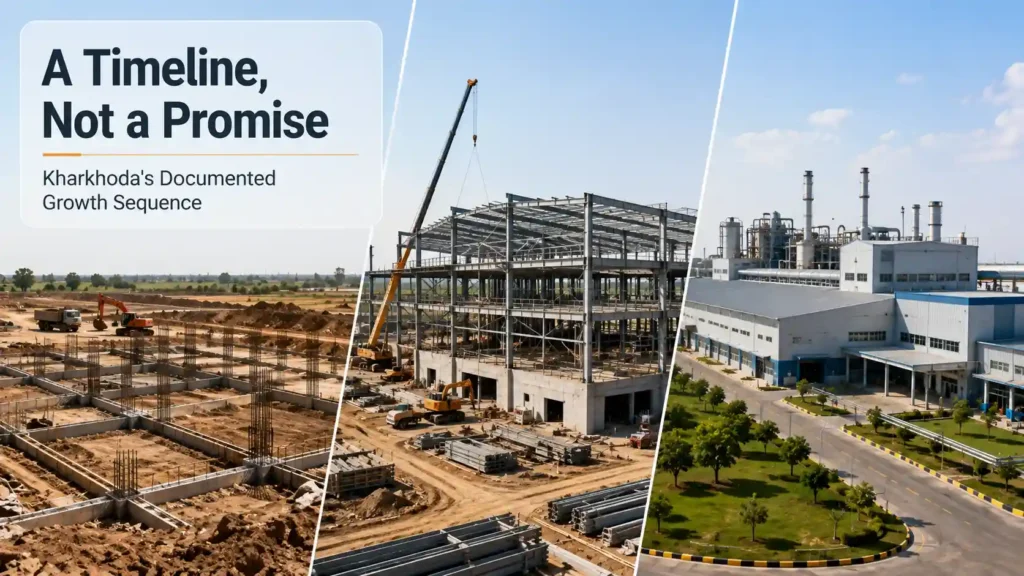
Sequential construction timeline representing Maruti Suzuki's documented hub-formation progress at Kharkhoda
Investment Guides

Manufacturing Growth in Haryana 2026: Hubs & Industries

Manufacturing Growth in Haryana: Key Industries, Hubs & Emerging Locations “Manufacturing growth in Haryana” isn’t one story. It’s several specific industries expanding in specific places, usually because one anchor company moved in first and pulled a whole supply chain in behind it. Understanding that mechanism matters more than memorising a list of factory types. Once you see how an anchor industry actually builds a hub around itself, you can spot which emerging locations are genuinely growing and which are just marketing themselves as if they are. This guide covers both: the key manufacturing categories active across Haryana today, and the real process by which a location turns into a manufacturing hub in the first place. Quick Answer: Manufacturing Growth in Haryana The Key Manufacturing Categories Driving Haryana’s Growth Haryana’s manufacturing base isn’t one industry wearing different labels. It’s genuinely distinct categories, each concentrated in its own part of the state. Automobiles and auto-ancillary components anchor Gurugram-Manesar and are now building a second major base around Kharkhoda in Sonipat district. Textiles concentrate around Panipat, one of India’s largest centres for carpets, blankets, and handloom weaving. Food processing and agro-based manufacturing cluster around Rai’s Mega Food Park and the broader Sonipat belt’s access to the Delhi NCR consumer market. Light engineering and general manufacturing spread widest around Faridabad, which never built around a single sector. Two-wheeler manufacturing and its ancillary base concentrate around Rewari-Bawal. Each category clusters where it does for a specific reason, usually tracing back to one early anchor decision that everything else followed. How an Anchor Industry Actually Builds a Manufacturing Hub Hub formation isn’t random, and it isn’t just about cheap land. It follows a fairly consistent three-step pattern. First, an anchor industry commits to a location, usually a large manufacturer capable of generating its own supplier demand. Second, infrastructure gets built or upgraded specifically to support that anchor: roads widened, power capacity added, sometimes new rail links planned. Third, a genuine supplier ecosystem forms around the anchor, as component makers and service providers move in to shorten their own supply chains. This sequence typically plays out over one to three years from the anchor’s initial commitment to a recognisable, self-sustaining ecosystem. Recognising which stage a location is actually in, rather than which stage its marketing claims, is the real skill in evaluating an “emerging hub.” A Live Example: How Maruti Suzuki Built an Ecosystem at Kharkhoda IMT Kharkhoda is Haryana’s clearest current example of this three-step pattern actually happening, with dates specific enough to verify yourself. Date Milestone Stage August 2022 Maruti Suzuki’s foundation stone laid Anchor commits Late 2023 Jay Bharat Maruti lays its own foundation stone inside the plant’s supplier park Suppliers begin following January 2024 UNO Minda’s alloy-wheel plant land approved Suppliers begin following February 2025 Maruti’s first production line goes commercial Anchor operational May 2025 Suzuki Motorcycle India begins construction of its own plant Ecosystem widens July 2026 Full facility formally inaugurated, confirming ₹35,000 crore total investment Hub matures For the full detail behind this anchor’s investment and production numbers, see our Maruti Suzuki Kharkhoda plant guide. 📖 Read This Also: IMT Kharkhoda Companies List: Verified & Updated See exactly which suppliers have already followed Maruti Suzuki into this corridor, and which are still under construction. Which Manufacturing Categories Fit Emerging Hubs Like Kharkhoda-Sisana Not every manufacturing category benefits equally from an emerging hub. Some fit the early stage well; others do better waiting for a more settled ecosystem. Auto-ancillary units fit earliest and most directly, since they can supply the anchor plant itself from day one, similar to how UNO Minda and Suzuki Motorcycle India moved into Kharkhoda’s own case. Logistics and warehousing operators fit early too, since multi-directional highway access matters more than a settled local supplier base. Food processing and packaging units fit well once the surrounding population and consumer base start growing alongside the industrial base. Light engineering and electronics assembly fit once basic infrastructure, especially power reliability, is confirmed rather than just planned. For a detailed breakdown of which specific factory types suit one such emerging corridor today, our manufacturing units guide for Sisana covers auto-ancillary, logistics, food processing, and light engineering fits in full. Not sure whether your factory type fits an emerging industrial location? Compare your manufacturing requirements with available industrial corridors before making a land investment. Established vs. Emerging Manufacturing Hubs: What Changes for a New Entrant Neither an established hub nor an emerging one is automatically the better choice. Each suits a different kind of manufacturer. What You Gain in an Established Hub Places like Gurugram-Manesar or Faridabad offer decades of supplier relationships already in place, proven infrastructure with no construction uncertainty, and an available, experienced workforce that already understands factory operations. The trade-off is cost: land and resale prices reflect that maturity, and available plots are scarcer. What You Gain in an Emerging Hub Places like Kharkhoda offer meaningfully lower entry pricing, more available land, and genuine ground-floor positioning inside an ecosystem that’s still forming. The trade-off is timing risk: some infrastructure may still be under construction, and the supplier base is younger and thinner than an established hub’s. Matching Your Manufacturing Business to the Right Haryana Hub The right hub depends on your specific manufacturing category and how much risk your business can absorb while an ecosystem is still forming. Questions to Ask Before Choosing a Location Ask whether your product can supply a confirmed anchor industry directly, or whether you depend on a wider, more diversified customer base. Ask whether your equipment can tolerate any infrastructure still being completed, or whether you need fully settled power and road access from day one. Ask whether your budget favours established-hub pricing or emerging-hub entry cost. Ask how many verified suppliers, not just the anchor company, are already committed to the location you’re considering. Need help selecting the right manufacturing location based on your industry, investment budget, and expansion plans? Speak with our industrial property specialists. Where This Leaves Manufacturers Manufacturing growth in
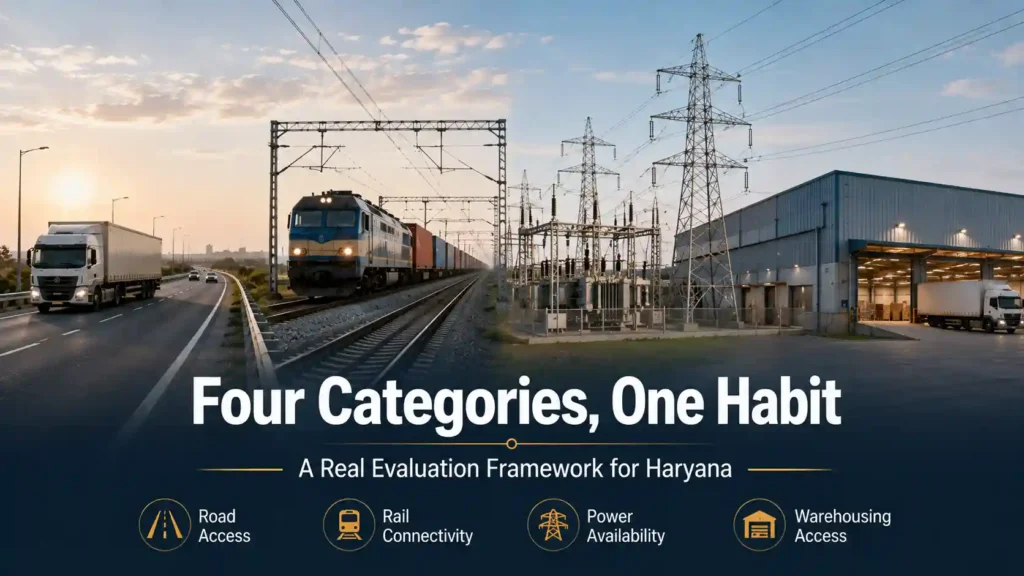
Illustrative overview of the four infrastructure categories — roads, rail, power, logistics — used to evaluate industrial locations in Haryana
Investment Guides

Industrial Infrastructure in Haryana: 2026 Evaluation Guide

Industrial Infrastructure in Haryana: Roads, Rail, Power & Logistics Connectivity Every industrial brochure claims “excellent connectivity.” Almost none of them tell you what that actually means, or how to check it yourself. Real infrastructure evaluation comes down to four things: roads, rail, power, and how well those three connect into your actual logistics chain. Each has its own specific checks, and skipping any of them is how buyers end up with a plot that looks connected on paper and isn’t in practice. This guide walks through all four, with real Haryana examples for each, so you know exactly what to verify before you commit to a location. Quick Answer: Evaluating Industrial Infrastructure in Haryana How Industrial Businesses Actually Evaluate Infrastructure Most infrastructure evaluation mistakes come from taking a brochure’s word for it. The fix is simple: verify each claim against something checkable, not a marketing adjective. “Excellent road connectivity” should become a specific road name, a toll point, and a drive time. “Reliable power” should become a discom name, a substation, and a confirmed feeder capacity. “Rail-linked” should become a specific station or freight corridor, with an actual distance. This distinction matters more in Haryana specifically, because the state’s industrial belts vary hugely in infrastructure maturity, from decades-old estates with settled utilities to newer corridors where some of this is still under construction. Roads: What to Actually Check Beyond “Near a Highway” Road evaluation starts with the connecting road, not the highway itself. A plot can sit near a major expressway and still be hard to reach if the connecting road is narrow or unpaved. In Sonipat district, for example, IMT Kharkhoda sits directly against the KMP Expressway, with the estate positioned at a specific toll point along that corridor rather than just generally “near” it. That precision matters: knowing your plot’s actual toll-point position tells you which national highways you can reach without extra local driving, something a general “near KMP” claim doesn’t. Internal road width matters just as much as the connecting highway. A road wide enough for two heavy trucks to pass without slowing is a meaningfully different asset than a road that forces single-file traffic during loading hours. Rail Access: When It Matters and How to Verify It Rail access only matters if your freight profile actually benefits from it. High-volume, bulky, or long-distance freight benefits from rail; smaller, frequent, local shipments usually don’t need it. The first check is whether “rail access” means a passenger station nearby or genuine freight-rail capacity. These are not the same thing. A location might sit a few kilometres from a passenger station while having no practical freight-rail route at all. Sonipat district shows this contrast well. Rai Industrial Area has no railway station directly inside it, with the nearest options several kilometres away. Meanwhile, the newer Kharkhoda corridor is being built with a dedicated station on the Haryana Orbital Rail Corridor, designed to connect directly into the national Dedicated Freight Corridor network. Same district, genuinely different rail-freight positions. 📖 Read This Also: Sisana Infrastructure: Roads, Rail & Power Near Kharkhoda See a full, location-specific breakdown of all three physical categories for one growing estate. Power Supply: The Infrastructure Factor Most Buyers Skip Power gets the least scrutiny of the four categories, and it’s often the one that causes real operational problems later. Haryana’s power distribution runs through two state-owned discoms: Uttar Haryana Bijli Vitran Nigam, covering northern districts including Sonipat, and Dakshin Haryana Bijli Vitran Nigam, covering southern districts including Gurugram and Faridabad. Knowing which discom serves your specific location is the first real check, since service quality and process can differ between them. The second check is capacity, not just presence. A “dedicated feeder” promise sounds reassuring, but a recent Haryana regulatory case showed a developer’s dedicated feeder ending up shared across several other projects without full disclosure, years after the original commitment. So, ask for the actual sanctioned load and substation capacity, not just confirmation that a connection exists. Not sure whether a location has reliable roads, power, and logistics infrastructure? Let our experts help you evaluate it before you invest. Logistics Connectivity: Putting Roads, Rail and Power Together Logistics connectivity isn’t a fourth, separate thing to check. It’s what happens when roads, rail, and power actually work together at one specific plot. A Worked Example: One Location’s Full Infrastructure Profile Take the Kharkhoda-Sisana corridor as a working example. Roads: direct KMP Expressway access, plus a state highway currently being widened from 66 to 200 feet. Rail: a dedicated Haryana Orbital Rail Corridor station under construction, linking to the national Dedicated Freight Corridor. Power: confirmed 24-hour supply already active on-site, under UHBVN’s jurisdiction. Put together, that’s a genuine multi-modal logistics position, not just one strong category covering for two weak ones. Red Flags That Signal Weak Infrastructure Watch for brochures that mention a highway, a station, and power without a single specific detail attached to any of them. Watch for “upcoming” infrastructure with no funding source or construction timeline named. Watch for a connecting road left undescribed entirely, since that’s usually the weakest link being quietly skipped. A Practical Infrastructure Evaluation Framework Bringing all four categories together gives you a repeatable framework, not a one-off checklist for a single plot. The Four-Category Checklist Confirm the exact connecting road class and drive time to the nearest highway or expressway toll point. Confirm whether rail access means a passenger station or genuine freight-rail capacity, and how far either actually is. Confirm the serving discom, the substation, and the sanctioned feeder capacity, not just a promise of power. Confirm that all three hold up together at the specific plot, not just somewhere within the broader estate. Where This Leaves Investors Infrastructure quality varies enormously even within one district, let alone one state, which is exactly why generic claims don’t hold up to scrutiny. The estates that verify well against all four categories tend to be the ones worth paying attention to. For the full infrastructure picture behind one specific,

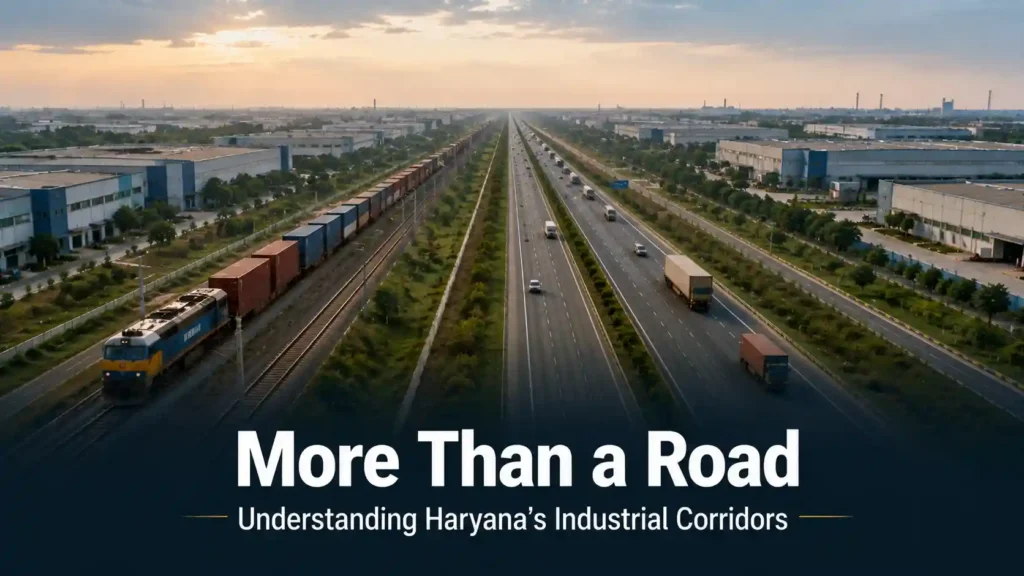
Parallel rail and expressway infrastructure representing Haryana's layered industrial corridor network
Investment Guides

Industrial Corridors in Haryana: 2026 Freight Update

Industrial Corridors in Haryana: Routes, Manufacturing Hubs & Investment Impact A corridor is not just a road. It’s a planned band of infrastructure, land, and policy designed to pull manufacturing toward it, deliberately, over decades. Haryana sits inside more of these corridors than almost any other state in India, largely because of where it sits: right next to Delhi, on the path between two of the country’s biggest ports, and along the route of both of India’s dedicated freight rail networks. This guide explains what these corridors actually are, which ones run through Haryana, and what that connectivity really means when you’re deciding where to put a factory or a warehouse. Quick Answer: Haryana’s Industrial Corridors, at a Glance What Is an Industrial Corridor, and Why Does Haryana Have So Many? An industrial corridor is a government-planned development band built around a high-capacity transport backbone, usually a dedicated freight rail line or a major expressway, designed to attract manufacturing investment along its length. India’s national programme currently recognises 11 such corridors, run through the National Industrial Corridor Development Corporation. Two of them touch Haryana directly: the Delhi-Mumbai Industrial Corridor and the Amritsar-Kolkata Industrial Corridor. Haryana’s position explains why it appears in both. The state sits directly between Delhi and the routes toward Mumbai’s and Kolkata’s ports, so both of India’s major west-facing and east-facing freight corridors pass through or near it. Corridor Backbone Approx. Length Haryana’s Role Delhi-Mumbai Industrial Corridor (DMIC) Western Dedicated Freight Corridor ~1,500 km Manesar-Bawal, Faridabad, Rewari, Palwal, and Kundli-Sonipat fall within its zone Amritsar-Kolkata Industrial Corridor (AKIC) Eastern Dedicated Freight Corridor ~1,839 km Hisar hosts Haryana’s designated Integrated Manufacturing Cluster The Delhi-Mumbai Industrial Corridor (DMIC) and Haryana’s Role In It The DMIC runs roughly 1,500 kilometres from Delhi to Mumbai’s Jawaharlal Nehru Port, built around the Western Dedicated Freight Corridor as its transport backbone. It’s a roughly $100 billion project, backed partly by Japanese government loans and investment. Haryana’s Manesar-Bawal stretch, Faridabad, Rewari, Palwal, and Kundli-Sonipat all sit inside DMIC’s planning zone, a major reason these belts have attracted sustained industrial investment for years. Sitting inside a corridor’s zone differs from sitting on its literal backbone, though. The Western DFC physically crosses the Delhi-Mumbai Expressway at two specific points inside Haryana, in Gurgaon and Palwal districts, and that literal crossing matters more for actual freight movement than the zone boundary alone. The Amritsar-Kolkata Industrial Corridor (AKIC) and Haryana’s Hisar Node The AKIC runs about 1,839 kilometres from Amritsar to Dankuni, near Kolkata, built around the Eastern Dedicated Freight Corridor. It spans seven states and 20 named cities, including Ambala in Haryana. Haryana’s actual designated development node on this corridor sits at Hisar: an Integrated Manufacturing Cluster spanning close to 3,000 acres, the largest single node anywhere on the AKIC route. That’s a meaningfully different thing from simply being a city the corridor’s planning zone happens to pass near. This distinction matters for site selection. A location inside AKIC’s broad, roughly 150-to-200-kilometre-wide influence band, such as Sonipat or Ambala, benefits from the corridor’s general economic pull. A location at Hisar itself benefits from a specific, funded, master-planned cluster built to attract anchor industries directly. How Haryana’s Expressways Function as Their Own Connectivity Corridor National freight corridors aren’t the only kind that matter here. Haryana’s own expressway network forms a second, more immediate connectivity layer. 📖 Read This Also: IMT Kharkhoda Map, Layout & Connectivity Guide See exactly where one growing estate sits relative to this expressway ring, toll point by toll point. The KMP Expressway and its eastern counterpart, the Eastern Peripheral Expressway, together form a ring around Delhi, built specifically to move heavy, inter-state traffic away from the city rather than through it. Delhi’s traffic authorities still actively enforce that diversion today, which makes this ring a genuine freight-routing asset, not just a bypass road. Rail is catching up to this road network too. The Haryana Orbital Rail Corridor, under construction between Palwal and Sonipat, is designed to connect directly into the Western Dedicated Freight Corridor at Prithala, near Palwal. Since the Western DFC’s full completion in March 2026, that connection now leads into an already-operational, JNPT-to-Dadri freight backbone, not a future promise. For the fuller road, rail, and power picture behind one specific estate on this network, see our Sisana infrastructure guide. Planning to set up a factory near a major industrial corridor? Compare locations before making your investment.  What Corridor Connectivity Actually Means for Manufacturing and Location Decisions All of this national and state-level infrastructure eventually reduces to one practical question: does it actually lower your cost or risk of doing business here? Freight Cost and Modal Choice A location with genuine rail-freight access, not just road access, gives a manufacturer options. Bulky or high-volume freight often costs less to move by rail over long distances, and having both a functioning expressway and a route into a Dedicated Freight Corridor means you aren’t locked into one mode when fuel prices or road congestion shift the calculation. Land Value and Growth Timing Corridor status tends to move land value in a predictable order: first the national corridor designation, then physical construction milestones, then completion, each step typically pushing nearby land prices up. Buying near a corridor before its key infrastructure is finished carries more risk, but also more upside, than buying after completion, once the price has usually already absorbed that certainty. How to Evaluate a Haryana Location’s Real Corridor Access Corridor names get used loosely in marketing. Separating a genuine, decision-relevant connection from a passing mention takes a specific set of questions. Questions That Separate Real Corridor Access from Marketing Claims Ask exactly which corridor a location sits in, and whether that means the designated node or just the wider influence zone. Ask how far the nearest physical junction, whether road or rail, actually is in drive time, not straight-line distance. Ask whether the specific freight infrastructure being cited is complete and operational, or still under construction. Ask whether the claimed corridor backbone

Expressway interchange with truck traffic and warehouses, representing logistics connectivity across Delhi NCR's industrial corridors
Investment Guides

Industrial Plots Near Delhi NCR: 2026 Discovery Guide

Best Industrial Plots Near Delhi NCR for Manufacturers & Investors “Industrial plots near Delhi NCR” isn’t one market. It spans several distinct corridors across Haryana, Uttar Pradesh, and Rajasthan, each with a different price point, maturity level, and ideal buyer. Picking a location before picking a use case usually leads to the wrong choice. This guide flips that order. It segments Delhi NCR’s industrial belt by who’s actually buying — manufacturers, investors, warehouse operators, and long-term industrial buyers — and shows how each should shortlist a location based on what their business actually needs. Quick Answer: Best Industrial Plots Near Delhi NCR by Buyer Type What Does “Industrial Plots Near Delhi NCR” Actually Cover? “Delhi NCR” for industrial land actually covers several distinct corridors, not one uniform belt. To the south and southwest, the NH-8 corridor runs from Gurugram through Manesar, Dharuhera, and Bawal into Neemrana in Rajasthan, forming India’s densest concentration of automotive OEMs. To the north, Sonipat district hosts the Kharkhoda-Sisana growth corridor and the older, established Rai and Kundli estates. To the west, Rohtak and Jhajjar host their own industrial base, including newer zones like Barhana along Sampla Beri Road. On the Uttar Pradesh side, Noida, Greater Noida, and Ghaziabad form a separate electronics- and manufacturing-heavy cluster. So, before comparing prices or plots, first identify which of these corridors actually matches your business, since each has a different maturity level, price point, and industry concentration. Delhi NCR Industrial Corridors Map Before choosing an industrial plot, it’s important to understand how Delhi NCR’s industrial ecosystem is geographically divided. The map below highlights the major manufacturing and industrial corridors across Haryana, Uttar Pradesh, and Rajasthan, including established hubs and emerging growth locations. Key Industrial Corridors Covered in This Guide Delhi NCR Industrial Corridors at a Glance Delhi NCR is not served by a single industrial zone. Instead, industrial development is spread across multiple corridors, each shaped by different infrastructure, industries, and investment cycles. The NH-44 corridor focuses on manufacturing and auto suppliers, the NH-48 corridor has evolved into India’s most established automobile belt, the Rohtak–Jhajjar region is emerging as a flexible manufacturing destination, while Noida and Greater Noida continue to dominate electronics and export-oriented industries. Understanding these corridor-level differences helps businesses shortlist locations based on operational needs rather than simply comparing land prices. Which Delhi NCR Location Fits Manufacturers Best? Manufacturers, especially auto-component and ancillary suppliers, generally fit best in either the Kharkhoda-Sisana belt or the established Manesar-Bhiwadi-Neemrana corridor, depending on budget and risk appetite. Each offers genuine OEM proximity, but at very different maturity stages. The Kharkhoda-Sisana belt centres on Maruti Suzuki’s Kharkhoda plant, now producing 5 lakh vehicles a year and scaling toward 10 lakh, with confirmed suppliers like UNO Minda and Jay Bharat Maruti already operating nearby. IMT Kharkhoda’s industrial plots in Sisana offer entry from around ₹14,000 per square yard, well below the Manesar-Bhiwadi-Neemrana corridor’s mature pricing. For manufacturers wanting flexibility across industry, warehousing, or service use without extensive zoning approvals, Barhana, near Rohtak and Jhajjar, operates as an NOC zone, allowing faster setup once infrastructure is in place. Rohtak and Jhajjar together already host close to 2,700 running industrial units, giving this corridor its own established skilled-labour base. Corridor Major Locations Primary Industries Best For NH-44 Corridor Kundli, Rai, IMT Kharkhoda, Sisana Auto, Warehousing, Manufacturing Manufacturers & Investors NH-48 Corridor Gurugram, Manesar, Bawal, Neemrana Automobile & Auto Components OEM Suppliers Rohtak–Jhajjar Corridor Barhana, Sampla Manufacturing, Warehousing Flexible Industrial Use Noida Corridor Noida, Greater Noida Electronics, Manufacturing Export-Oriented Industries Which Locations Fit Warehouse and Logistics Operators Best? Warehouse and logistics operators should prioritise expressway and highway access above almost every other factor, since connectivity drives daily operating cost more directly than land price alone. The table below compares access across the main corridors. Corridor Key Connectivity Best Suited For Kharkhoda-Sisana (Sonipat) KMP Expressway, NH-44, Delhi-Amritsar-Katra Expressway Manufacturers and logistics tied to the Maruti Suzuki ecosystem Rohtak-Jhajjar / Barhana NH 334B, NH 352, NH 9, Sampla Beri Road Flexible-use manufacturing, warehousing, service businesses Manesar-Bhiwadi-Neemrana NH-8/NH-48, close to multiple ICDs Large-scale, established logistics and OEM-linked warehousing Rai / Kundli (Sonipat) NH-44 (GT Road), near Sonipat’s inland container depot Businesses wanting an immediately operational base with container access Because KMP Expressway nodes serve both the Kharkhoda-Sisana belt and the Rai-Kundli estates, a logistics operator prioritising Sonipat district specifically can compare those two directly on price and maturity, since connectivity is broadly similar across both. Which Locations Fit Investors Looking for Appreciation? Investors chasing capital appreciation generally do better in still-developing zones than in already-mature markets, since most of a mature location’s price growth has already happened. Sisana and Barhana both fit this profile within RS Group Realty’s own coverage area. Sisana’s entry pricing around ₹14,000 per square yard sits well below established hubs like IMT Manesar, which command ₹60,000 to ₹80,000 per square yard, precisely because Sisana’s growth story, anchored by the Maruti Suzuki plant, is still unfolding. Barhana offers a different appreciation thesis, positioned as a flexible, NOC-zone opportunity in a broader Rohtak-Jhajjar corridor that’s also gaining density. 📖 Read This Also: Why Invest in IMT Kharkhoda Industrial Plots? ROI Guide For a deeper look at the Kharkhoda-Sisana growth thesis specifically, this guide breaks down the ROI logic behind that corridor in detail. Looking for an industrial location that matches your investment budget and long-term goals? Get personalized recommendations from our team. Which Locations Fit Long-Term Industrial Buyers Setting Up Operations? Long-term industrial buyers face a genuine trade-off between an established ecosystem and a growth corridor with more room to run. Rai Industrial Area, for instance, offers close to 800 already-operating firms and fully built infrastructure, but mostly through resale rather than fresh allotment. By contrast, the Kharkhoda-Sisana belt offers a still-forming ecosystem with a much lower entry cost and a clearer long-run growth trajectory, tied directly to the Maruti Suzuki plant’s continued expansion. Neither choice is wrong: it depends on whether a buyer values proven stability or long-term upside more. How Should You Shortlist a

Illustrative overview of Haryana's multiple distinct industrial belts and identities
Investment Guides

Top 10 Industrial Areas in Haryana (2026 Investor Guide)

Top Industrial Areas in Haryana for Manufacturing & Investment in 2026 Haryana isn’t one industrial story. It’s several, running side by side across the state, each with its own history, its own anchor industries, and its own reasons to invest there. Gurugram-Manesar builds cars and components. Faridabad runs on decades of light engineering. Panipat weaves textiles for the world. Sonipat’s belt, including newer names like IMT Kharkhoda, is where most of the fresh growth is happening right now. This guide maps the major belts by geography, industry ecosystem, and who actually fits best in each one, so you can find your match instead of guessing from a generic list. Quick Answer: Haryana’s Major Industrial Belts How Haryana’s Industrial Map Is Actually Organized Nearly every formal industrial estate in Haryana traces back to one body: HSIIDC, the Haryana State Industrial and Infrastructure Development Corporation, formed in 1967. It develops Industrial Model Townships, Industrial Estates, and smaller theme parks across the state, each governed by its own allotment and management rules. Several of these belts also sit inside the Delhi-Mumbai Industrial Corridor’s zone of influence, including Faridabad, Palwal, Rewari, and the Manesar-Bawal stretch, which brings national infrastructure priority alongside state-level development. What Grade A Industrial Parks Offer in Haryana Grade A industrial parks in Haryana are pre-plotted, infrastructure-ready zones with built-in utilities, road networks, and often single-window clearance. Unlike raw industrial land, these parks come with completed internal roads, power substations, water supply, and drainage – so a manufacturer can start construction immediately instead of waiting for basic infrastructure. HSIIDC operates several of these across the state, while private developers like Reliance Industrial Investments, Adani Logistics, and Embassy Group have also launched Grade A parks in the Delhi-Mumbai Industrial Corridor zone. The key difference from standard industrial estates: Grade A parks typically enforce stricter zoning, maintain common facilities like testing labs and warehousing, and offer leasehold or freehold titles with clearer documentation. For investors comparing options, Grade A parks near IMT Kharkhoda sit inside Haryana’s fastest-growing corridor, while established Grade A zones in Faridabad and Gurugram offer proximity to existing supplier networks. The trade-off is straightforward: newer parks offer lower entry pricing and growth upside, while established ones offer proven infrastructure and immediate operational readiness. Haryana Industrial Cluster Map (Official MSME Cluster Overview) This map shows the official industrial and MSME cluster distribution across Haryana. It provides a geographical overview of manufacturing belts, engineering clusters, textile hubs, food-processing zones, and industrial corridors before exploring each region in detail. The map is based on the Haryana MSME Directorate’s cluster information. Key Highlights from the Official Cluster Map: Source: Cluster | directorate of MSME, Haryana | India Here’s how the major belts compare at a glance: Belt Primary Industry Identity Best Fit For Gurugram-Manesar Automobiles, auto components Large-scale auto and component manufacturers Faridabad Light engineering, tractors, textiles Diversified manufacturers wanting a mature ecosystem Rewari-Bawal-Dharuhera Two-wheelers, auto ancillaries, brass Two-wheeler and component suppliers Panipat-Karnal Textiles, carpets, agro-processing Textile, food, and agro-based businesses Sonipat Belt Mixed: established estates plus new growth Buyers wanting either an established base or early-stage growth Looking specifically at IMT Kharkhoda, Sisana, or Barhana? We’re on the ground in this exact corridor every day. How Haryana Became One of India’s Largest Manufacturing States Top Manufacturing Industries Driving Haryana’s Economy Haryana’s manufacturing sector spans automotive, textiles, food processing, engineering, and IT hardware – with each industry concentrated in specific geographic clusters. The state contributed over Rs 9.5 lakh crore to India’s GDP in 2025-26, making it one of the top five manufacturing states by industrial output. Here are the leading sectors and their geographic homes: Manufacturing Sector Key Districts Major Companies Est. Share of Output Automobiles & Auto Components Gurugram, Manesar, Faridabad Maruti Suzuki, Honda, Denso, JCB ~30% Textiles & Handloom Panipat, Ambala, Karnal Vardhman, Lumax, local exporters ~18% Food & Agro-Processing Rai, Karnal, Kaithal Veetee, PepsiCo, Dabur ~12% Light Engineering & Fasteners Faridabad, Rohtak, Ambala Escorts, Lakshmi Machine Works ~15% IT & Electronics Gurugram, Faridabad Samsung, Vivo, Oppo ~10% Two-Wheelers & Ancillaries Rewari, Bawal, Dharuhera Hero MotoCorp, Harley-Davidson ~8% For a manufacturer evaluating where to set up, the practical question isn’t just “which industry is biggest” but “which cluster already has my specific supply chain.” An auto-component supplier will find faster buyer access in Gurugram-Manesar’s established ecosystem than in a newer corridor, while a food processor benefits more from Rai’s Mega Food Park infrastructure. Gurugram-Manesar: Haryana’s Largest Auto and Component Hub Gurugram-Manesar is Haryana’s biggest, most globally recognized industrial belt, built almost entirely around the automobile industry. IMT Manesar alone spans several thousand acres across multiple development phases. Maruti Suzuki’s original large-scale plant sits here, alongside Honda Motorcycles and Scooters, Denso, Johnson Matthey, Mitsubishi, and dozens of other component makers supplying automakers across India. This depth of supplier ecosystem is Manesar’s real advantage: a new auto-ancillary unit here plugs into decades of existing buyer relationships immediately. The trade-off is scarcity and cost. Manesar’s older phases are largely built out, and some expansion land remains tied up in legal or planning delays, so fresh plots are rare and resale prices reflect that maturity. Faridabad: Haryana’s Oldest and Most Diversified Industrial Base Faridabad’s industrial identity goes back to the late 1940s, when the New Industrial Township was built partly to resettle and employ Partition-era migrants. It has grown into one of North India’s largest, most diversified industrial clusters since. Tractors, auto components, textiles, footwear, and light engineering all have a genuine home here, alongside major names like Escorts and JCB. Faridabad and neighbouring Gurugram together generate roughly half of Haryana’s income tax collection, a rough proxy for just how much economic weight this corridor carries. For a manufacturer that doesn’t fit neatly into one narrow sector, Faridabad’s diversified base is often the safer bet, precisely because it was never built around a single industry. Rewari-Bawal-Dharuhera: The Two-Wheeler and Ancillary Corridor Rewari’s industrial story predates modern Haryana by centuries: the district has produced brass wares since 1535. Its modern identity is different, but the

Scroll to Top